

Building A1 DDP - Dubai Silicon Oasis
Industrial Area - 342001 -
Dubai - United Arab Emirates
+971 50 756 2346
SERVICES
COMPANY LINKS
SIGN-UP
For Newsletter


You’ve got a product idea. Maybe it’s a SaaS tool, a marketplace, or something powered by AI.
But questions are piling up fast:
If that sounds familiar, you’re not alone. Most product teams hit this roadblock early great ideas without a clear design process to shape them into solutions that meet user needs.
That’s where product design comes in.
In this guide, we’ll break down what product design is, how it helps you align with business goals, and why user-centric design is the difference between a flop and a product that delights customers.
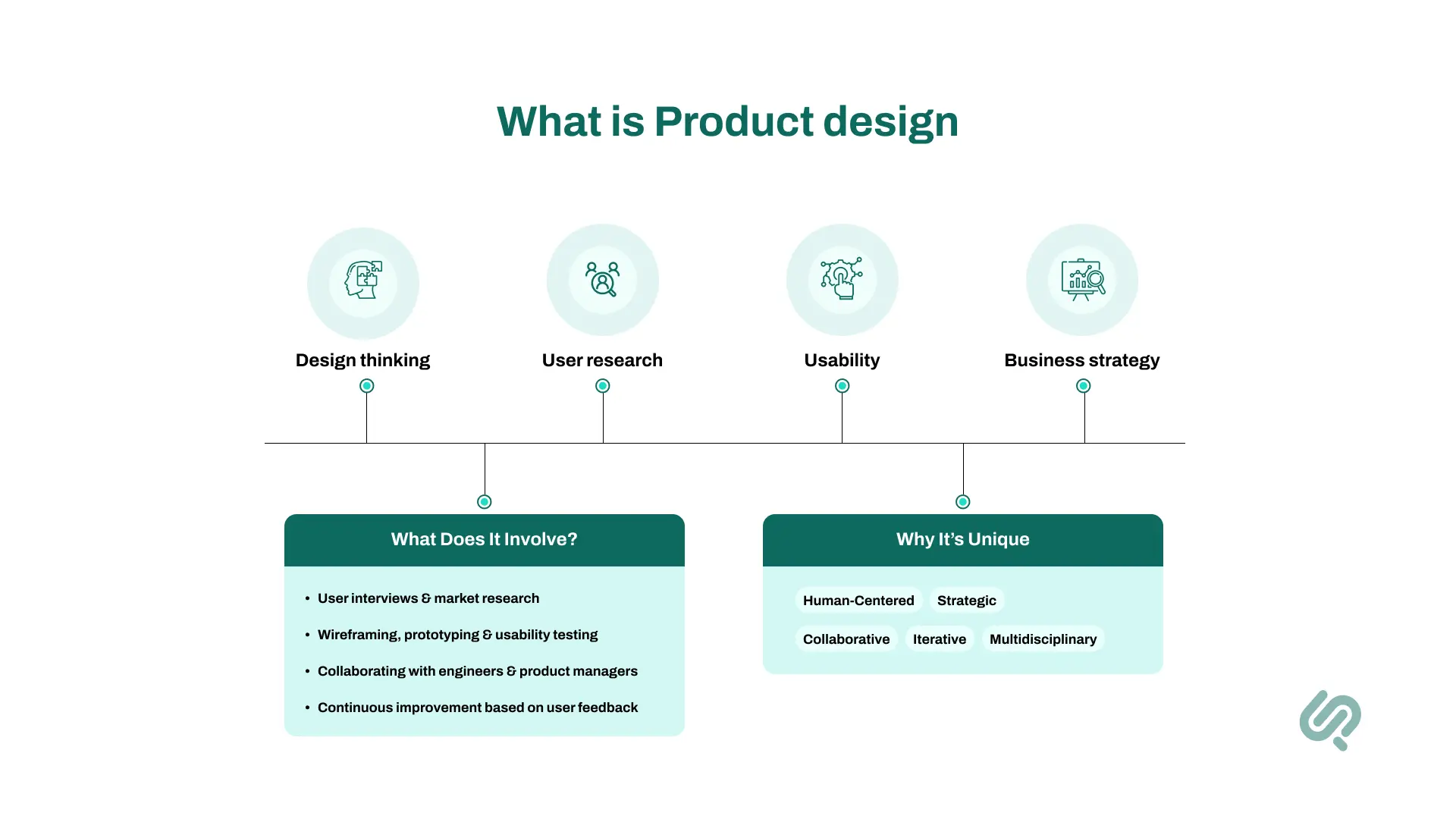
Product design is the full process of imagining, building, testing, and refining a solution that solves real user problems and supports your company’s business goals.
It blends design thinking, user research, business strategy, and usability into a cross-functional workflow that spans the entire product lifecycle.
It’s the space where user needs, technical feasibility, and business viability all intersect.
And the outcome? A product that people actually want to use, and one your team can confidently build and scale.
So, what does product design actually include?
It covers everything from user interviews and market research, to prototyping, usability testing, and collaborating with engineers and product managers to bring the product to life.
It doesn’t stop at the first version either. It involves gathering user feedback, analyzing behavior, and continuously improving the product over time.
This can apply to digital products like apps and SaaS tools, or physical products like consumer gadgets or wearables.
In fact, many modern products are a hybrid of both, and product designers often work across disciplines, collaborating with software engineers, industrial designers, and marketers to ensure a seamless experience across all touchpoints.
Here’s what makes product design unique:
Think of it like planning a wedding. 🎉
You're not just picking the cake. You're designing the whole experience, from what guests see and feel, to how they arrive and leave, to whether they’ll remember it fondly.
In simple terms, product design means solving the right problem in the right way.
Great ideas don’t guarantee great products. Without smart design, even the best concept can fail to connect with users, or the market.
That’s the importance of product design, it bridges vision and user reality.
Here’s why investing in product design isn't optional anymore:
Design isn't just about aesthetics. It’s a revenue driver.
According to McKinsey, companies in the top quartile of design maturity saw 32% higher revenue growth and 56% more shareholder returns compared to competitors. (1)
That’s not by accident it’s by design.
A product designer brings strategic thinking into the design process, aligning user needs with business strategy.
The result? Smarter decisions, more usable products, and better outcomes across the board.
Your product’s design is often its first impression and sometimes the only one that’s going to last.
Design-led companies outperformed the S&P 500 by more than 200% over 10 years (2). That kind of edge doesn’t come from guesswork.
By understanding how users interact with your product and solving real pain points, product designers help you build something your competitors can’t easily replicate.
That’s how you build loyalty (and market share).
Bad design drives users away fast.
Studies show that 88% of users won’t return after a poor experience (3). But when a product is intuitive, smooth, and delightful? Users stick around.
That’s where UX design, user research, and usability testing come in. Product designers dig into user behavior, run tests, and iterate fast using tools like high-fidelity prototypes.
The goal is simple: meet user expectations or exceed them.
Here’s a scary stat: 95% of new products fail (4). Mostly because they didn’t meet actual user needs (MIT).
Skipping the design process or rushing to build without proper user research is a recipe for wasted time, effort, and money. Product designers help you avoid this by conducting user interviews, testing ideas early, and making data-driven design decisions.
You get to uncover issues early before they become expensive mistakes.
Design isn’t just about what the product looks like. It’s about whether it works for your business.
A strong product designer keeps your business objectives in view while designing for users.
That means your product not only solves real problems, but also fits your business model, supports your product roadmap, and drives outcomes like retention or conversion.
In other words, product design bridges the gap between business context and user experience.
From physical gadgets to mobile apps to complex service flows, product design takes different forms depending on what you're building and who you’re building it for.
Understanding the different types of product design helps you apply the right tools, skills, and approach for your target solution.
Before diving into each type, here’s a quick side-by-side comparison:
This is where design meets engineering.
Physical product design focuses on the shape, feel, and usability of tangible items (headphones, kitchen appliances, wearables, etc.). It requires a deep understanding of materials, manufacturing, and ergonomics.
Industrial design plays a key role here. These designers think through the form and function of the product, ensuring it's not only appealing but also comfortable and safe for the end user.
Key aspects include:
This type of design often utilizes technical skills in computer-aided design (CAD) and 3D prototyping to develop innovative products that meet real-world needs.
This is where screens, clicks, and flows live.
Digital product design involves crafting experiences for software, websites, and mobile apps. Anything users interact with through a screen.
UX and UI designers focus on:
It requires a balance of creativity, logic, and research tools.
Designers often conduct user research, analyze behavior, and use prototyping tools like Figma or Sketch to test their ideas before handing them off to development.
Whether it's designing a dashboard for project management or a slick onboarding flow for a new fintech app, the goal is always to simplify interaction and create a frictionless experience for the target audience.
This goes beyond a single product. It’s about designing the entire experience.
Service design focuses on how users move through multi-step journeys that span various platforms, tools, or even real-world interactions.
Think: hailing a ride, ordering takeout, or scheduling a medical appointment.
Here, the designer isn’t just thinking about the app. They’re looking at the entire design process, including:
This type of design often overlaps with digital product design, but zooms out to map complex workflows that impact many user groups.
It requires collaboration with stakeholders across tech, support, and project management teams, and a holistic mindset that treats every touchpoint as part of the product.
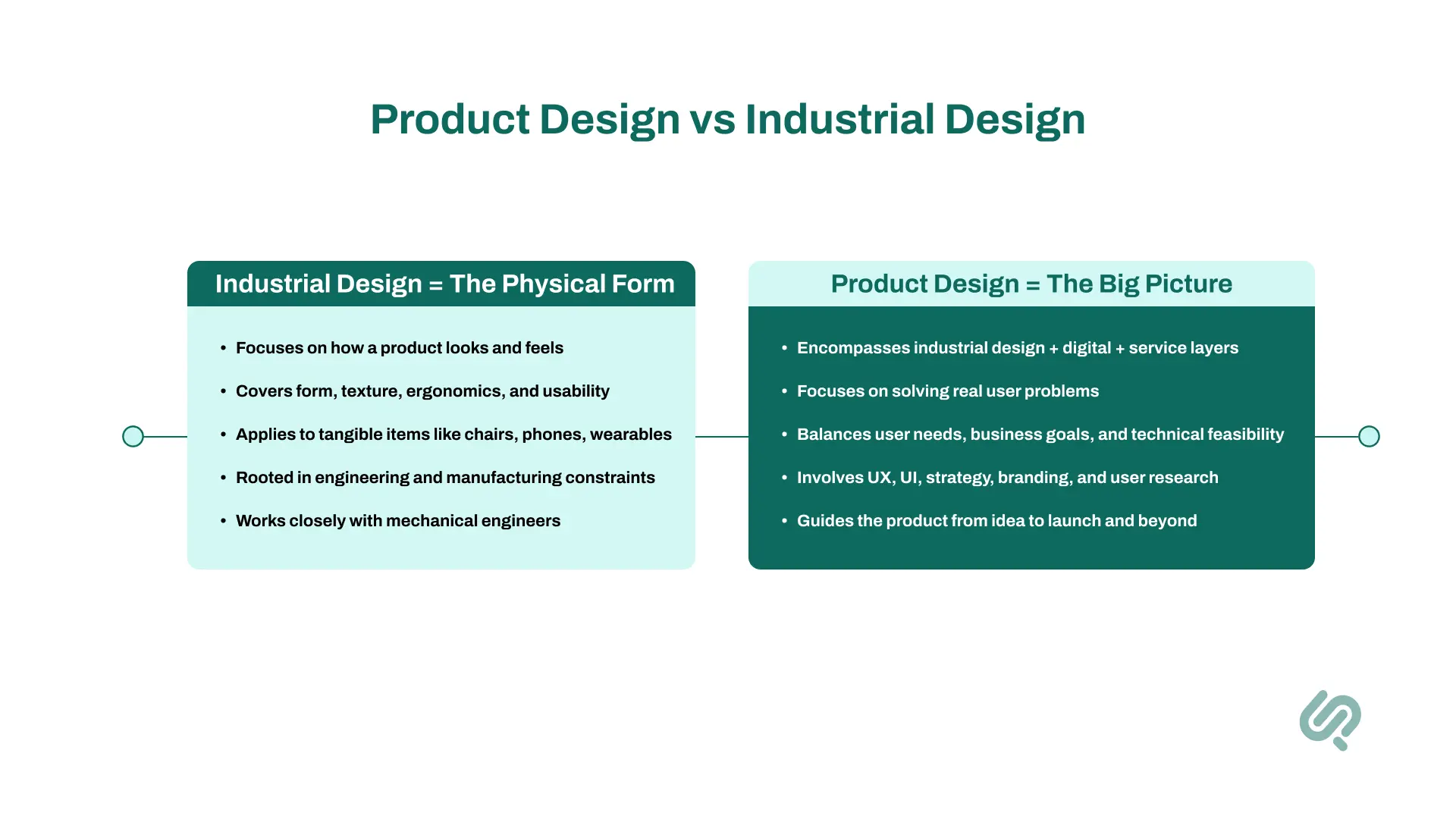
These two terms are often confused, and for good reason. They’re closely related. But they focus on very different aspects of the product journey.
Industrial design deals with the physical product.
It’s about form, aesthetics, texture, and how something feels in your hand. Think of it as designing the object itself, from the curve of a chair to the weight of a smartphone.
It’s rooted in engineering and ergonomics. Industrial designers focus on usability in the real world. They care about safety, comfort, and durability. They often collaborate closely with mechanical engineers to ensure manufacturability.
Product design, on the other hand, is broader.
It includes industrial design, but it also covers digital products, services, and business strategy. A product designer looks at the big picture.
They ask:
While industrial designers perfect the physical shape, product designers think beyond the object. They consider digital flows, onboarding, branding, distribution, and adoption—often leveraging distribution management software to streamline logistics and reach.
The product designer’s role often involves balancing multiple disciplines, UX, UI, research, and strategy. Their work touches both user needs and business impact.
That’s why a product designer’s work typically spans a broad range of deliverables. From user personas and wireframes to design specs and feature prioritization.
To simplify it:
One focuses on execution. The other guides the entire product design process from idea to launch — and beyond.
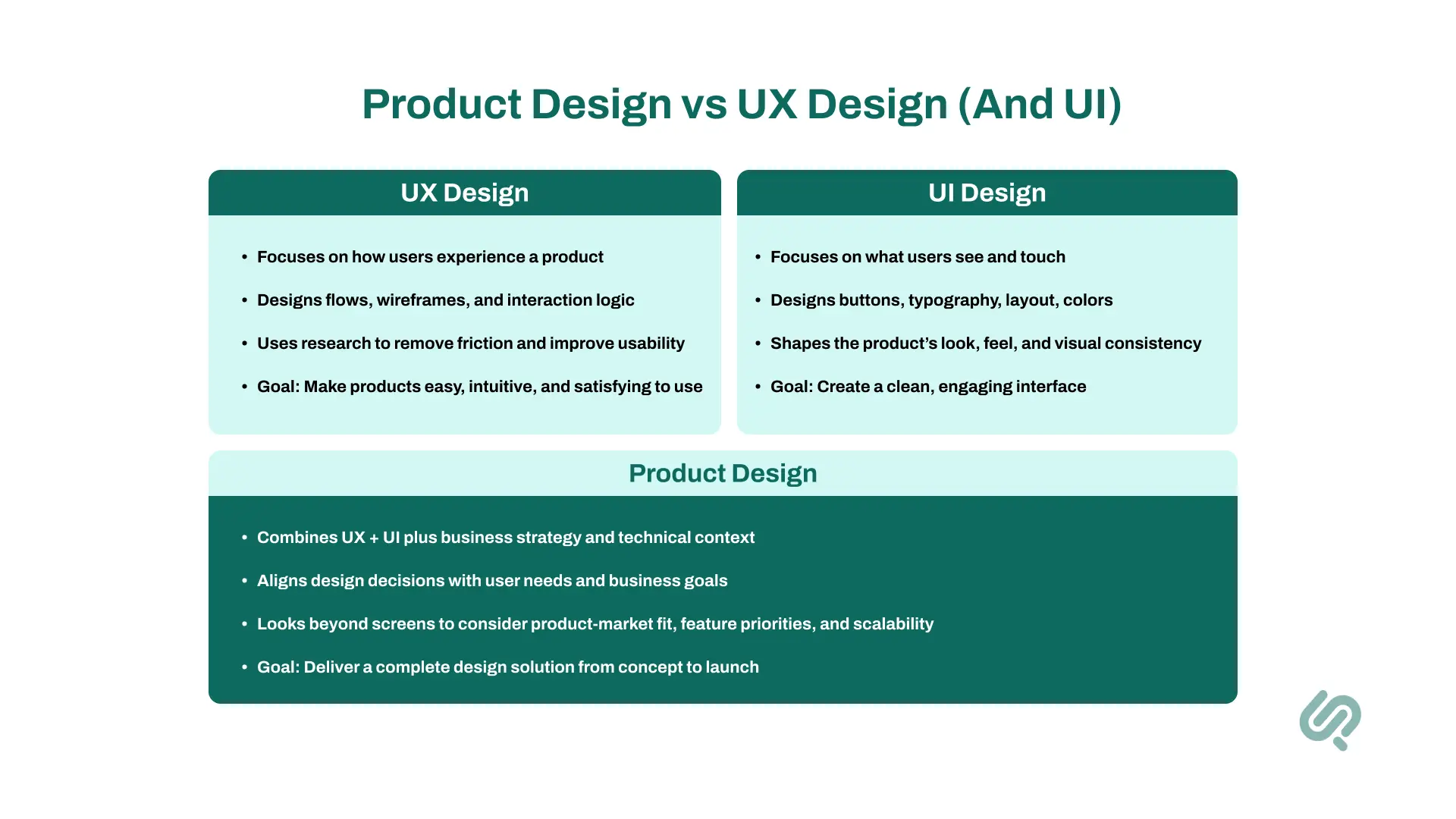
Product design and UX design often work hand-in-hand. But they’re not the same role.
UX design focuses on the experience.
It’s about making products easy, intuitive, and satisfying to use. UX designers study how users behave and what gets in their way.
They create flows and wireframes, navigation paths, and interaction logic.
They also test and improve those flows through usability research. Their mission? Make sure the product feels right when people use it.
UI design goes one level deeper.
It’s the visual layer: colors, typography, buttons, spacing. It’s all about how the product looks and responds.
In short:
Product designers take a wider view. They care about the interface but also the strategy behind it.
They ask tough questions like “Does this feature support our business goals?” or “Are we solving the right problem in the first place?”.
That’s why the product designer’s role often includes aligning UX work with the bigger picture from pricing and positioning to technical feasibility.
While UX and UI focuses on flows and feedback, product designers add a business perspective.
The best product designers also care about brand consistency. They make sure the product not only works well but looks and feels like one cohesive system.
So here’s the simplest way to remember it:
For further insights, check out this article on Generative AI for software development to see how generative AI is reshaping the product design process.
Let’s walk through the core principles that make product design truly effective. This article on web design vs web development may also shed some light on the matter.
At its heart, product design means understanding and serving the user.
That starts with empathy. Using user interviews, behavioral data, and research tools to pinpoint real pain points.
This principle, often called human-centered design, ensures the product is built for the person who’ll use it not for internal assumptions.
If the product doesn’t meet real user needs, nothing else matters.
Great design lives at the intersection of these three forces:
A smart product designer balances all three. They evaluate each idea as a potential solution not just for users, but for the business too.
This is where cross-functional collaboration is key. Design, engineering, and product all weigh in.
Every product should do its job clearly and intuitively.
This means designing workflows that make sense, user interfaces that are easy to navigate, and avoiding unnecessary friction.
Through usability testing and prototyping, teams refine interactions until they just feel right.
Whether you’re designing digital products or physical products, simplicity and clarity are non-negotiable.
People judge by looks, and feel by emotion.
Yes, function comes first. But visual design still matters. A lot.
Typography, color, spacing, these elements shape first impressions. A polished UI builds trust and credibility.
Emotional design takes it further, aiming to delight customers through small moments, like a playful animation or satisfying micro-interaction.
Plus, strong brand consistency across products reinforces identity and familiarity.
A beautiful product that breaks? Still a bad product.
Product design in engineering means thinking beyond the mockup, into how the thing is actually built.
That includes technical skills, code stability, material durability, and performance under real-world conditions.
Reliability = trust.
That’s why high standards and thorough QA are baked into the product design and development process.
Inclusive design helps everyone.
Not just people with disabilities, but also users in different environments or with varied preferences.
This means designing with:
Inclusive design = ethical design. And it often leads to a better user experience for all.
No product is perfect at launch. In fact, that’s just the beginning.
The best product design process includes cycles of:
This mindset of continuous learning drives real innovation. Your team evolves the product based on real use, not guesses.
That’s what separates good products from great, innovative products.
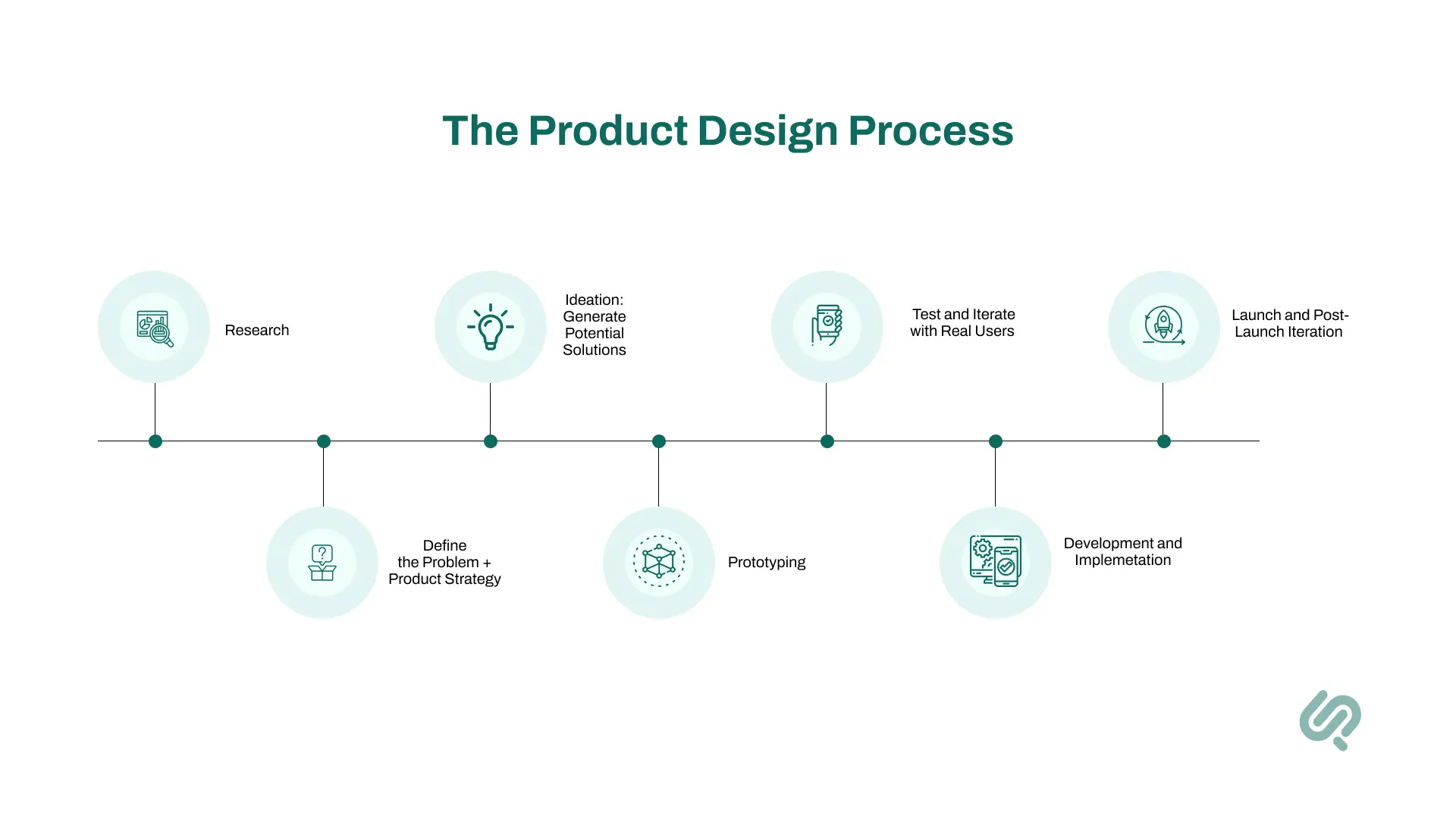
The product design process transforms a rough idea into a market-ready solution.
Each stage requires cross-functional collaboration, strategic thinking, and a comprehensive understanding of both the user and the business.
Let’s walk through the key stages of this journey.
Great design starts with listening not guessing.
This phase is all about conducting user research and analyzing the market. The goal is to understand who your users are, what they need, and what’s already out there. Key tasks include:
This foundation helps teams align on real problems, avoiding the trap of building something no one wants a mistake behind 95% of product failures. (5)
Once research is done, the team distills insights into a clear direction.
This step shapes the project’s intent and outlines the product designer’s role moving forward. What it includes:
This becomes the product brief, a shared source of truth for the product team and stakeholders to stay aligned throughout the entire design process.
With the problem defined, it’s time to get creative.
This is where the team explores a broad range of possibilities. No idea is off-limits especially early on. Some common techniques:
The goal is to explore different aspects of the problem and uncover the most promising design solutions.
Here, ideas take shape.
Prototyping tools like Figma, InVision, or CAD software are used to create early versions of the product either digital or physical.
This phase helps surface usability issues before expensive development starts a key principle in product design and development.
Want further insights on prototyping? Check out this blog on how to develop an AI MVP.
Now it’s time to validate the design.
Through usability testing, teams observe how users interact with the prototype and gather actionable user feedback. This stage may include:
Findings fuel the next iteration refining layouts, flows, or even core features. It’s the purest application of design principles in action: build, test, learn, repeat.
Once the design is validated, it’s time to build.
The product designer partners with engineers to bring the design to life bridging design and development through cross-functional partners.This includes:
This is where strong project management and agile workflows come into play, especially in software development projects.
Launch is a milestone not the finish line.
After release, designers monitor performance, gather real-world insights, and plan the product roadmap ahead. This includes:
This ongoing process is a core part of what product design means today. Not just creating something new, but ensuring it continues to evolve, improve, and achieve business goals.
Ready to Design Smarter, Faster, and More User-Focused? Explore Our Product Design Services.
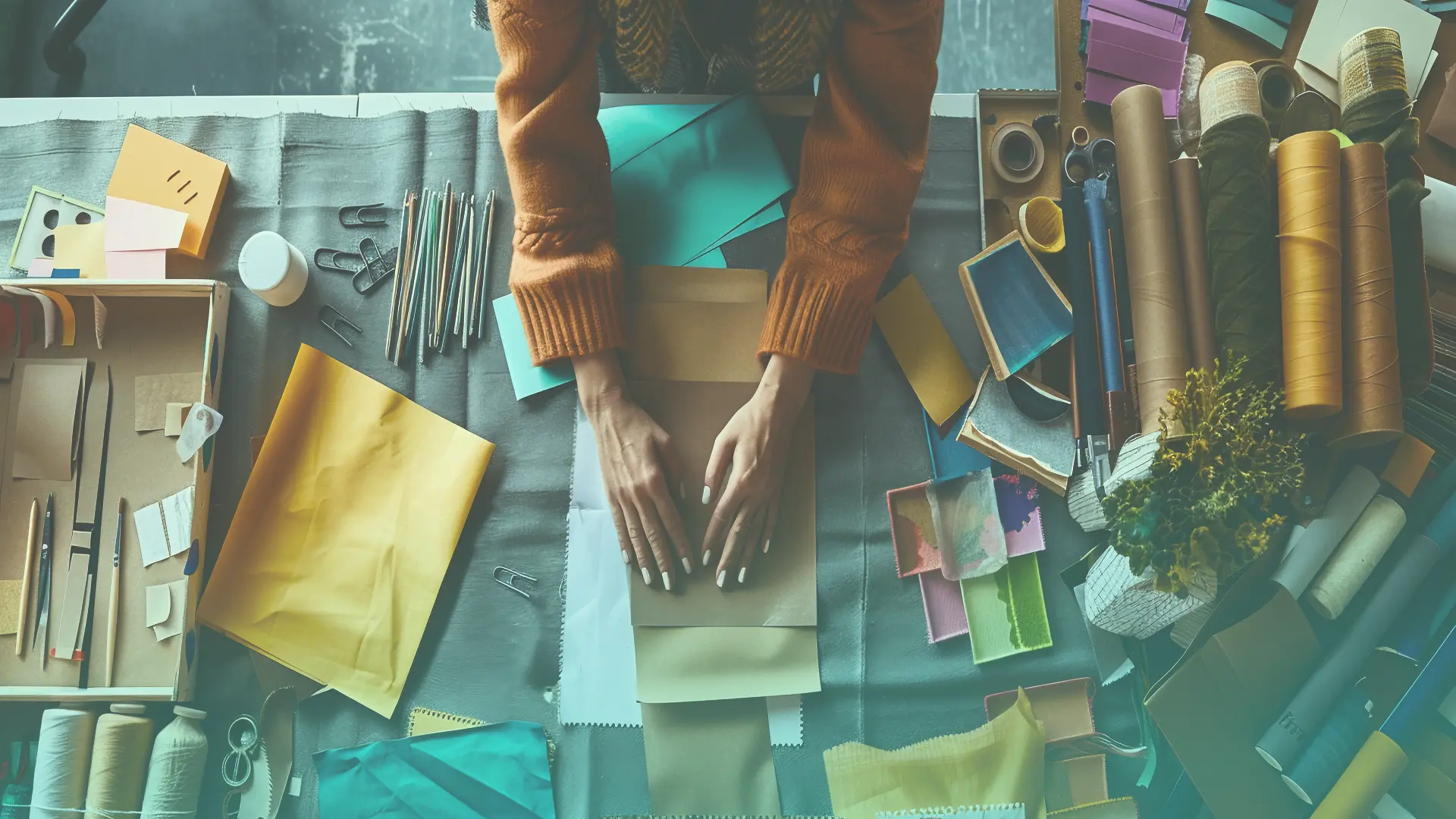
The product designer’s role spans the entire design process. From user research and early concepts to prototyping, usability testing, and post-launch refinement.
One day, they might be conducting user interviews to uncover pain points.
The next, they’re sketching out flows, testing a clickable prototype, or syncing with engineers to ensure designs are implemented correctly.
They often collaborate closely with cross-functional partners like developers, product managers, marketers, and researchers.
Their job is to ensure every decision visual or strategic supports user needs and business outcomes.
It’s a role that blends creativity, strategy, systems thinking, and communication.
The best designers don’t just create screens. They drive outcomes. They think beyond the UI, aligning every decision with business strategy and the needs of the end user.
In short, a product designer is equal parts creator, problem solver, and strategic partner.
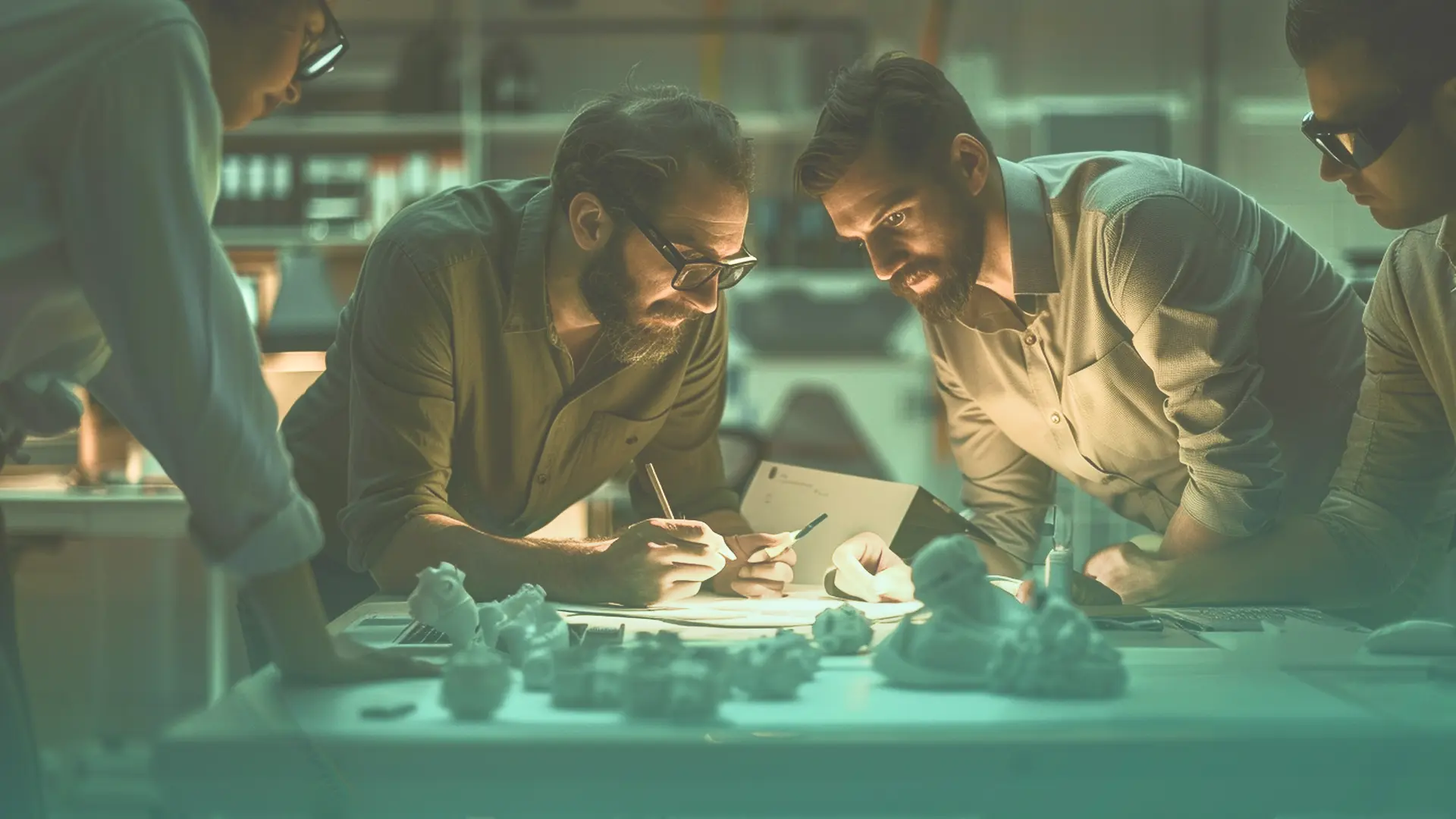
In theory, product design and development are distinct.
Design defines what a product should do and how users interact with it, while development brings that vision to life through code, systems, and structure.
But in reality, they’re inseparable.
Modern product teams treat design and development as a continuous collaboration.
A product designer needs to understand technical limitations; a developer needs to understand user experience goals. Both must contribute across the entire product design process, from ideation to launch and beyond.
Think of it like this:
To avoid both, design and development teams must stay in sync sharing context, giving feedback, and solving problems together.
In successful teams, cross-functional collaboration is embedded into daily routines. Designers attend sprint planning. Developers review early wireframes. User feedback is discussed openly by all roles.
When a feature gets stuck, both sides explore trade-offs not just in code or layout, but in how it impacts users.
This integration is key not just during build, but across the entire lifecycle:
Ultimately, the shared goal is to create a product that works and feels great to use. That’s what product design is all about not just making things pretty, but delivering value.
Below are two real world case studies of our product design skills in action:
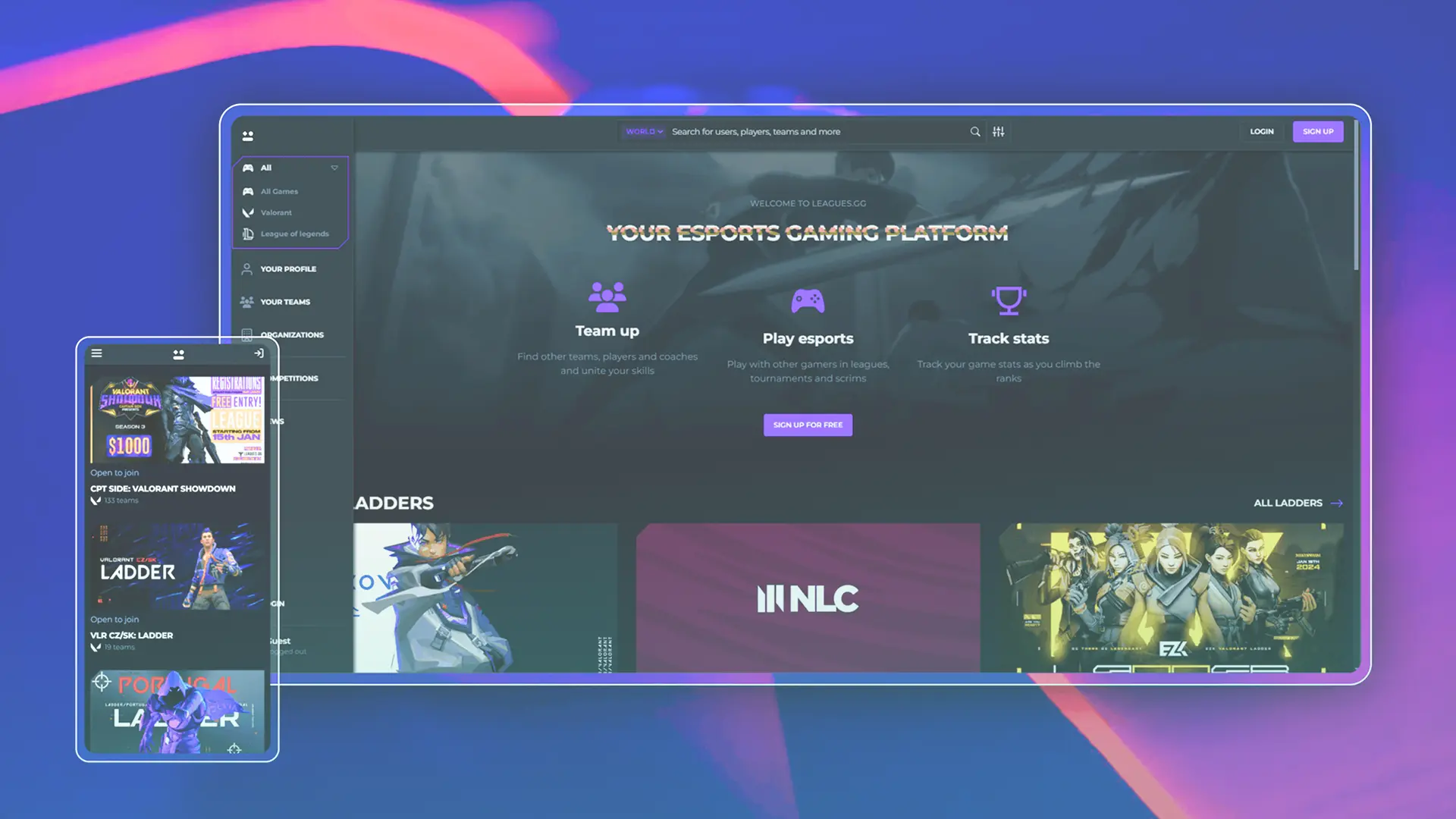
Our client, an aspiring esports tournament platform, faced challenges in providing casual gamers with access to organized competitions and visibility into their skill progression. PhaedraSolutions collaborated with them to develop a user-friendly platform that addressed these issues.
Key Design Solutions:
This collaboration resulted in a platform that not only met the needs of casual gamers but also positioned our client as a market leader in esports gaming tournaments.
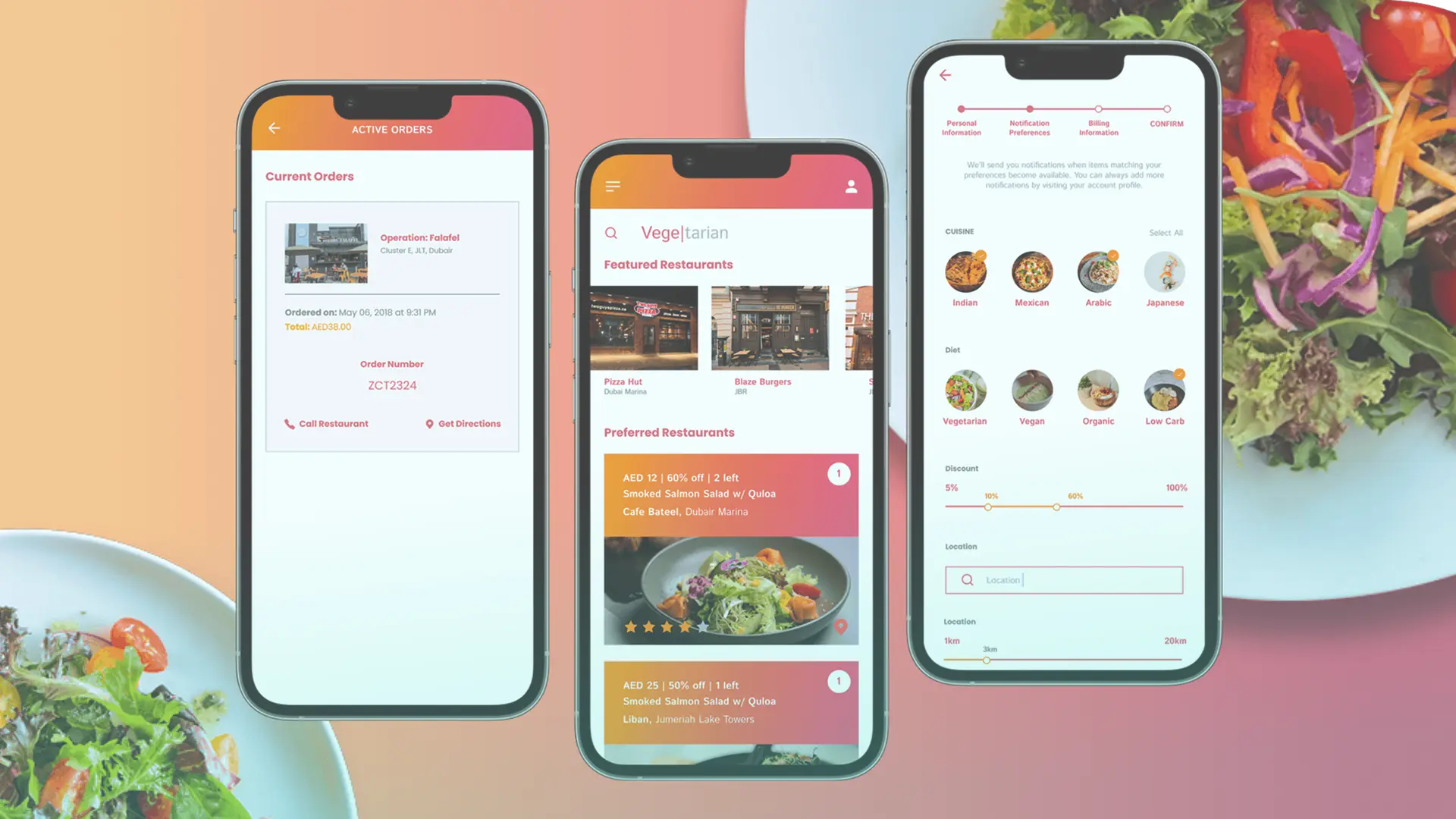
Our client aimed to tackle the global issue of food waste by connecting restaurants with value-conscious customers. PhaedraSolutions developed a mobile app that facilitated this connection, allowing restaurants to sell surplus meals at a discount.
Key Design Solutions:
The app's impact was significant: it rescued 1,200 tons of food, saved 3 million meals, and reduced CO2 emissions by 1,800 tons.
Product design is about solving real problems with solutions that users love and businesses value.
Whether you're a founder planning your next product, a product manager shaping a roadmap, or a designer refining your process the goal is the same: create experiences that meet user needs and support business goals.
Here’s what’s next in your product design journey at a glance:
If you're ready to move from idea to impact, we can help.


Why 95% of New Products Miss the Mark—Extended with Anchor. (2022, August 3). MIT xPRO.

Musa is a senior technical content writer with 7+ years of experience turning technical topics into clear, high-performing content.
His articles have helped companies boost website traffic by 3x and increase conversion rates through well-structured, SEO-friendly guides. He specializes in making complex ideas easy to understand and act on.