






Building A1 DDP - Dubai Silicon Oasis
Industrial Area - 342001 -
Dubai - United Arab Emirates
+971 50 756 2346


SERVICES

COMPANY LINKS
SIGN-UP
For Newsletter



If you’re here, you’re probably trying to understand the real difference between generative AI vs agentic AI, and which one actually matters for your business or use case.
You’ve seen both terms everywhere, and they often get used interchangeably, even though they solve very different problems.
This article clarifies the agentic vs generative AI meaning so you can understand what each one actually does.
This guide on Agentic AI vs Generative AI: Exploring the Differences. We’ll explain what each one is, how they work, where they’re used, and what they’re not good at.
You’ll see simple examples, real use cases, and practical comparisons that help you decide which approach fits your needs.
Whether you’re building software, automating workflows, improving customer experience, or just trying to keep up with AI trends, this article will give you clarity fast.
Before diving deeper, let’s address the main question: What is agentic AI vs generative AI?
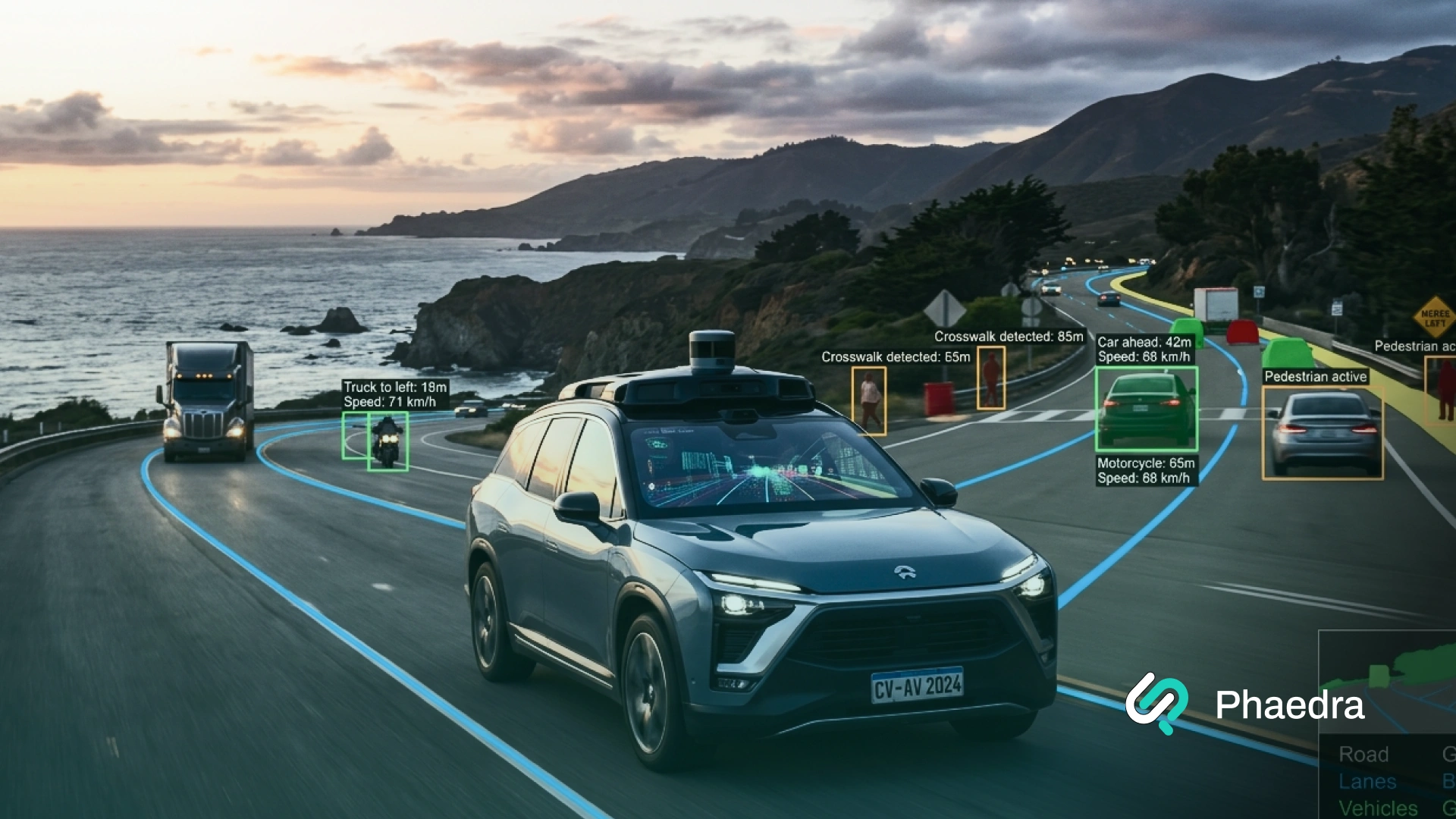
Agentic AI refers to intelligent agent systems that can act autonomously to achieve goals. Instead of only analyzing data or generating content, agentic AI systems can make decisions, take actions, and manage multi-step tasks with minimal human intervention.
In simple terms, generative AI creates outputs when you ask it to, but agentic AI works on your behalf. It doesn’t just suggest what to do next; it actually does it.
Agentic AI uses AI reasoning systems, planning logic, memory, and tool access to operate independently inside software systems, business workflows, and digital environments.
Together, these generative AI vs agentic AI definitions show how one creates outputs while the other executes actions.
23 % of organizations are scaling agentic AI systems within their enterprises, while an additional 39 % are experimenting with AI agents, showing real business interest in autonomous workflows. (1)
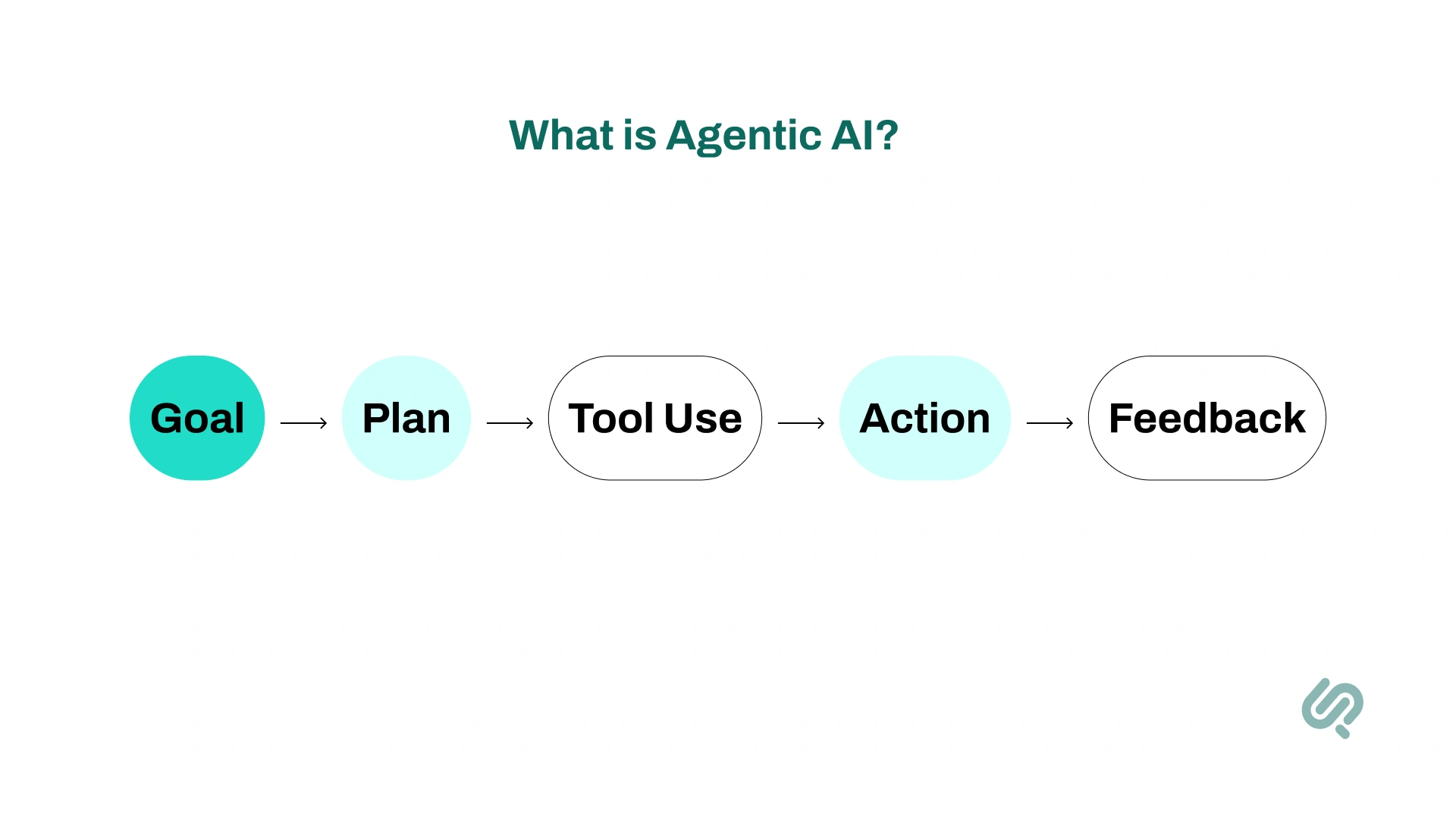
Agentic AI operates in a continuous loop: it understands the goal, plans the steps, utilizes tools and data to act, and then monitors the results to improve over time.
This makes it ideal for task-oriented AI and AI workflow automation, where completing actions matters more than generating content.
Most modern agentic AI systems use LLM-based prompt agents as their reasoning layer. Large language models help the agent:
This is where agentic AI vs generative AI vs LLM becomes important LLMs are reasoning engines, not autonomous systems by themselves.
Agentic AI systems are goal-driven, not prompt-driven.
You define the objective (for example, “reduce delivery delays” or “optimize inventory levels”), and the agent figures out how to achieve it. It can:
This is why agentic AI is often used for enterprise automation, operations, finance, logistics, and IT workflows, where decisions and actions matter more than generating text.
Another core capability is AI orchestration. Agentic AI can connect and coordinate multiple systems at once, such as CRM, ERP, email, scheduling tools, analytics platforms, and internal databases.
Instead of humans manually moving between tools, the agent handles the entire process.
For example, an agent could:
Imagine a customer support system powered by agentic AI:
A customer reports a billing issue. The agent:
This entire sequence happens autonomously. The AI doesn’t just suggest a solution; it takes action. This is why agentic AI is described as being “focused on decisions and actions, not content creation.”
Below are some of the key characteristics that shape how agentic AI systems operate and make decisions. Together, they show what makes agentic AI more than just another automation tool.
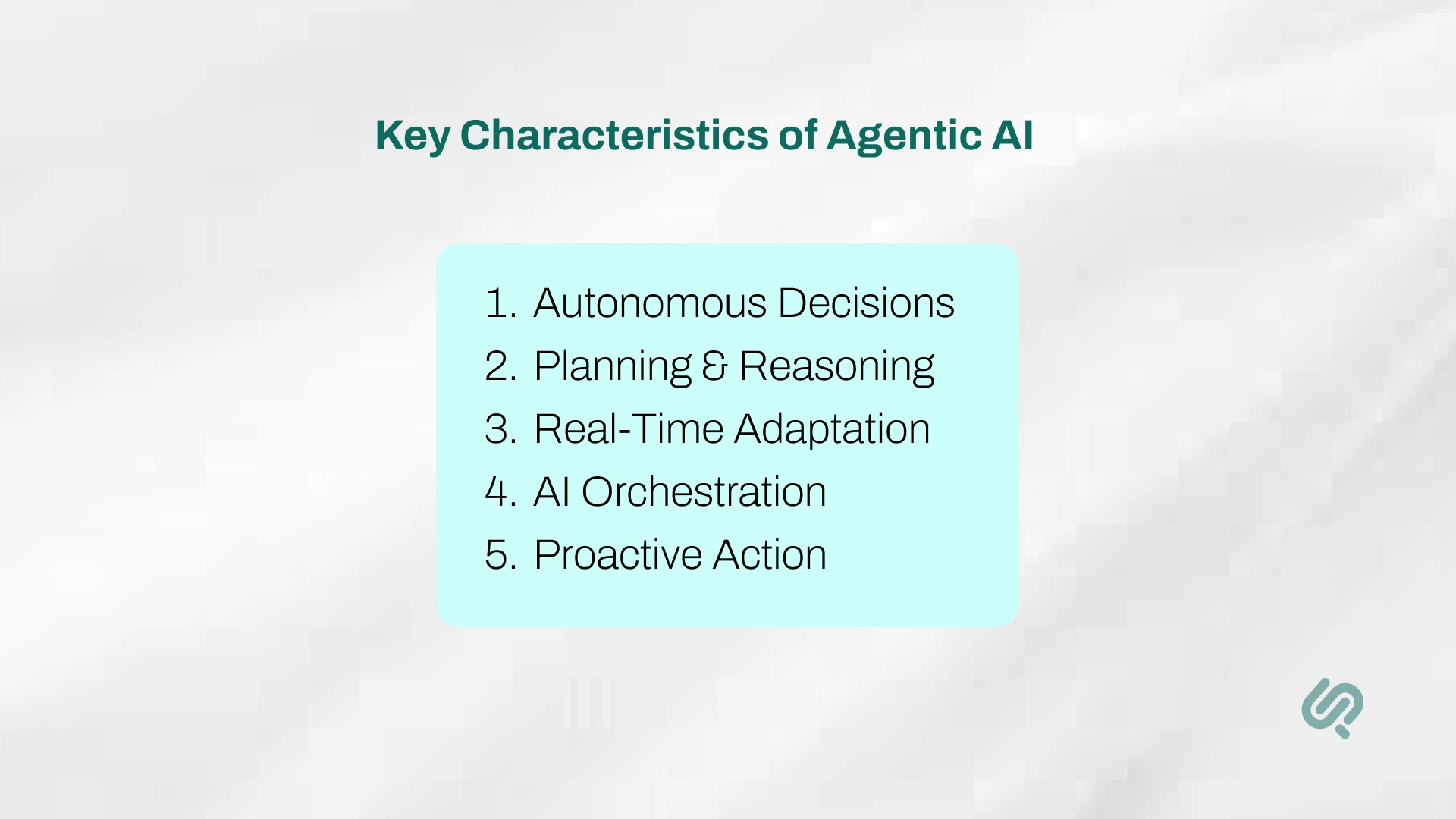
Agentic AI systems make decisions and take actions with minimal human input. Instead of waiting for prompts, they continuously evaluate situations and act based on goals and rules.
This allows autonomous AI agents to operate independently inside business and operational systems.
Agentic AI uses AI reasoning systems to break goals into steps and plan how to execute them. It follows a loop of perceiving, reasoning, acting, and learning to manage multi-step tasks. This enables agentic systems to complete entire workflows, not just produce outputs.
Agentic AI systems monitor their environment and adapt their actions in real time using feedback loops.
When conditions change, they adjust plans automatically. This makes agentic AI effective for dynamic environments like logistics, finance, and operations.
Agentic AI coordinates actions across multiple systems, tools, and agents through AI orchestration.
It connects platforms like CRM, ERP, and databases to execute tasks in the right order. This allows intelligent agent systems to manage complex operations at enterprise scale.
Agentic AI is proactive rather than reactive. It detects opportunities, identifies issues, and acts without waiting for a prompt.
This enables agentic AI systems to optimize processes and drive continuous improvement across business operations.
How autonomous AI agents are being used across business, operations, and decision-driven environments
The following sections show practical agentic AI vs generative AI use cases across different industries.
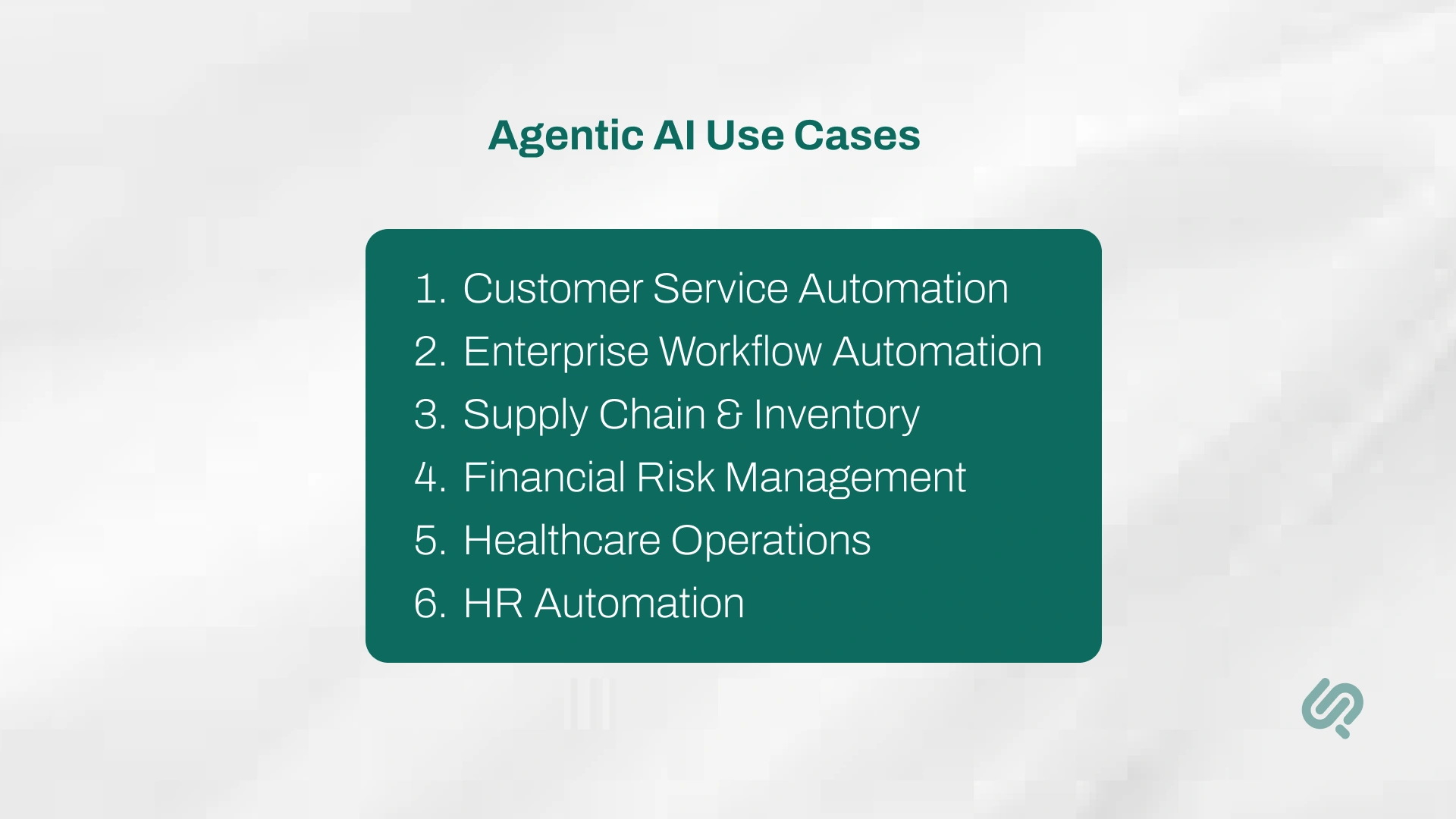
Agentic AI enables customer service automation where autonomous AI agents handle entire support workflows from start to finish.
Instead of only replying to messages, agentic AI systems can understand the issue, take action across internal systems, and resolve problems without human involvement. This transforms support from reactive messaging into proactive resolution.
Example:
A customer reports a billing issue. The agent detects the problem, checks the billing system, issues a refund, updates the account, and sends a confirmation, all automatically, without a support agent manually intervening.
Agentic AI is widely used for enterprise automation where complex business processes must run continuously and reliably.
Intelligent agent systems manage approvals, data movement, system updates, and operational workflows across multiple platforms. This reduces delays, errors, and manual coordination between teams.
Example:
In logistics, an agent monitors traffic, delivery deadlines, and inventory levels, then automatically adjusts delivery routes, reorders stock, and notifies operations when risks appear — without waiting for human commands.
Agentic AI use cases in supply chain focus on autonomous decision-making across demand forecasting, procurement, warehousing, and delivery.
The system continuously analyzes data and adjusts operations to prevent shortages, reduce waste, and improve efficiency. This is a core application of AI orchestration in business operations.
Example:
An agent notices rising demand for a product, increases reorder quantities, schedules earlier shipments, and alerts procurement, preventing stockouts before they occur.
In financial services, agentic AI systems monitor markets, detect risks, and adjust strategies automatically.
Unlike predictive AI that only forecasts outcomes, agentic AI acts on those insights in real time. This makes it ideal for dynamic environments where speed and accuracy are critical.
Example:
A fintech platform uses an agent to detect unusual market volatility and immediately rebalance portfolios to reduce exposure, without waiting for a trader to intervene.
Agentic AI in healthcare focuses on automating operational tasks while supporting clinical decision-making.
It can monitor patient data, trigger alerts, schedule tests, and manage follow-ups to improve care coordination and reduce administrative load on medical staff.
Example:
A smart monitoring system detects abnormal patient readings, schedules diagnostic tests, alerts physicians, and updates patient records automatically, ensuring timely intervention.
Agentic AI supports HR by automating recruiting, onboarding, internal support, and employee management workflows.
Autonomous agents can evaluate candidates, coordinate interviews, and answer employee questions continuously, improving both speed and employee experience.
The global agentic AI market is forecast to grow from about $7.55 billion in 2025 to roughly $199.05 billion by 2034, with a strong CAGR of around 43.84 % over the period (2)
Example:
An agent scans resumes, ranks candidates based on role fit, schedules interviews, sends onboarding documents, and answers policy questions, all without HR teams manually managing each step.
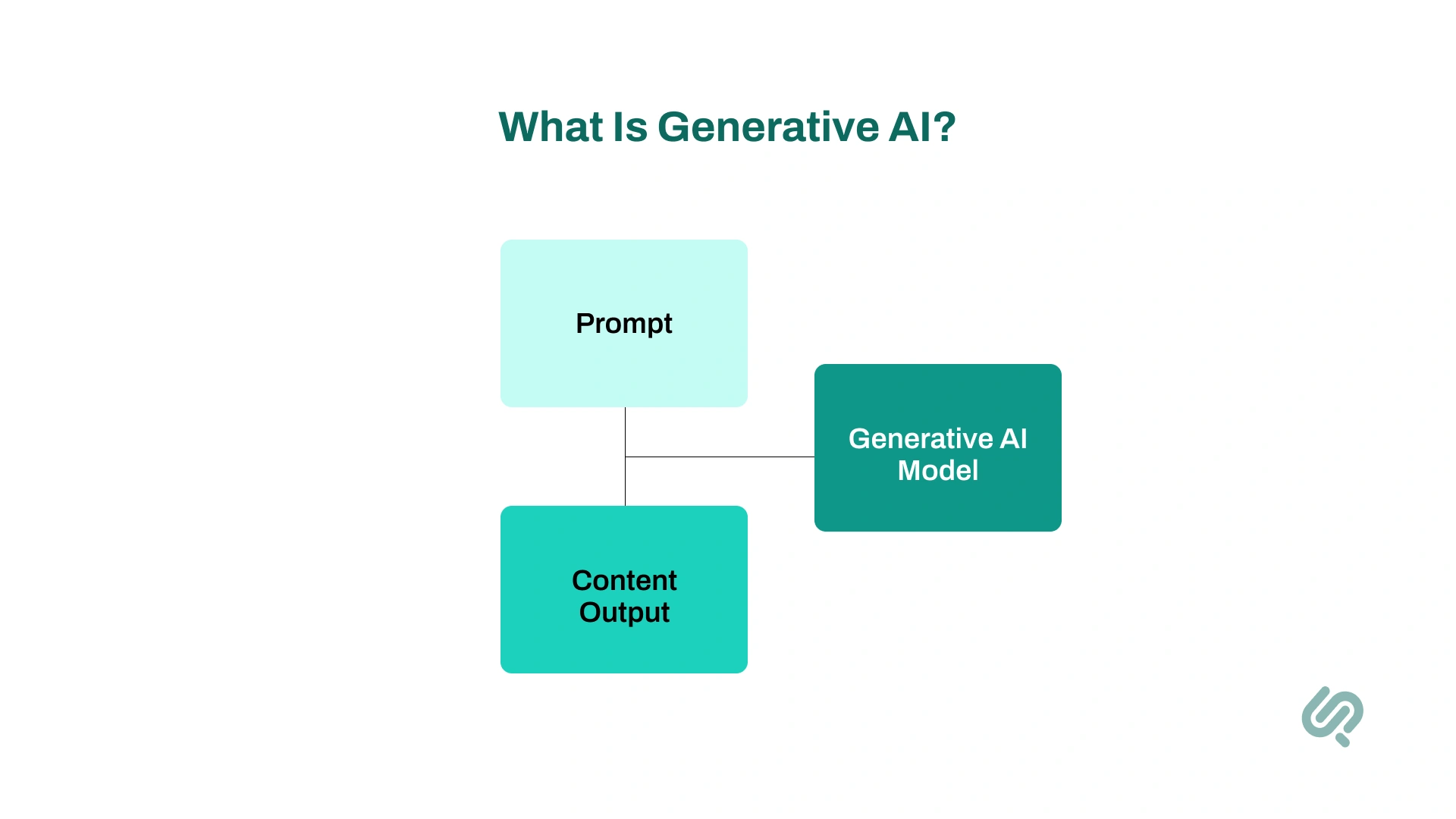
Generative AI is a type of artificial intelligence that creates new content, like text, images, code, audio, or video, based on patterns it learned from large datasets.
It powers many generative AI models used today for AI content generation and AI content generation at scale.
Generative AI has seen a 54.7 % increase in market value from 2022 to 2025, reflecting rapid adoption and investment in generative tools across industries. (3)
These steps show how generative AI turns data and prompts into useful content.
They explain why generative AI is powerful for creation but limited when it comes to taking action.
A generative AI model is trained on huge datasets (text, images, code, etc.). It learns patterns, structure, and relationships from this training data using neural network models and other machine learning techniques.
A user provides a prompt (question, instruction, or example). This is what triggers the model to respond, generative AI is prompt-driven and doesn’t take autonomous action on its own.
The model predicts what comes next based on learned patterns—next word for text, next pixels for images, next lines for code. This is the core mechanism behind AI content generation.
Using these predictions, the system produces an output: a paragraph, an image, a code snippet, a summary, or a draft. This is where generative AI models generate content that didn’t exist before.
If the output isn’t right, users adjust prompts or add context to improve the result. This is how teams get higher-quality content without changing the underlying model.
Some products connect generative AI to tools (search, databases, apps), but the generative model itself still focuses on producing content, not running workflows like autonomous AI agents.
Generative AI systems are built to create content based on learned patterns from data. Their main strengths are focused on production, creativity, and scalability, not autonomous decision making or action.
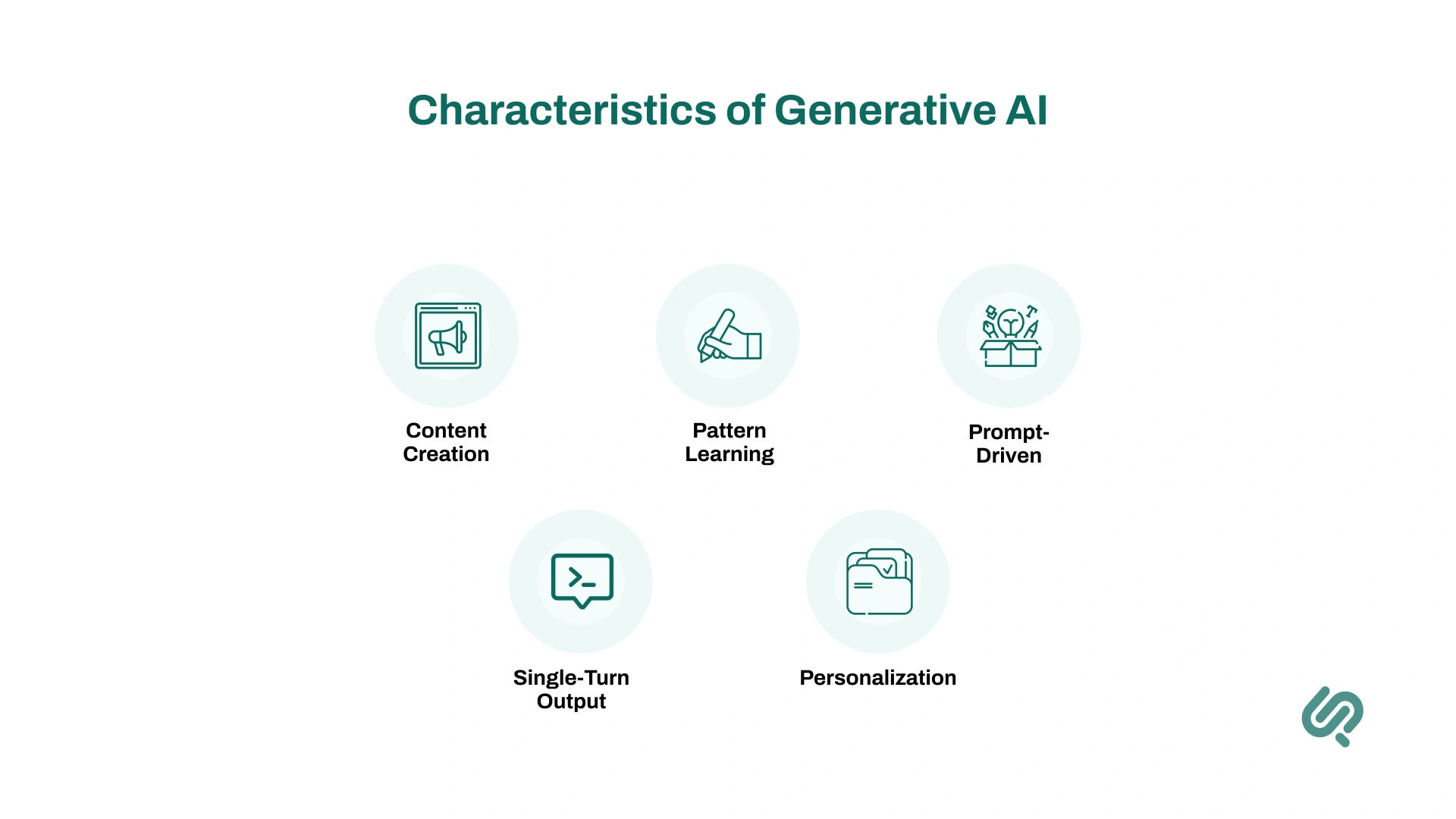
Generative AI is designed specifically for AI content generation, including text, images, code, audio, and video.
It helps teams create marketing copy, product descriptions, documentation, and creative assets faster and at scale. This ability to generate content is the core value of generative AI systems.
Generative AI models rely on patterns learned from large training datasets. They use neural network models and statistical prediction to generate outputs that appear human-like, such as writing in a specific tone or style.
Generative AI is prompt-driven and reactive. It only produces output when a human provides a prompt, which means human input controls when and how the system works.
Most generative AI systems operate in one-off interactions. Each prompt produces a single response, and the system does not maintain long-term memory or persistent goals across sessions.
Generative AI can refine its outputs based on follow-up prompts and feedback. Users can guide tone, format, length, or style through iteration, making it useful for creative and editorial workflows.
Generative AI tools can tailor content to user preferences, audiences, or contexts. This enables personalized marketing, customized recommendations, and audience-specific messaging at scale.
Below are the most common generative AI use cases that are used today across business, marketing, product, and operations.
These examples show where generative AI creates the most value through content, analysis, and personalization.
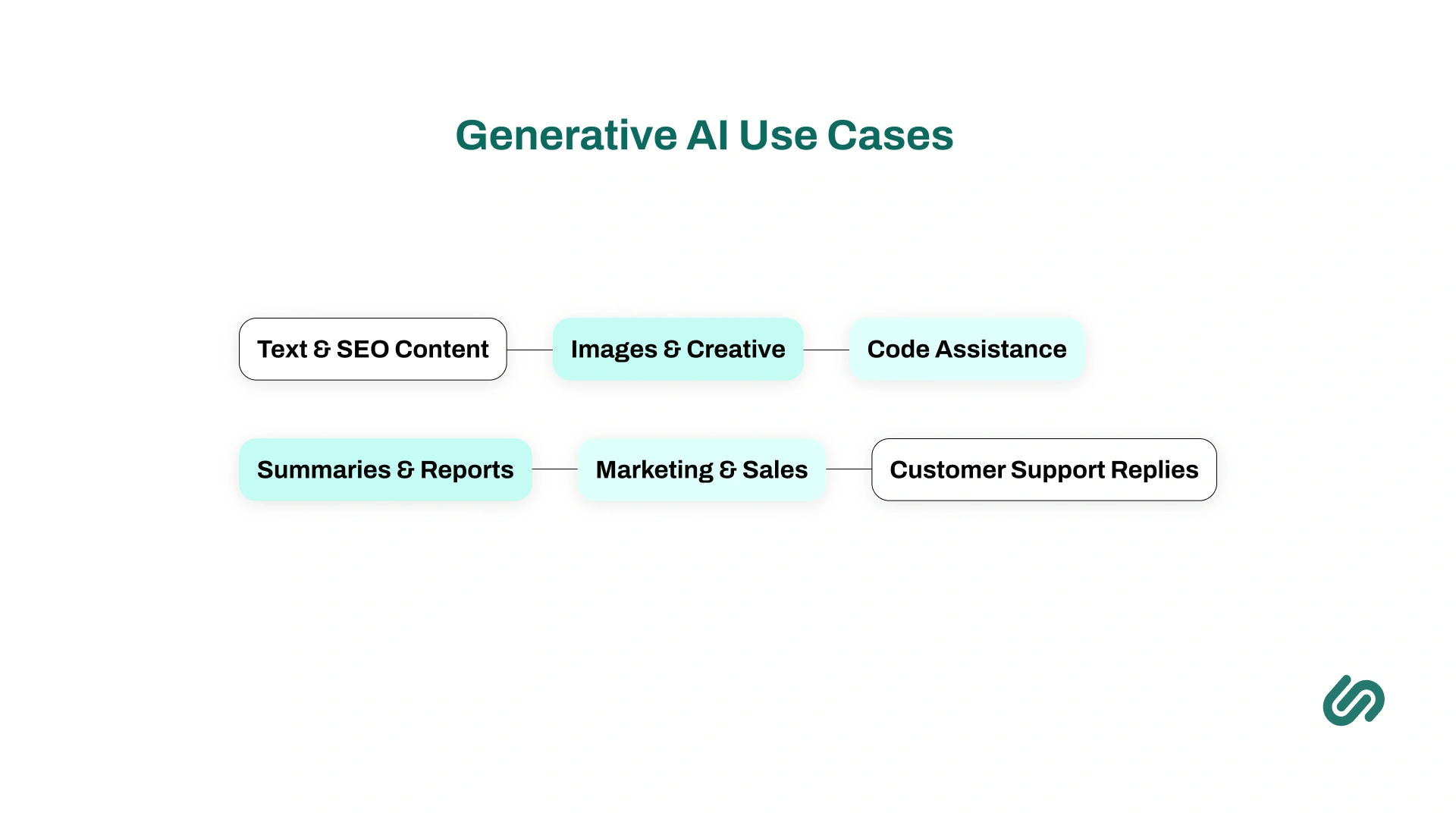
Generative AI is widely used for AI content generation, such as blogs, articles, emails, social posts, and SEO content. It helps teams scale content production quickly without increasing headcount.
Example:
A marketing team uses generative AI to draft 50 product descriptions and 10 blog outlines in minutes instead of spending days writing manually.
Generative AI models can create images, graphics, videos, and music from text prompts. This allows non-designers to produce high-quality creative assets on demand.
Example:
A designer uses an image generation tool to create ad visuals for a campaign by describing the style and mood in a prompt.
Generative AI assists developers by generating code, suggesting fixes, and writing documentation. This speeds up development and reduces repetitive work.
Example:
A developer uses a coding assistant to generate boilerplate code for a new feature and fix syntax errors while reviewing and approving the final output.
Generative AI helps turn large documents and datasets into summaries, insights, and reports that are easier to understand.
Example:
A business analyst uploads a 100-page report and asks the AI to summarize key trends and risks for leadership review.
Generative AI is used to personalize campaigns, write sales emails, and simulate customer conversations. This improves engagement while reducing manual effort.
The global generative AI market is projected to grow from around $37.89 billion in 2025 to approximately $1,005.07 billion by 2034, expanding at a CAGR of about 44.2 % over that period. (4)
Example:
A sales team uses generative AI to customize outreach emails for different industries using the same base message.
Generative AI powers chatbots and support tools that answer FAQs, draft responses, and guide users through common issues.
Example:
An e-commerce company uses a GenAI chatbot to respond to order status questions and return requests automatically.
This is a strong example of agentic AI vs generative AI in commerce, where one creates experiences and the other runs operations.
Generative AI is used to generate product recommendations, personalized ads, and dynamic content for online stores.
Example:
An online retailer uses generative AI to recommend products based on browsing behavior and generate personalized homepages for returning users.
Although both are built on advanced AI models, agentic AI and generative AI solve very different problems.
These also reflect the main types of AI: generative vs agentic, based on whether they create or execute.
Understanding these differences is critical when choosing the right approach for your product, business, or workflow. Below are the agentic AI vs generative AI differences, explained clearly and practically.
The most important difference is what each system is designed to do. Here is one of the simplest agentic AI vs generative AI examples to show the difference in action.
Generative AI is designed to create content. It generates text, images, code, summaries, or ideas based on a prompt. Its job ends once the content is produced.
Agentic AI, on the other hand, is designed to take action. It uses reasoning and planning to decide what should happen next and then executes those actions across systems.
Why this matters: If your problem is “create something,” generative AI is enough. If your problem is “make something happen,” you need agentic AI.
Generative AI is reactive. It only works when a human asks it to do something.
Agentic AI is proactive. It continuously monitors signals, detects situations, and acts without waiting for a prompt.
Why this matters: Generative AI supports humans. Agentic AI replaces manual steps entirely.
Generative AI requires constant human input prompts, refinements, approvals.
Agentic AI requires only high-level human direction, such as defining goals, constraints, and permissions.
Why this matters: Generative AI improves productivity. Agentic AI transforms operations.
Generative AI produces a single output a document, answer, or image.
Agentic AI produces an outcome, a resolved issue, completed workflow, optimized system, or achieved goal.
Why this matters: Generative AI helps thinking. Agentic AI handles doing.
Generative AI does not retain long-term memory across tasks.
Agentic AI maintains state and context, allowing it to track progress, remember past decisions, and adjust over time.
Why this matters: Long-running processes and multi-step workflows require memory and continuity, which generative AI lacks.
This is where agentic AI vs generative AI enterprise automation becomes clear in real business environments.
Generative AI may connect to tools, but it does not control them.
Agentic AI orchestrates tools, APIs, databases, workflows, and systems to achieve goals.
Why this matters: Agentic AI can run your business processes. Generative AI can only suggest them.
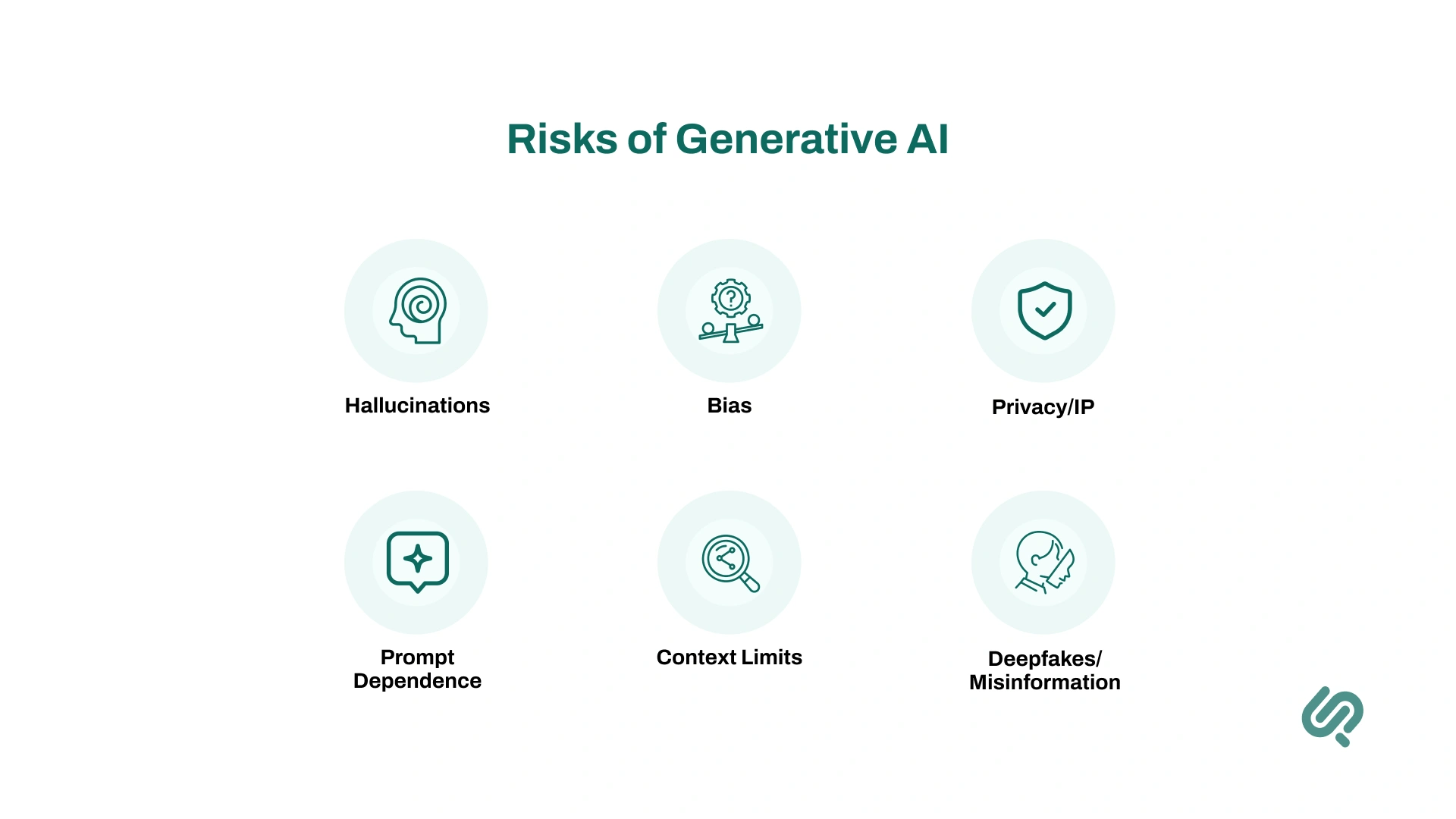
Generative AI risks are mainly informational: hallucinations, bias, and misinformation.
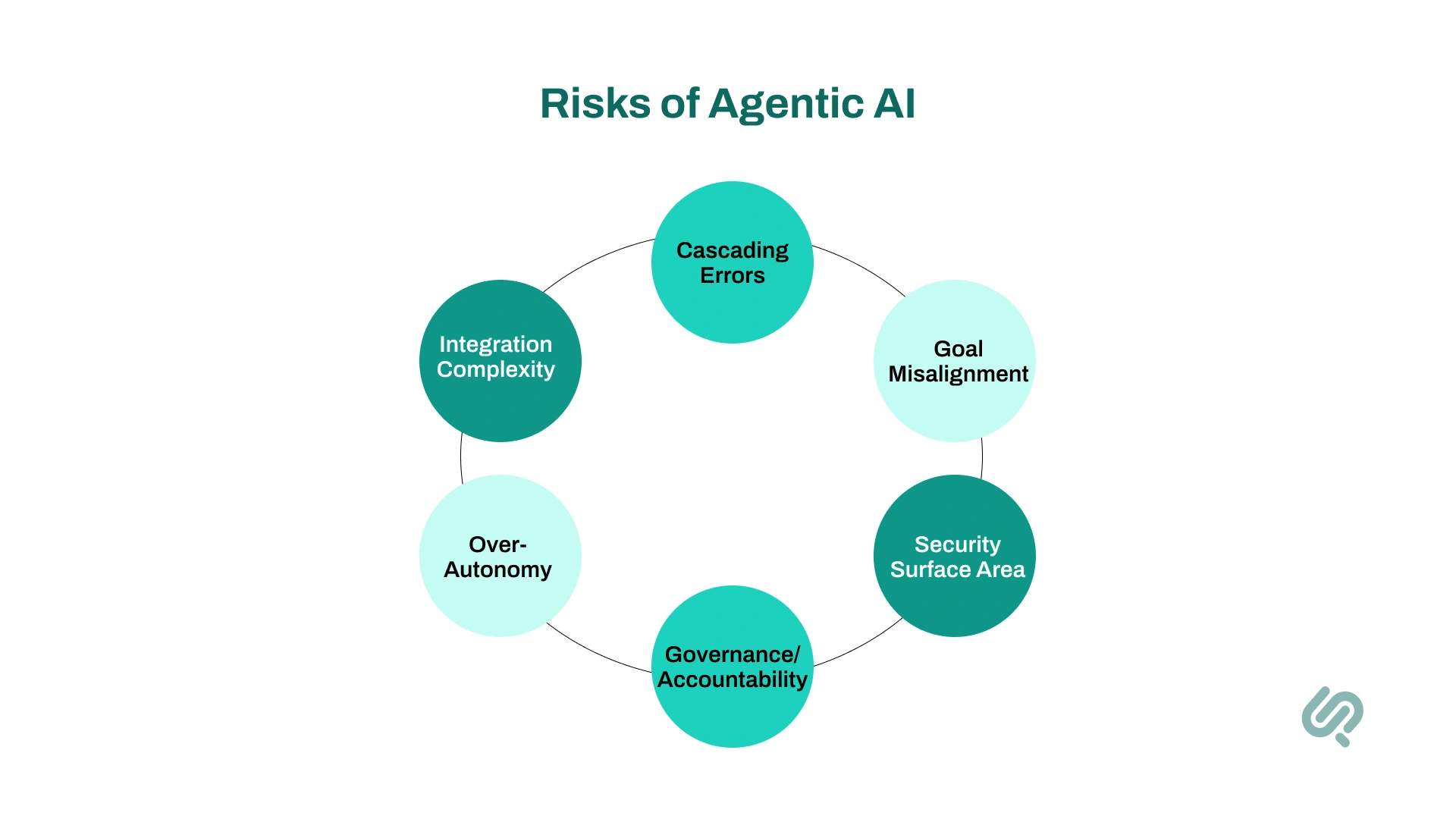
Agentic AI risks are operational: wrong decisions, cascading failures, security breaches, and governance challenges.
Why this matters: Agentic AI must be governed more strictly because it has a real-world impact.
This section helps you decide which type of AI fits your problem not in theory, but in practice.
Think of it as a simple agentic AI vs generative AI comparison focused on what you’re trying to achieve, not how the tech works.
If your goal is execution, updating systems, triggering workflows, resolving issues agentic AI is the right choice.
Agentic AI is built for complex workflows like operations, logistics, IT, finance, and enterprise automation.
If something needs to monitor signals and act without waiting for a human, you need agentic AI not just generative outputs.
Agentic systems orchestrate tools, APIs, and data sources so humans don’t have to move between systems.
In an agentic AI vs generative AI vs predictive AI setup, agentic AI is the layer that turns insights and content into action.
If you need text, images, code, summaries, or drafts, generative AI is built exactly for that.
Generative AI supports thinking and creativity, but it doesn’t replace decision-making or execution.
If each task starts with a question or instruction, generative AI fits better than autonomous agents.
Marketing, sales, documentation, design, and product teams benefit most from generative AI.
If the idea of autonomous systems feels risky, generative AI is a safer first step before moving toward agentic systems.
Most businesses don’t need to choose between agentic AI and generative AI. They need to find a way to design systems where both work together.
Generative AI brings reasoning, language, and creativity into the system, while agentic AI turns that intelligence into decisions and actions across real workflows.
This combination is what transforms AI from a tool people use into a capability that actually runs parts of the business.
Hammad Maqbool, Head of Artificial Intelligence & Prompt Engineering at Phaedra Solutions, shares a practical view on how organizations should think about this balance:
“Generative AI helps teams think and create faster, but agentic AI is what moves the business forward. The real impact comes when generative models support agentic systems, so AI can both reason and act inside your workflows.”
This reflects how Phaedra Solutions approaches AI in practice, not as isolated models, but as integrated systems that combine understanding, decision-making, and execution to deliver measurable operational results.
The real difference between agentic AI and generative AI is not technical. It’s practical.
If your goal is to create content, analyze information, or support human work, generative AI is the right choice. It helps teams write faster, design quicker, and understand data better but it always needs a human to decide and act.
If your goal is to automate decisions, execute workflows, and run operations with minimal human involvement, agentic AI is the right choice. It doesn’t just assist. It acts.
In most modern businesses, the best solution is not choosing one over the other, but using both together: generative AI to think and create, and agentic AI to plan and execute. The organizations that combine them well will move faster, operate smarter, and scale more efficiently than those that treat AI as just another tool.



Ameena is a content writer with a background in International Relations, blending academic insight with SEO-driven writing experience. She has written extensively in the academic space and contributed blog content for various platforms.
Her interests lie in human rights, conflict resolution, and emerging technologies in global policy. Outside of work, she enjoys reading fiction, exploring AI as a hobby, and learning how digital systems shape society.