






Building A1 DDP - Dubai Silicon Oasis
Industrial Area - 342001 -
Dubai - United Arab Emirates
+971 50 756 2346
SERVICES

COMPANY LINKS
SIGN-UP
For Newsletter



Ever wondered why some AI responses are brilliant while others feel flat?
The secret isn’t the AI model you’re using. It’s the prompt.
Prompt hierarchy turns messy one-liners into structured instructions that guide AI step by step, delivering sharper, smarter, and more reliable results.
As AI gets more advanced, learning this skill will be the difference between average outputs and truly effective ones.
A prompt hierarchy is the layered way of structuring instructions for AI models, moving from the simplest request to more detailed, step-by-step guidance.
Instead of a single vague command, it builds context gradually (like giving role, format, and constraints)to shape smarter outputs.
This concept is closely tied to prompt engineering, since both focus on turning human intent into clear directions that AI can follow.
By applying a prompt hierarchy, users get responses that are not just accurate, but also more consistent and useful across different tasks.
Prompt hierarchies come in different forms, each guiding AI in unique ways. Understanding these types helps you choose the right structure for your task.
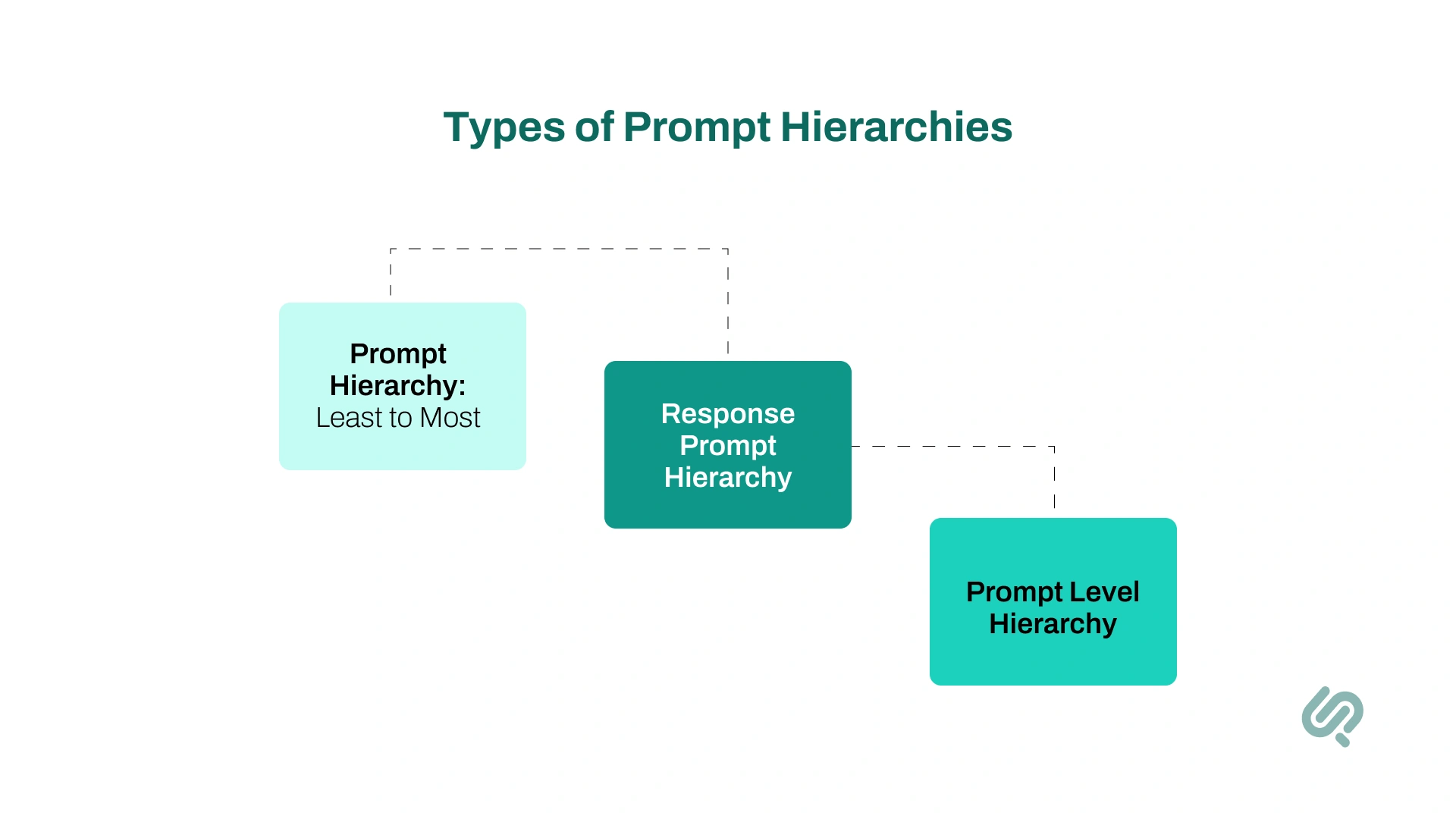
Start broad, then add detail step by step. Moves from open-ended prompts to highly specific instructions.
Focuses on how the AI presents its answer. Let's you request structured formats like bullet points, numbered lists, tables, or JSON.
It is the most complete structure for effective prompting.
Without hierarchy, prompts often turn into vague or conflicting instructions.
A single prompt with mixed goals confuses large language models, leading to incomplete or generic answers.
Benefits of a structured hierarchy:
Experts often call hierarchy the hidden backbone of effective prompt engineering. It’s what transforms an average output into tailored, high-quality AI-generated content.
Following response prompt hierarchy techniques show that structured inputs consistently outperform single prompts.
They deliver more accurate responses, better formatting, and outputs aligned with the desired format, whether the goal is storytelling, analytics, or AI workflow automation.
Let’s look at a few prompt writing examples:
Writing effective prompts is not about guessing; it’s about following a clear framework that helps AI systems deliver accurate, structured, and context-aware results.
By combining a step-by-step process with proven best practices, you can create prompts that consistently guide AI toward reliable outputs.
Start with a clear, direct instruction that defines what you want the AI to do. Avoid vague prompts like “Explain history”, which can lead to unfocused outputs.
AI relies on context to shape its behavior and tailor responses. Add details like the audience, purpose, or perspective you want.
Giving one or more examples helps the AI learn your preferred style or format.
Tell the AI exactly how you want the response presented: bullets, tables, numbered lists, JSON, or paragraphs.
Define tone as formal, conversational, concise, empatheticbased on your audience.
Mastering prompt engineering requires more than just writing a single instruction.
Below are the four core prompting techniques every beginner and professional should knowplus how combining them unlocks even better results.
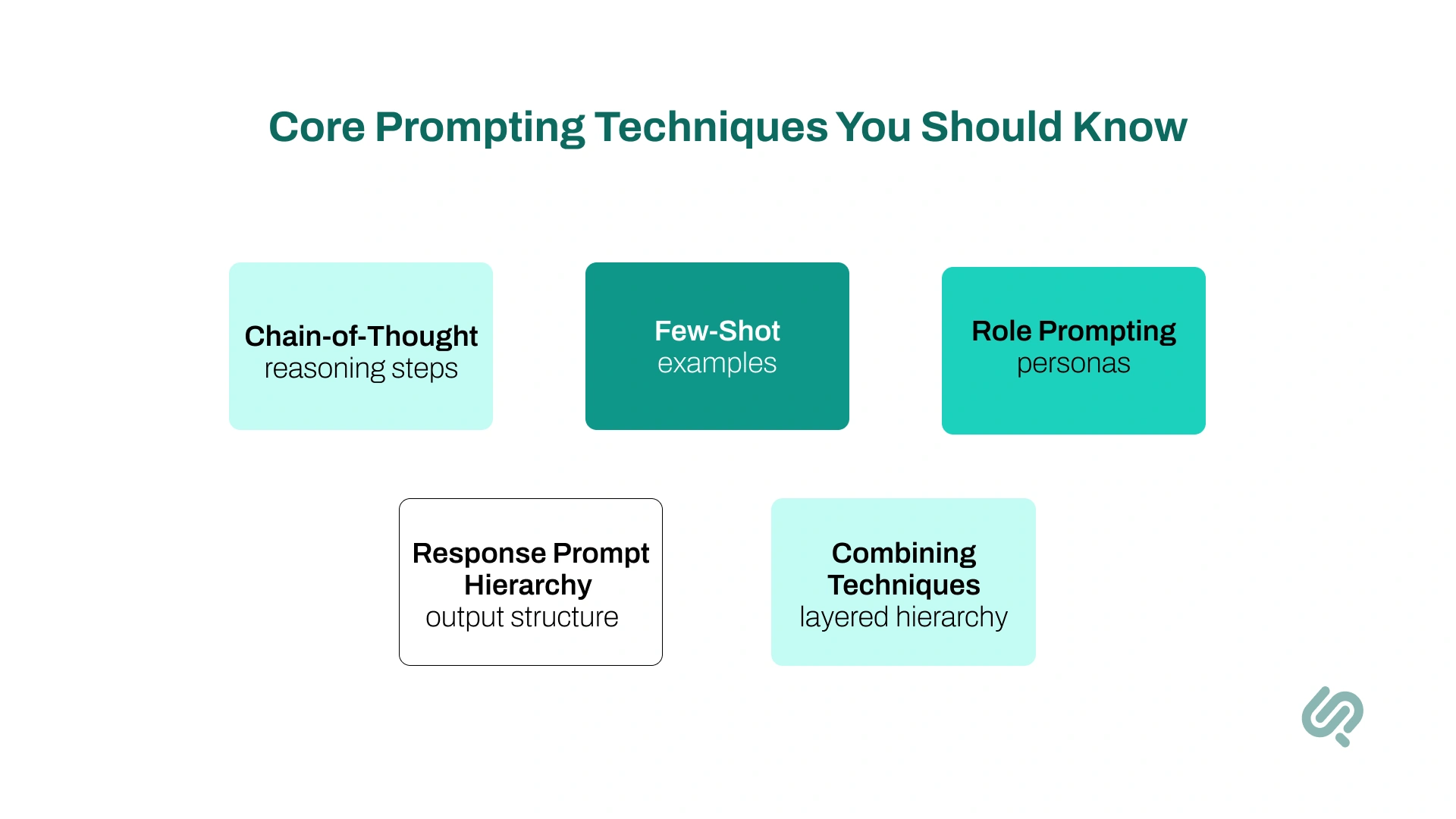
Chain-of-thought prompting asks the AI to show its reasoning before giving a final answer. It mirrors how people tackle complex tasks by breaking them into smaller, logical steps so the model doesn’t jump to conclusions.
This matters because it produces clearer, more defensible outputs, cuts down on vague responses, and makes it easier for you to spot and fix mistakes.
It’s especially effective for data analysis, problem-solving, and technical work.
For example, instead of “What’s the best marketing strategy?”, ask: “First list the main challenges, then explain possible solutions, and finally recommend the best strategy for a non-technical audience.”
Few-shot prompting gives the model a couple of short examples to imitate, so it learns the target style and structure instead of guessing.
By showing concrete patterns, the AI delivers outputs that match your desired format and tone.
This technique reflects the idea of prompt hierarchy, from least to most, where you start with a simple task and progressively add structure, for example, acting as the bridge between vague requests and highly specific instructions.
It improves accuracy, reduces inconsistent phrasing, and helps you maintain brand voice or reporting style across many outputs. In practice, this reinforces the prompt hierarchy definition: structuring instructions to move from broad tasks toward more clarity, context, and control.
It also highlights the prompt hierarchy, meaning organizing inputs so the AI always knows what is expected.
Example:
“Here’s a product description example:
Input → Noise-Canceling Headphones
Output → A two-sentence introduction plus three bullet benefits.
Now do the same for an Ergonomic Office Chair.”
Role prompting tells the AI who it is before it answers, which sets expectations for depth, tone, and perspective.
Framing the model as a tutor, CTO, reviewer, or UX writer instantly shapes the response for the right audience.
This matters because it makes outputs more context-aware and human-sounding, adapts explanations for non-technical readers or executives, and keeps communication aligned with your goals.
Examples include: “Act as a Python tutor and explain recursion to a beginner,” “You are a CTO presenting to executives; summarize the AI roadmap,” or “Act as a UX writer; craft friendly onboarding copy.”
The most effective prompts often blend methods, set a role, request chain-of-thought reasoning, include a few examples, and specify the response format.
This layered approach is a practical prompt hierarchy: you start broad and gradually add structure until the model has everything it needs.
Combining techniques maximizes clarity and control, keeps the work tied to the actual task, and handles complex instructions more reliably.
Here’s what to avoid in prompt hierarchies:
One of the most common mistakes is giving prompts that are too vague. For example, asking “Explain history” leaves the AI with no clear direction.
Without specificity, the model may generate anything from world wars to ancient civilizations, missing your actual task. The result is usually a vague, unfocused response that requires extra editing.
Do This Instead:
Use simple, natural language and direct commands. For example: “Summarize World War II in 5 bullet points for a non-technical audience.”
This gives the AI clarity on the task, the level of detail required, and the format, producing a much sharper response.
Another mistake is skipping context or leaving out examples. Without knowing who the audience is, what the purpose is, or how much detail to include, AI systems often return generic or misaligned outputs.
Similarly, failing to provide one or more examples (few-shot prompting) deprives the AI of clear guidance.
Do This Instead:
Add relevant context up front, state the audience, tone, or role the AI should take and include examples that demonstrate the output style you expect.
For instance, giving one product description and asking the AI to create another in the same style improves accuracy and alignment with your goals.
While skipping context is a problem, overloading the prompt with too much irrelevant detail is equally harmful.
Long, cluttered prompts dilute the prompt hierarchy and make it harder for the AI to understand the actual task.
Do This Instead:
Keep prompts concise and focused. Only include details that directly shape the AI’s output, and structure your instructions in a logical sequence.
This balance ensures the model processes information effectively and stays aligned with the task.
Even when the AI generates accurate information, it can still be difficult to use if formatting is ignored.
Without clear instructions, the model often produces dense blocks of text, leaving you to manually restructure it into bullets, tables, or numbered lists.
Do This Instead:
Always specify the desired response format in your prompt. For example: “Provide the answer in a table with two columns: Concept and Definition.”
This ensures the AI delivers content that is structured, consistent, and immediately actionable.
Prompt hierarchy is not just a theory for researchers or developers. It is already proving its value in real-world industries.
By applying structured prompting, organizations can generate more accurate, reliable, and usable AI responses across different domains.

Teachers use a prompt hierarchy to simplify complex subjects, ensuring explanations match the student’s level. Instead of vague requests, they refine prompts to guide tone, length, and focus. This makes lessons clearer and easier to absorb.

In healthcare, precision and speed are critical. Prompt hierarchy helps medical staff structure AI outputs into usable formats that reduce errors and speed up decisions.

Financial analysts rely on structured prompts to turn messy datasets into actionable insights. By layering instructions, they get outputs that are both accurate and executive-ready.

Customer service teams depend on AI chatbots, but vague instructions can lead to poor experiences. Role-based, structured prompts ensure clarity, consistency, and brand alignment.

Writers and designers use prompt hierarchy to guide creativity while keeping structure. This ensures stories and visuals remain consistent with the intended tone and style.
The success of prompt hierarchy also depends on the prompt engineering tools that support structured prompting.
Today’s leading AI models and AI tools are evolving to make prompts more powerful, flexible, and easy to manage.
Below are the most widely used platforms and the features that help them support effective prompt engineering.
ChatGPT has become the go-to platform for professionals experimenting with prompt hierarchy.
It supports a wide range of techniques such as role prompting, few-shot prompting, and structured formatting.
Users can request outputs in the form of bullet points, tables, JSON, or multi-paragraph formats, making it ideal for both technical and non-technical audiences.
With custom AI prompt development and memory features being introduced, ChatGPT also allows users to save preferences for tone and style, reducing the need to repeat context with every query.
Claude is designed with safety and alignment in mind, but it also excels at handling long-form reasoning and context.
Its ability to process large amounts of information makes it particularly well-suited for complex tasks where chain-of-thought prompting or detailed formatting instructions are needed.
Developers and business users rely on Claude for high-stakes outputs such as policy summaries, research analysis, or technical documentation, where clear instructions and logical sequence are essential.
Google’s Bard, now evolved into Gemini, emphasizes real-time integration with live data and other Google tools.
This makes it especially useful for tasks requiring relevant context pulled from the web or organizational documents.
By combining structured prompts with real-time search, Bard/Gemini enables users to create outputs that are not only accurate but also up to date. For example, analysts can ask for structured market summaries in bullet-point format, grounded in current data.
Midjourney shows how prompt hierarchy applies to visual creativity.
Instead of vague instructions like “Draw a city,” structured prompts such as “Generate an image of a futuristic city at sunset, wide-angle view, neon lights, cinematic style” produce far more relevant and visually compelling results.
Designers and marketers often combine text and image prompts to create consistent, multi-modal campaigns.
Across platforms, certain features are becoming essential for supporting a guide to prompt hierarchy for effective AI responses:
Creating prompts is only half the job knowing whether they actually work is just as important.
To ensure your prompt hierarchy delivers reliable results, you need measurable criteria. Below are the key metrics professionals use to evaluate the effectiveness of prompts across different use cases.
The future of generative AI will depend on structured prompting (and the salaries of prompt engineers will surely rise!).
As models become more advanced and multimodal, prompt hierarchy will guide them to deliver accurate, context-aware, and scalable outputs.
This structured approach shapes AI interactions much like human conversations, moving from broad requests to detailed guidance.
Looking ahead, advanced for techniques prompt engineering will expand into multimodal AI, where prompts mix text, images, audio, and video.
Structured inputs will be essential in industries like design, customer service, and data analysis, unlocking reliable, cross-modal performance for real-world applications.
Prompt hierarchy is the backbone of effective prompt engineering.
By moving from broad instructions to structured inputs, users can unlock clearer, more accurate, and more relevant AI responses.
From education and healthcare to finance, customer support, and creative industries, prompt hierarchy transforms AI from a helpful tool into a powerful partner.
As generative AI continues to evolve, especially into multimodal systems, structured prompting will shift from a best practice to an essential skill for anyone looking to guide AI effectively.



Ameena is a content writer with a background in International Relations, blending academic insight with SEO-driven writing experience. She has written extensively in the academic space and contributed blog content for various platforms.
Her interests lie in human rights, conflict resolution, and emerging technologies in global policy. Outside of work, she enjoys reading fiction, exploring AI as a hobby, and learning how digital systems shape society.