








Building A1 DDP - Dubai Silicon Oasis
Industrial Area - 342001 -
Dubai - United Arab Emirates
+971 50 756 2346


SERVICES

COMPANY LINKS
SIGN-UP
For Newsletter



Mastering machine learning isn’t about memorizing algorithms or reading papers. It’s about building projects that solve real problems.
But with so many options out there, it’s hard to know:
You’re not alone in wondering this because while 83% of businesses now see AI as a top priority (1), only those who can implement practical machine learning applications stand out in today’s market.
That’s why we wrote this guide. It’s designed to cut through the noise and show you how to build machine learning projects that teach you critical skills like data wrangling, feature engineering, and algorithm selection (while delivering real-world business value).
We’ll even share two AI case studies from our work at PhaedraSolutions, so you can see what success looks like in action.
If you’re ready to take your skills to the next level, let’s dive in.
At its core, machine learning teaches computers to spot patterns and make predictions from data without explicit instructions.
A machine learning project takes that concept and turns it into a practical solution, whether predicting house prices, classifying images, or automating customer interactions.
In business, ML projects bridge the gap between theory and results. They’re how you transform theoretical knowledge into systems that save time, boost revenue, and solve real-world problems.
We won’t just throw a list at you.
Instead, we’ll walk you through 12 machine learning project ideas, categorized by skill level, so you can build your expertise step by step from simple machine learning projects to sophisticated enterprise solutions involving deep learning, computer vision, and natural language processing.
Here’s a preview of what’s coming:
Ready to build ML solutions that make a difference?
Let’s start with our first project.
When you’re new to machine learning, it’s easy to feel overwhelmed. There’s so much talk about deep learning, neural networks, and big words like “convolutional neural networks.”
But here’s the good news: You don’t have to start there.
The best way to begin is with simple machine learning projects that teach you the basics. These projects help you learn how to:
They’re also perfect for final-year students who need solid projects to show their skills.
Let’s explore four great beginner machine learning projects that build a strong foundation for bigger things ahead.

Imagine knowing how much a house should cost before anyone tells you.
That’s what this project is about. You’ll build a predictive model to estimate house prices. It’s one of the most popular learning projects for beginners because it’s simple, yet powerful.
Here’s how it works:

Ever wonder how banks decide who gets a credit card?
They use classification models, a key part of machine learning applications. This project is perfect for beginners who want to learn how to predict yes/no outcomes.
In this project, you’ll:
This is one of the most practical ML project ideas because many industries, especially machine learning in finance, rely on these models.
You’ll also get experience working with:

Who knew machine learning could help you pick a better bottle of wine?
In this fun project, you’ll build a classification model to predict wine quality. You’ll learn how to handle multi-class classification, meaning there’s more than just “yes” or “no” as an answer.
You’ll work with a dataset that includes:
Your goal is to train a machine learning model to predict the wine’s quality score, usually from 1 to 10.
Real wineries use similar models for quality checks to keep their customers happy.

Not every customer is the same.
Some people buy lots of products. Others only shop during sales. Businesses want to know these patterns, so they can better serve each group.
This is where K-Means clustering comes in. It’s a machine learning algorithm used for unsupervised learning, meaning there’s no “right answer” provided.
Here’s what you’ll do:
It’s one of the best learning projects for beginners because it shows how machine learning can reveal hidden patterns.
In short, these four simple machine learning projects are the perfect place to start.
They’ll give you:
Start small, experiment, and build your skills step by step. You’ll be ready for intermediate machine learning projects and beyond in no time!
Congrats on making it through the beginner projects!
Now, it’s time to level up.
These intermediate machine learning projects will challenge you with:
These are perfect for final-year students, early-career professionals, or anyone looking to gain hands-on experience and stand out as a data scientist or machine learning engineer.
Let’s jump in!

People talk about everything on social media platforms: their favorite brands, bad days, and even cute dogs.
This project teaches you how to build a natural language processing (NLP) model that reads text and figures out how people feel.
It’s called sentiment analysis.
Here’s what you’ll do:

Ever wonder how Netflix seems to know exactly what show you’ll love?
Or how Amazon suggests the perfect product?
That’s the power of recommendation systems, one of the most impactful machine learning applications.
In this project, you’ll:
For example, if Alex loves sci-fi movies and Jamie has similar tastes, the system will suggest to Jamie the movies Alex enjoyed.

Welcome to computer vision.
Imagine teaching a computer to tell the difference between cats and dogs. That’s image classification.
In this project, you’ll use convolutional neural networks (CNNs). These are special deep learning models that automatically spot patterns in pictures, like edges or shapes.
Here’s what you’ll learn:

Can you predict the stock market?
Well, not perfectly, but you can try!
This machine learning project teaches you how to work with time series data. That means data where order matters, like stock prices day after day.
You’ll:
No, you’ve now explored projects using:
These intermediate machine learning projects push you closer to real-world problems.
They also help you think like a machine learning engineer, connect data science skills to business goals, and prepare for advanced machine learning projects.
Keep experimenting, and remember, each project builds your confidence and knowledge.
Next up, we’ll tackle advanced machine learning projects that go even deeper!
Welcome to the big leagues.
These are advanced machine learning projects that show what’s possible when you combine smart algorithms with real-world business needs.
They’re not just academic exercises. They’re AI solutions you’d find in production systems built by machine learning engineers and data scientists working on enterprise machine learning development.
These projects often involve:
Let’s explore four powerful projects, including two AI and machine learning case studies from our team at Phaedra Solutions!

Think about a grocery store.
If they have too much milk, it might spoil. If they run out, customers get upset.
This is where an AI-powered inventory management system comes in. It predicts how much stock a store needs before it runs out.
In this project, you’ll:
This project is based on a real solution we built at Phaedra Solutions.

Security cameras see everything.
But humans can’t watch thousands of hours of video to catch important moments.
In this project, you’ll build an AI cloud surveillance platform. It uses computer vision and cloud computing to:
We built a system like this at Phaedra Solutions. It’s one of our favorite AI and machine learning case studies because it shows how deep learning models can solve real problems.

Talking to computers used to be frustrating.
Now, AI chatbots can answer questions, help customers, or even tell jokes.
In this project, you’ll build an intelligent chatbot using transformer models like GPT-3 or Hugging Face’s DialoGPT.
Here’s what you’ll do:
This goes way beyond simple keyword bots; it’s true natural language processing in action.

Imagine a giant machine in a factory.
If it breaks, production stops, costing thousands of dollars every hour.
Predictive maintenance is all about stopping problems before they happen.
This machine learning project uses sensor data to predict when machines might fail.
Here’s how it works:
McKinsey says predictive maintenance can reduce downtime by 50%. (3) That’s huge.
These advanced machine learning projects are where things get real.
They show how to:
Whether you’re aiming for enterprise machine learning development, starting your own AI venture, or just love building cool things, these projects will stretch your skills and open doors.
Breaking into the world of machine learning might feel big and scary.
But here’s the truth: it’s never been a better time to get started.
Jobs in AI and data science are growing fast. The World Economic Forum predicts a 40% rise in AI and ML specialist roles by 2027. (4)
That means companies everywhere, from big banks to tech startups, are hungry for people who can build machine learning projects and solve real problems.
If you’re a final year student, a career switcher, or someone early in their tech journey, here’s how you can set yourself apart and build a strong path into this exciting field.
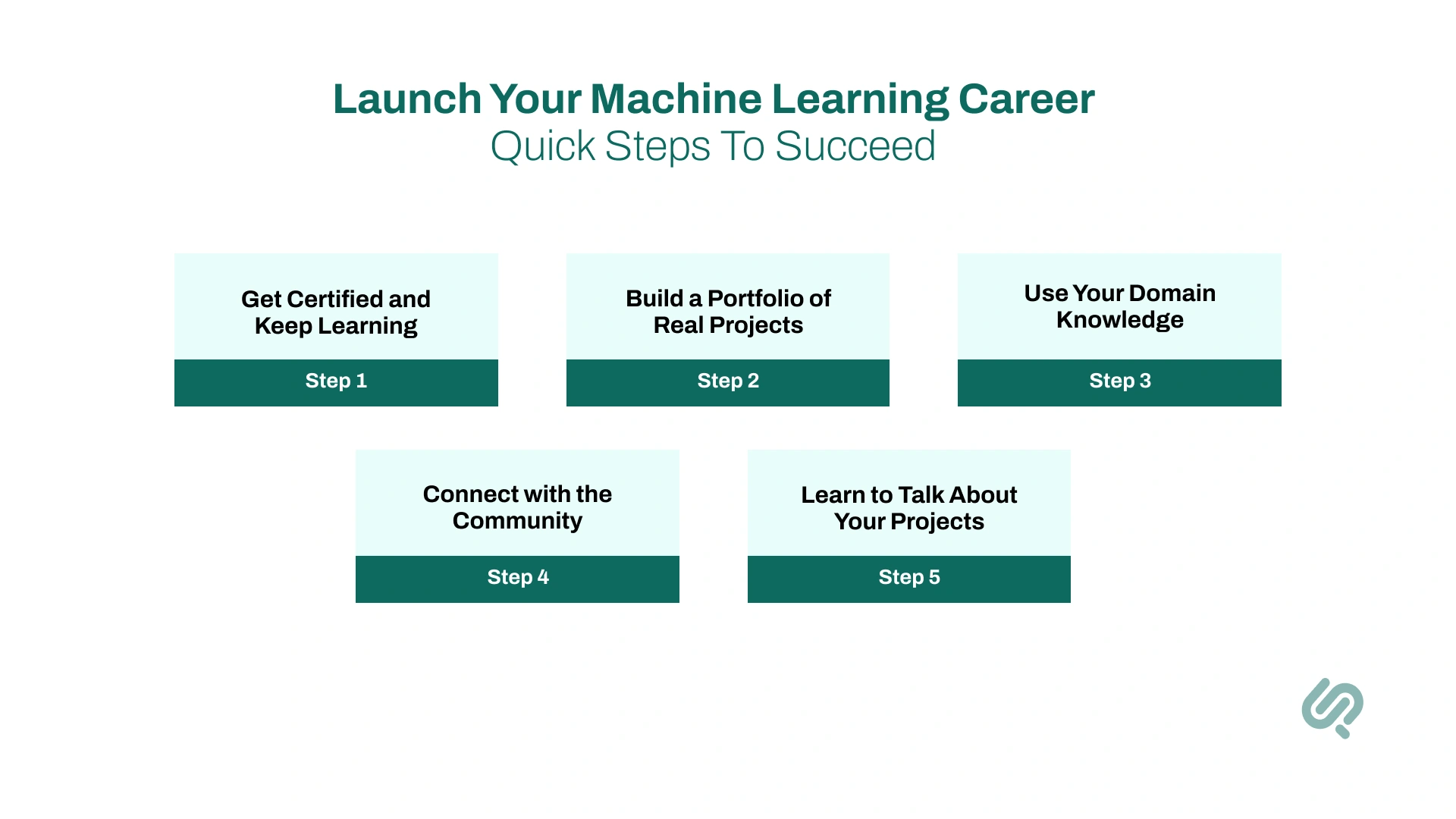
Career Guidance – Quick Steps Overview
Now, let’s discuss these in detail!
First things first: learn the basics.
Take online courses or get a degree if you’d like. But also look into certifications like:
These show you’ve got solid theoretical knowledge and practical skills.
Employers love to see proof you’ve studied machine learning algorithms, model building, and data analysis.
But don’t stop learning after a certificate. The AI world moves fast. Keep up with new data, tools, and trends like deep learning, computer vision, or natural language processing.
Certificates are great. But hands-on experience is even better.
Start working on your machine learning projects. These don’t have to be huge. Simple ones like:
These show you know how to clean data, train models, and measure model performance.
Upload your projects to GitHub or share them on Kaggle. Add clear explanations and example source code. Show how your work solves real-world problems.
A strong portfolio is pure gold in this field!
Are you coming from another field like finance, healthcare, or marketing? Great!
That’s not a weakness, it’s a superpower.
Your domain expertise helps you pick the right machine learning applications and design features that matter. For example:
When describing your projects, don’t just say which machine learning model you used. Explain the problem you solved and the impact it made, like: “Built a recommendation system to boost online sales by 10%.”
This shows you’re not just a coder; you’re a problem-solver who understands business.
Landing a job isn’t only about your skills. It’s also about who you know.
Up to 85% of jobs are filled through networking (5). That’s huge!
So start connecting:
Share your projects. Ask questions. Give help.
Being visible in the community opens doors. It might even get you your first interview or job offer.
And remember: the machine learning community is friendly and full of people who love sharing valuable insights!
Finally, practice explaining your work.
When you apply for jobs, don’t just list tasks like: “Built a model in TensorFlow.”
Instead, talk about results: “Developed a deep learning model that boosted image recognition accuracy by 20%.”
Use numbers if you can. Show how your project is connected to business goals like:
And be ready to answer questions in interviews about:
Being able to clearly explain your projects shows you’re ready for real work in enterprise machine learning development or Custom AI Model Development.
The world of machine learning is wide and full of amazing possibilities.
Start small. Keep building. Share your work.
And soon, you’ll find yourself tackling advanced machine learning projects and making an impact in the world.
Building great machine learning projects is exciting, but it’s also easy to slip up.
Surprisingly, about 85% of machine learning projects fail to deliver real results (6), often because of avoidable mistakes.
The good news? Once you know these pitfalls, you’ll be way ahead of many beginners and even some pros.
Here’s a handy table of common mistakes and how to avoid them:
Even advanced machine learning projects can fail if these basics aren’t handled well.
Focus on clean data, good validation, and simple solutions before reaching for the latest deep learning models.
These good habits will help you become a reliable machine learning engineer who delivers solutions people trust and keeps your projects off the list of failed AI experiments.
Keep learning, keep experimenting, and remember: sometimes the simplest model wins!
Machine learning projects aren’t just exercises. They’re your gateway to solving real-world problems and mastering valuable skills.
Whether you’re a beginner, a student, or a professional, there’s a project here to help you grow.
Start with one that excites you, take it step by step, and don’t stress about perfection. Every expert started somewhere.
The world needs problem-solvers who can turn data into impact. So, start small, keep experimenting, and enjoy the journey.
Every big innovation begins with a single project.


1. https://superagi.com/the-future-of-sales-top-ai-trends-and-innovations-to-watch-in-2025-3/
2. https://www.linkedin.com/pulse/netflixs-billion-dollar-secret-how-recommendation-systems-qin-phd-7zece
4. https://www.wire19.com/ai-machine-learning-jobs-fastest-growth-next-4-years/

Areesha is a content writer with over 2 years of experience in writing about tech and digital trends. She focuses on topics like AI, remote work, and productivity.
Her blogs have helped startups grow their content reach and improve lead generation. She writes with a focus on clarity, simplicity, and reader value.