









Building A1 DDP - Dubai Silicon Oasis
Industrial Area - 342001 -
Dubai - United Arab Emirates
+971 50 756 2346


SERVICES

COMPANY LINKS
SIGN-UP
For Newsletter



In 2026 and beyond, the best blockchain development trends are driving real change across industries like finance, healthcare, logistics, and government.
Businesses are using blockchain to cut costs, increase transparency, and build systems where data, trust, and automation work together seamlessly.
From tokenization and DeFi to green blockchain and AI-powered smart contracts, the technology is redefining how digital value moves across the world.
This guide breaks down the most important blockchain development trends you need to know, plus real examples, industry insights, and a roadmap to help you stay ahead.
The global blockchain market is expanding at record speed, showing how powerful these blockchain development trends have become.
According to Fortune Business Insights, the market was worth $20.16 billion in 2024 and is expected to reach $393.42 billion by 2032, growing nearly 43% each year (1).
Another forecast predicts it could even exceed $1.4 trillion by 2030, reflecting explosive enterprise adoption. (2)
From finance and logistics to healthcare and retail, blockchain is reshaping how organizations build trust, share data, and manage transactions securely.
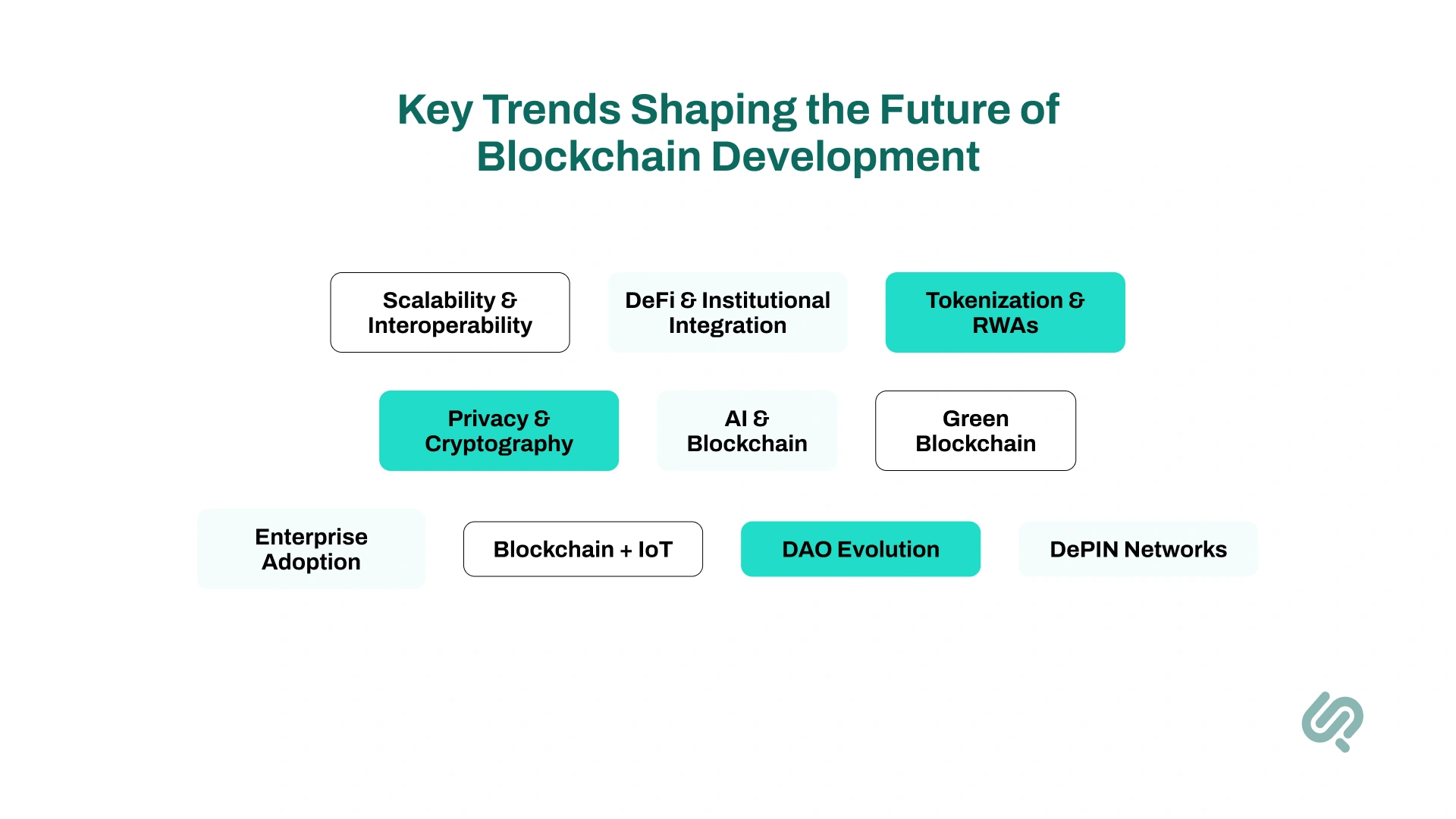
Blockchain is evolving fast, and the best blockchain development trends of 2026 show how this technology is moving beyond crypto into real-world business transformation.
In this section, we chart the best blockchain development trends driving growth across industries
Key Points
Scalability and interoperability define the backbone of modern blockchain innovation. Tools like Polkadot and Cosmos connect independent chains into one “internet of blockchains,” while Ethereum’s Layer-2 rollups boost speed and reduce costs.
Crucially, the industry is transitioning from monolithic to modular architecture. This modular approach, championed by projects like Celestia and the restructured Polygon 2.0, separates functions (like execution, data availability, and consensus) to achieve unparalleled speed and efficiency.
Example: The Graph works like a search engine for blockchain data, enabling cross-chain indexing and faster app performance.
Key Points
DeFi is no longer just for crypto enthusiasts. Institutions are adopting it to power real-time global settlements and transparent finance.
Example: Fnality, backed by Citi and UBS, uses blockchain to settle payments instantly between major banks, proving that decentralized finance can integrate with traditional systems.
Key Points
Tokenization is bringing the physical and digital worlds together. Investors can now buy small shares of high-value assets like real estate or fine art through blockchain tokens.
Example: Aura Blockchain tracks millions of luxury products, proving authenticity and ownership on-chain, reducing fraud and improving brand trust.
Key Points
Privacy and security are top priorities in blockchain development. Tools like ZK-proofs protect user data while maintaining transparency.
Example: The QRL project uses quantum-secure signatures to safeguard data from next-gen hacking threats, ensuring blockchain networks stay future-proof.
Key Points
AI and blockchain are combining to power smarter, more transparent systems. Together, they make automation auditable and trustworthy.
Example: DePIN networks reward users for renting out unused GPU power, helping train AI and ML models while tracking usage on-chain for accuracy and fairness.
Key Points
Sustainability is now essential for blockchain adoption. With PoS systems reducing energy consumption drastically, green blockchain is gaining momentum.
Example: Toucan Protocol and Klima DAO tokenize carbon credits, allowing businesses to offset emissions transparently and meet ESG goals.
Key Points
Companies are embracing blockchain to digitize operations securely. Private and hybrid networks allow control, privacy, and compliance.
Example: IBM’s Food Trust uses Hyperledger to trace food products from farm to shelf, improving supply-chain transparency and safety.
Key Points
Integrating IoT with blockchain allows physical devices to record data securely.
Example: VeChain connects IoT sensors with blockchain, tracking goods, temperature, and logistics data in real time to prevent fraud and improve efficiency.
Key Points
DAOs are reshaping how organizations operate, replacing hierarchy with community-led governance
Example: Uniswap DAO lets token holders vote on protocol updates, budgets, and integration, making decision-making democratic and transparent.
Key Points
DePIN is turning physical infrastructure into decentralized systems.
Example: Helium Network lets users host wireless hotspots and earn tokens, creating community-powered connectivity without traditional telecoms.
These recent trends in best blockchain development represent the best blockchain development trends to watch.

As blockchain adoption accelerates across industries, companies are looking for ways to turn these best blockchain development trends into real business results.
From supply chains to healthcare and digital rights, the latest trends in blockchain development are proving that transparency and automation can deliver measurable impact.
These blockchain success stories show how the technology is reshaping industries globally.
Blockchain in supply chain and logistics focuses on traceability, transparency, and accountability. By replacing paper trails with digital ledgers, companies can track every product’s journey from origin to shelf.
Example: Walmart’s use of IBM’s Hyperledger Food Trust reduced the time needed to trace mango shipments from seven days to just 2.2 seconds, showcasing how blockchain development trends are improving real-time tracking and product authenticity.
As IoT sensors and QR codes integrate with blockchain, logistics teams can now monitor shipments, reduce fraud, and enhance customer trust seamlessly.
The blockchain in healthcare movement focuses on protecting patient data while improving interoperability. Hospitals use encrypted, tamper-proof ledgers for record sharing and consent management.
Example: Pfizer’s MediLedger pilot uses blockchain to verify and track pharmaceuticals, combating counterfeit drugs while ensuring regulatory compliance.
With more hospitals exploring blockchain-based electronic health record (EHR) exchanges as well as healthcare software development services, the industry stands to gain from improved collaboration, faster access, and reduced costs.
One of the recent trends in blockchain development is its use in protecting creative rights and digital ownership.
Blockchain in intellectual property ensures creators get automatic royalties and proof of authorship through smart contracts and NFTs.
Example: Platforms like Royal.io allow musicians to mint NFTs representing song ownership, and when these NFTs are resold, royalties automatically flow to the original creator, eliminating intermediaries.
This innovation ensures transparency in content licensing and marks a new chapter for digital rights management.
Financial institutions are using blockchain for instant settlements, cross-border payments, and tokenized assets.
The blockchain development trends report shows that banks are shifting toward CeDeFi (Centralized Decentralized Finance), combining the efficiency of DeFi with compliance.
Example: Fnality International, backed by major banks like UBS and Citi, is developing blockchain-based settlement systems that enable real-time, 24/7 transactions, reshaping how money moves globally.
Governments are increasingly adopting blockchain to enhance transparency, improve service delivery, and issue digital currencies.
Over 100 countries are now exploring CBDCs (Central Bank Digital Currencies), a leading example of how the latest trends in blockchain development are influencing global policy.
Example: The Dubai Blockchain Strategy 2030 aims to migrate all government services to blockchain, making the UAE a global leader in blockchain-driven governance.
Real estate tokenization has become one of the most promising blockchain development success stories. By turning property into digital tokens, investors can buy fractional ownership, reducing barriers to entry and improving liquidity.
Example: EY estimates that tokenizing just a portion of the $280 trillion global real estate market could create new opportunities for small investors, enabling round-the-clock trading through smart contracts.
Green and ethical blockchains are gaining traction. The blockchain development trends report shows a rise in projects that tokenize carbon credits, track renewable energy, and verify sustainability claims.
Example: Toucan Protocol and Klima DAO use blockchain to bring carbon markets on-chain, improving traceability and accountability in emissions trading, aligning technology with ESG goals.
AI and blockchain are merging to create smarter decentralized systems. This trend drives automation, auditability, and trust in data-driven decision-making.
Example: DePIN (Decentralized Physical Infrastructure Networks) projects reward users for sharing GPU power or sensor data using blockchain to coordinate decentralized AI training and resource sharing.
Academic institutions are adopting blockchain to issue tamper-proof degrees and certifications. This trend enhances trust, cuts verification delays, and prevents fraud.
Example: The MIT Digital Diploma Project uses blockchain to issue verifiable certificates that employers can check instantly, a clear sign of blockchain’s growing role in digital verification systems.
E-commerce companies are using blockchain to prove product authenticity, improve loyalty programs, and streamline global transactions.
Example: LVMH and Prada’s Aura Blockchain Consortium tracks over 70 million luxury products, ensuring each item’s authenticity, proving how blockchain transforms customer trust in retail supply chains.
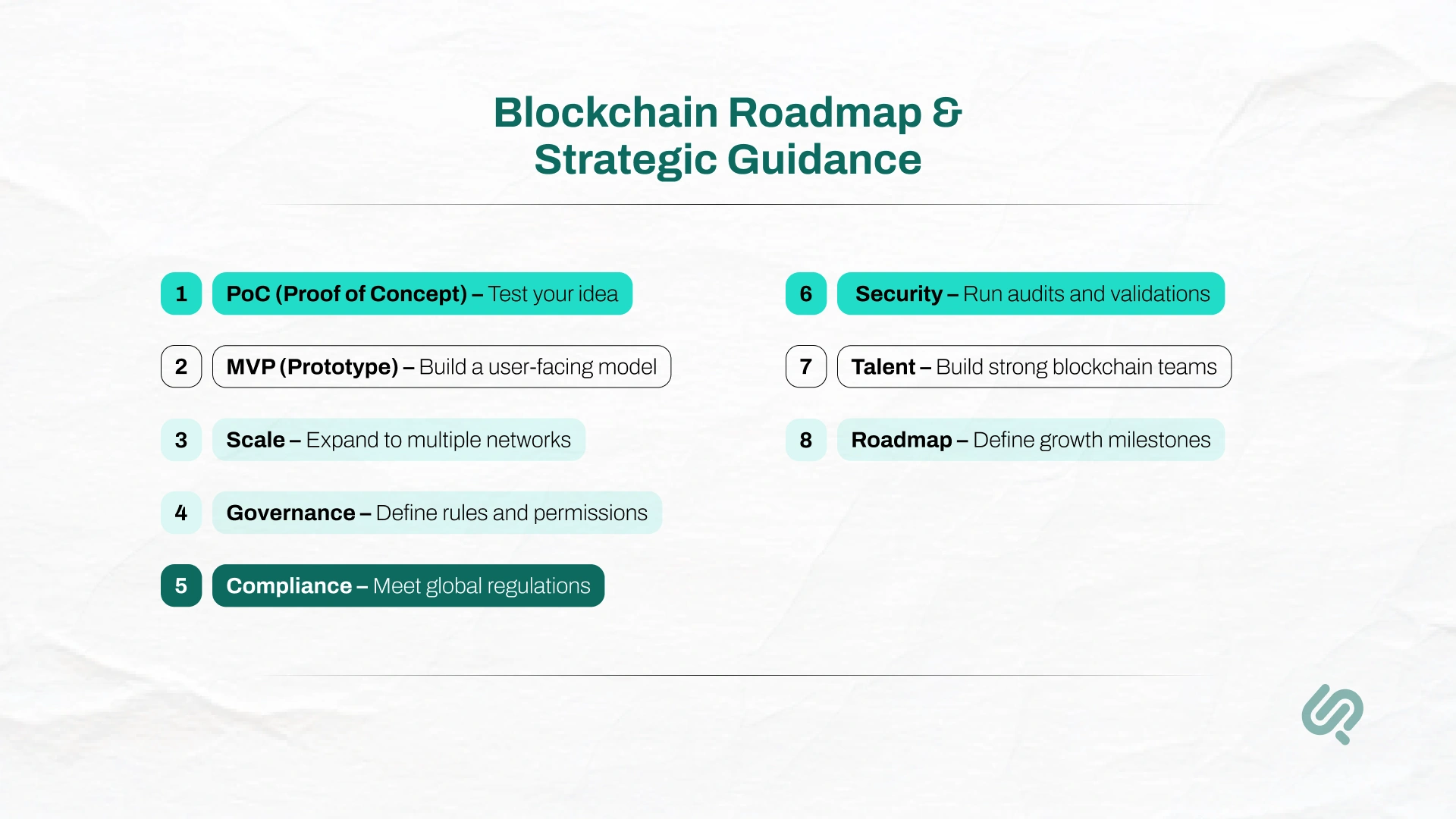
Building a blockchain solution isn’t just about coding smart contracts; it’s about following a clear roadmap from concept to enterprise-grade deployment.
Below is a practical blockchain development roadmap and consultancy guide that outlines each critical step, complete with real-world examples.
Start by testing your idea on a small scale. For instance, if your goal is to improve supply chain transparency, you could begin by tracking a single shipment (like a batch of coffee beans) on a blockchain ledger.
The objective is to prove faster traceability, reduced fraud, or better auditability before investing further resources.
Once your PoC works, build a prototype that users can actually interact with. Expand tracking from one product line to multiple suppliers and customers.
Add dashboards or smart contracts for automatic payments. For example, your MVP blockchain app could let suppliers upload delivery details and customers verify authenticity with a QR code, collecting real-time feedback on usability and ROI.
If the MVP performs well, it’s time to scale. Boost transaction throughput, run smart contract security audits, and integrate blockchain with your CRM or ERP systems.
For example, a logistics company could expand from tracking one product line to managing thousands of daily deliveries across multiple regions, turning a test pilot into a live business platform.
Selecting the right architecture is crucial for long-term success. Private blockchains like Hyperledger Fabric are ideal for internal data, while public or hybrid blockchains (e.g., Ethereum + private chain) provide transparency with control.
For instance, your system could log shipment data privately while publishing hash proofs on Ethereum for external verification.
Governance defines who can write, verify, or upgrade your blockchain. Set clear rules, e.g., suppliers get limited write access, customers get read-only.
At the same time, ensure compliance with privacy laws like GDPR by storing personal data off-chain and only keeping encrypted hashes or decentralized IDs on-chain.
Security should be embedded early. Schedule regular smart contract audits, establish multi-signature approvals, and plan responses for potential breaches.
For example, before approving supplier payments, your blockchain could require verification from both logistics and finance teams, minimizing single-point failure risks.
Blockchain success depends on skilled teams. Hire or upskill developers, smart contract auditors, and DevOps engineers.
If resources are limited, partner with a blockchain development services company or join ecosystems like Hyperledger.
For instance, collaborating with an external blockchain firm could help you optimize node performance and cloud integration faster.
Finally, outline key milestones: PoC validation, MVP launch, pilot expansion, audits, and full rollout. Assign accountable owners for each stage.
For example, your project might aim to cut shipment tracing time from five days to one minute. Regular reviews and success metrics will ensure every phase delivers measurable business value.
Of course, there are a few challenges/risks associated with blockchain development. Let’s take a look:
Rules around blockchain and crypto differ across countries, and they’re still evolving. Europe’s MiCA framework is bringing some clarity, but in other regions, regulations remain unclear.
Projects should stay updated and flexible, for example, pausing token launches or adjusting smart contract features if laws change.
Many blockchain apps are still too technical for everyday users. Managing wallets, private keys, and seed phrases can be confusing or risky.
To make onboarding easier, developers are adopting wallet-as-a-service tools or allowing social logins for account creation. The simpler the user experience, the faster mainstream adoption will follow.
Cross-chain bridge tools that connect different blockchains are frequent hacking targets. The safest approach is to use battle-tested frameworks like Chainlink’s CCIP and implement multi-signature approvals or time locks for transfers. Keeping minimal funds in a single bridge reduces risk if one is ever compromised.
Energy consumption remains a hot topic for blockchain’s reputation. Older proof-of-work (PoW) systems use significant power, while newer proof-of-stake (PoS) models, like Ethereum’s, have cut energy use by over 99%.
Companies can further improve sustainability by using renewable-powered data centers and publishing transparent carbon reports to align with ESG goals.
As quantum computing advances, today’s encryption methods could become vulnerable. Projects dealing with high-value data, such as CBDCs or long-term contracts, should start adopting quantum-resistant cryptography and upgradeable crypto libraries.
Keeping an eye on research ensures systems stay secure in a post-quantum world.
Skilled blockchain developers are in short supply. According to Stack Overflow, blockchain specialists earn among the highest tech salaries, showing strong demand.
To overcome this gap, organizations can train existing teams, recruit engineers from adjacent fields like cybersecurity, or rely on blockchain-as-a-service platforms that simplify deployment.

Let’s also look at the future of blockchain and see what emerging angles are most likely to transpire:
Future blockchains will connect the physical world, too.
DePIN projects let people share internet, energy, or GPU power and earn tokens. It’s like a crowd-powered network built by users, not corporations.
Soon, AI bots could run on blockchains, making decisions, signing contracts, or managing systems automatically.
Every move they make would be recorded on-chain, keeping their actions transparent and trustworthy.
DAOs' online communities run by code will become smarter.
They could manage real businesses, fund projects, or even self-upgrade. Decisions will happen democratically, through votes written into smart contracts.
With deepfakes rising, blockchain can prove what’s real.
Projects are already using on-chain records to verify the source of photos, videos, and art. This could become a global standard for fighting misinformation.
Blockchain will blend with other fields, tracking genes in biotech, owning land in the metaverse, or verifying carbon credits for sustainability.
Wherever trust and transparency matter, blockchain will be part of the solution.
The best blockchain development trends and success stories are no longer futuristic concepts. They’re transforming how businesses operate today.
From real-time supply chain visibility to secure healthcare data and digital asset tokenization, blockchain is proving its value across industries.
Scalability, interoperability, and sustainability are driving the next wave of innovation, while AI integration and DeFi are expanding what’s possible.
As regulations mature and enterprises adopt blockchain at scale, the technology is shifting from experimentation to essential infrastructure.
In short, the future of blockchain development is practical, data-driven, and here to stay.



Ameena is a content writer with a background in International Relations, blending academic insight with SEO-driven writing experience. She has written extensively in the academic space and contributed blog content for various platforms.
Her interests lie in human rights, conflict resolution, and emerging technologies in global policy. Outside of work, she enjoys reading fiction, exploring AI as a hobby, and learning how digital systems shape society.