

.webp)
.webp)




Building A1 DDP - Dubai Silicon Oasis
Industrial Area - 342001 -
Dubai - United Arab Emirates
+971 50 756 2346


SERVICES

COMPANY LINKS
SIGN-UP
For Newsletter


.webp)
An IoT network (Internet of Things network) is a foundational, interconnected system of smart devices, including sensors, machines, appliances, and gateways, that communicate, share data, and take automated actions over the internet.
These networks are the engine that connects the physical world to the digital world, enabling real-time monitoring and intelligent automation across virtually every industry.
By the end of 2024, there were 18.8 billion connected IoT devices worldwide, and this number is projected to rise to about 27 billion by the end of 2025. (1)
Keep reading to get complete guidance related to what an IoT network is, its architecture, types, and how it works.
An IoT network architecture acts like a blueprint that defines how devices, data, and applications interact to deliver smart outcomes.
Each layer has a clear purpose, from sensing the environment to analyzing and acting on the data
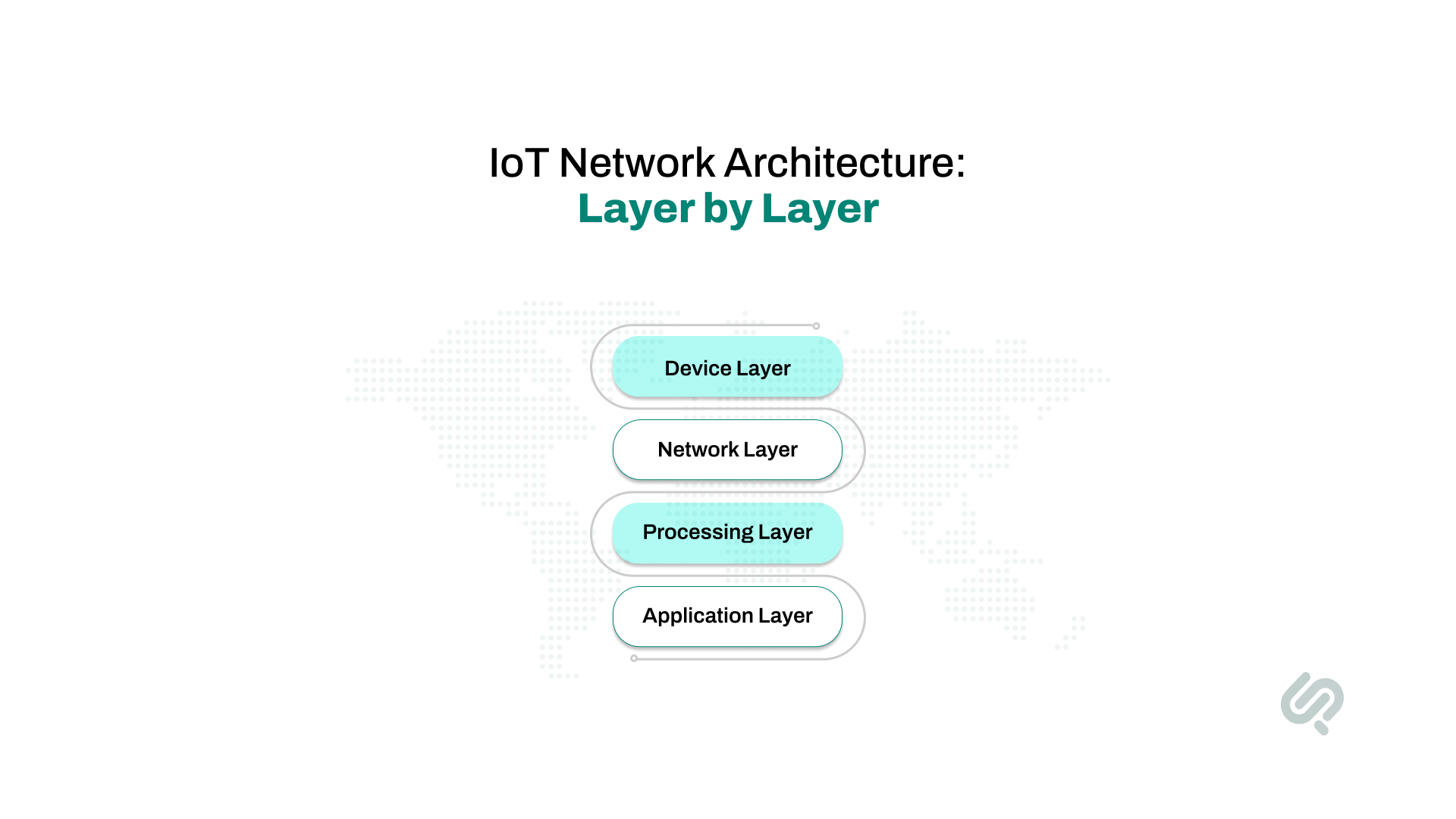
This is the foundation of an IoT system. It includes all the physical devices that collect information from the environment or take actions based on commands.
These can be sensors (like temperature, motion, or air quality) or actuators (like locks or motors). The data collected here is the starting point of the entire IoT process.
Devices in this layer are often placed in homes, factories, farms, or hospitals. They are usually small, power-efficient, and connect to the next layer via a local gateway or wireless link.
A forecast from International Data Corporation (IDC) estimates there will Core Components of an IoT Networke 41.6 billion IoT devices in 2025, generating around 79.4 zettabytes (ZB) of data. (2)
Key Points:
Example: A smart thermostat senses indoor temperature and sends the reading to the cloud, while also adjusting the heater as needed.
This layer is responsible for transmitting daIoT Network Architectureta from devices to cloud systems or other devices. It includes all the communication technologies like Wi-Fi, Bluetooth, Ethernet, 4G/5G, and LPWAN.
IoT gateways and routers also live here, managing the flow of information from the sensors to centralized servers. The network layer ensures smooth, secure, and efficient data flow.
It also supports IoT protocols like MQTT or CoAP, which help organize and move data between devices.
Key Points:
Example: A smart building sends energy usage data from all rooms to a central server over a Wi-Fi and Ethernet setup, coordinated by an IoT hub.
This is where raw data is filtered, processed, and organized before going to the cloud.
Also known as the middleware or edge layer, it reduces bandwidth use by processing data closer to where it’s collected.
It often includes edge servers, AI processors, and software that manage devices and apply business logic. This layer enables faster response times and better security. It also stores and aggregates data temporarily, filtering out noise and only sending what matters.
Key Points:
Example: In a factory, edge processors analyze vibration data on-site and shut down a machine instantly if it detects signs of failure, no cloud delay needed.
At the top is the application layer, where the real business value of IoT is unlocked. This layer includes cloud platforms, mobile apps, dashboards, and analytics tools.
Here, processed data is stored, visualized, and used to trigger actions or alerts. It connects to business tools like CRMs, ERPs, and decision-making systems.
It's where users and managers get meaningful insights from raw device data.
Key Points:
Example: an IoT Example may include a logistics company that monitors the real-time temperature of its cold storage trucks through a cloud dashboard that alerts them when it gets too warm.
Not all IoT networks are built the same way; they differ based on range, power use, and connectivity technology.
Each type serves specific use cases, from short-range smart home devices to large-scale industrial systems.

Cellular networks connect IoT devices using the same mobile infrastructure as phones. These are ideal when you need coverage across cities, highways, or large rural areas.
Modern standards like LTE-M and NB-IoT are tailored for IoT use; they offer low power consumption and reliable performance for connected devices.
Example: A fleet of delivery trucks uses 4G/5G to send real-time GPS, fuel, and temperature data to a central dashboard.
These networks connect devices within short distances, usually within a room, building, or campus. Wi-Fi offers high bandwidth, while Bluetooth/BLE is perfect for wearables and health gadgets.
Zigbee and Thread are common in smart homes, creating mesh networks for better coverage.
Example: A smart home hub connects to smart bulbs, thermostats, and door sensors using Zigbee and Wi-Fi.
LPWANs are built for low-data, long-range communication with extremely low power use. Devices can operate on a battery for 5–10 years.
These are best for scenarios where you only need to send small updates once or twice a day.
Example: A vineyard uses LoRaWAN sensors to monitor soil moisture and weather, optimizing irrigation and crop health.
In mesh networks, each device can relay data for others, creating a strong and flexible network. These are great for buildings where a direct connection to a central hub isn’t always possible. If one node goes offline, others reroute the data.
Example: A smart office has lighting, thermostats, and occupancy sensors connected through Zigbee mesh, reducing cabling and boosting reliability.
Wired networks offer the highest stability and security, often used in mission-critical environments.
Devices are physically connected via Ethernet cables, which can also carry power using PoE.
A forecast from International Data Corporation (IDC) estimates there will be 41.6 billion IoT devices in 2025, generating around 79.4 zettabytes (ZB) of data. (3)
Example: A factory uses Ethernet-connected robots and sensors to perform precise, real-time tasks with zero signal dropouts.
Satellite IoT is used when there's no cellular or terrestrial coverage, such as oceans, deserts, or mountain regions.
It sends small data packets from remote sensors directly to satellites, offering global reach.
Example: A wildlife conservation project uses satellite-connected GPS collars to track elephants across remote terrain.
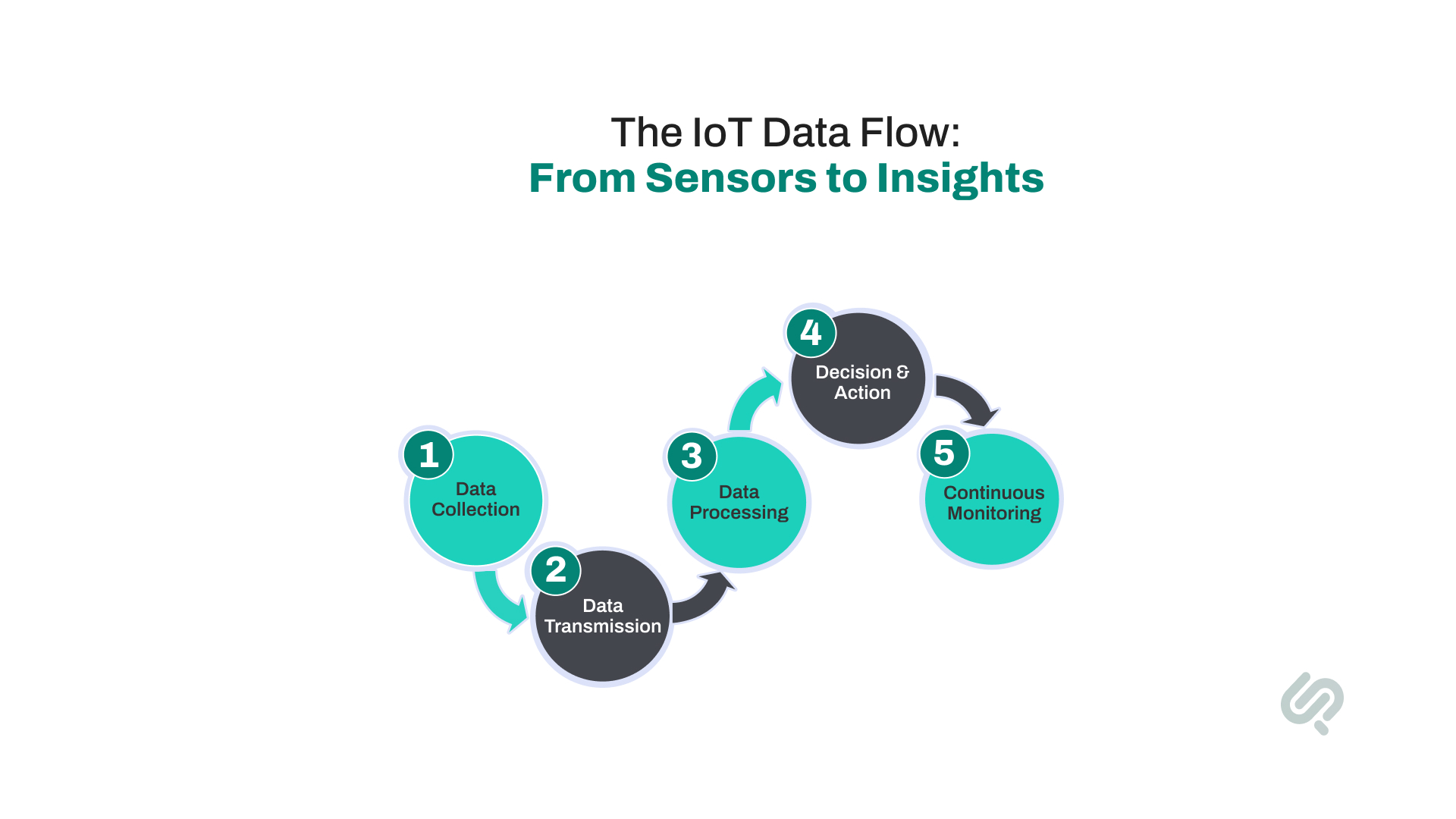
Let’s break down the data flow of an IoT network to see how information moves from devices to insights and back again.
Every IoT network starts at the device level, where sensors collect data from their surroundings. These devices might measure temperature, movement, light, heart rate, or location, depending on the use case.
This raw data reflects real-world activity and is often gathered continuously.
For example, a heart monitor might track pulse every second, or a motion sensor might detect when someone enters a room. This step brings physical information into the digital world, ready for action.
Once data is collected, it needs to be sent to a place where it can be processed. IoT devices utilize various types of networks to accomplish this, including Wi-Fi, Bluetooth, Zigbee, 4G/5G, and satellite connections.
Often, the data is first sent to a local gateway, which gathers information from multiple sensors and sends it to the cloud. In some cases, devices talk directly to cloud platforms.
The transmission process must strike a balance between speed, energy consumption, and reliability to ensure that the right data reaches its intended destination.
After reaching the cloud or an edge server, the data is processed. Sometimes it’s cleaned and stored; sometimes it’s immediately analyzed.
IoT systems might use simple rules (like flagging when a reading crosses a threshold) or advanced tools like AI and machine learning to spot patterns and predict problems.
For example, a factory might use vibration data to forecast when a machine needs maintenance. This is where raw information becomes something useful.
Based on the insights from data analysis, the system may act automatically or alert someone to take action.
This could mean sending a command back to a device (like turning off a machine), pushing a notification to a user, or adjusting a system’s settings.
For instance, a smart irrigation system might detect dry soil and activate sprinklers without human help. This is the step where the IoT platform turns digital insights into real-world impact.
IoT networks don’t stop after sending a command; they keep running 24/7. Systems monitor device performance, network health, data accuracy, and security.
If something goes wrong, like a sensor stops working or a network goes down the system can flag it for maintenance or automatically attempt to fix it.
Updates and security patches are often pushed remotely to keep everything safe and efficient. This step ensures the network stays reliable over time.
Connecting thousands of devices in an IoT system brings incredible power, but also significant risk. These devices often operate in less secure environments and can become entry points for cyberattacks.
That’s why it’s essential to build both strong securit IoT in Action Across Industries and smart management systems into any IoT network from day one. Here's how to do it right:
IoT security must begin at the device level. Many devices are basic, with weak or outdated protections. In f
Best practices include:
Example: A smart thermostat should only send temperature data, not access your HR system.
Don’t let IoT devices connect freely to your main IT systems. Instead, isolate them on separate network zones or VLANs.
Why this matters:
Example: Your smart vending machine should never be able to reach the finance server.
IoT networks handle a lot of sensitive data. From health stats to location tracking, all of it should be protected.
To protect this data:
Example: A fitness tracker should store and send health data in a secure, anonymized format.
Just like IT systems, IoT networks need constant monitoring. Since many devices have no user interface, problems can go unnoticed without automated tools.
How to stay on top:
Example: If a door sensor usually sends 1KB per day but suddenly sends 10MB, it could be compromised.
IoT devices often stay in the field for years. Managing them securely over time is just as important as the setup.
Key actions:
Example: Platforms like AWS IoT or Airtel IoT allow you to update thousands of sensors remotely and securely.
As your IoT project expands, your infrastructure must scale and connect with other business systems.
What to plan for:
Example: A logistics company may scale from 100 to 10,000 trackers—only a scalable platform can handle that jump.
Let’s look at some real-world IoT applications and examples that show how these networks are transforming daily life and business operations.
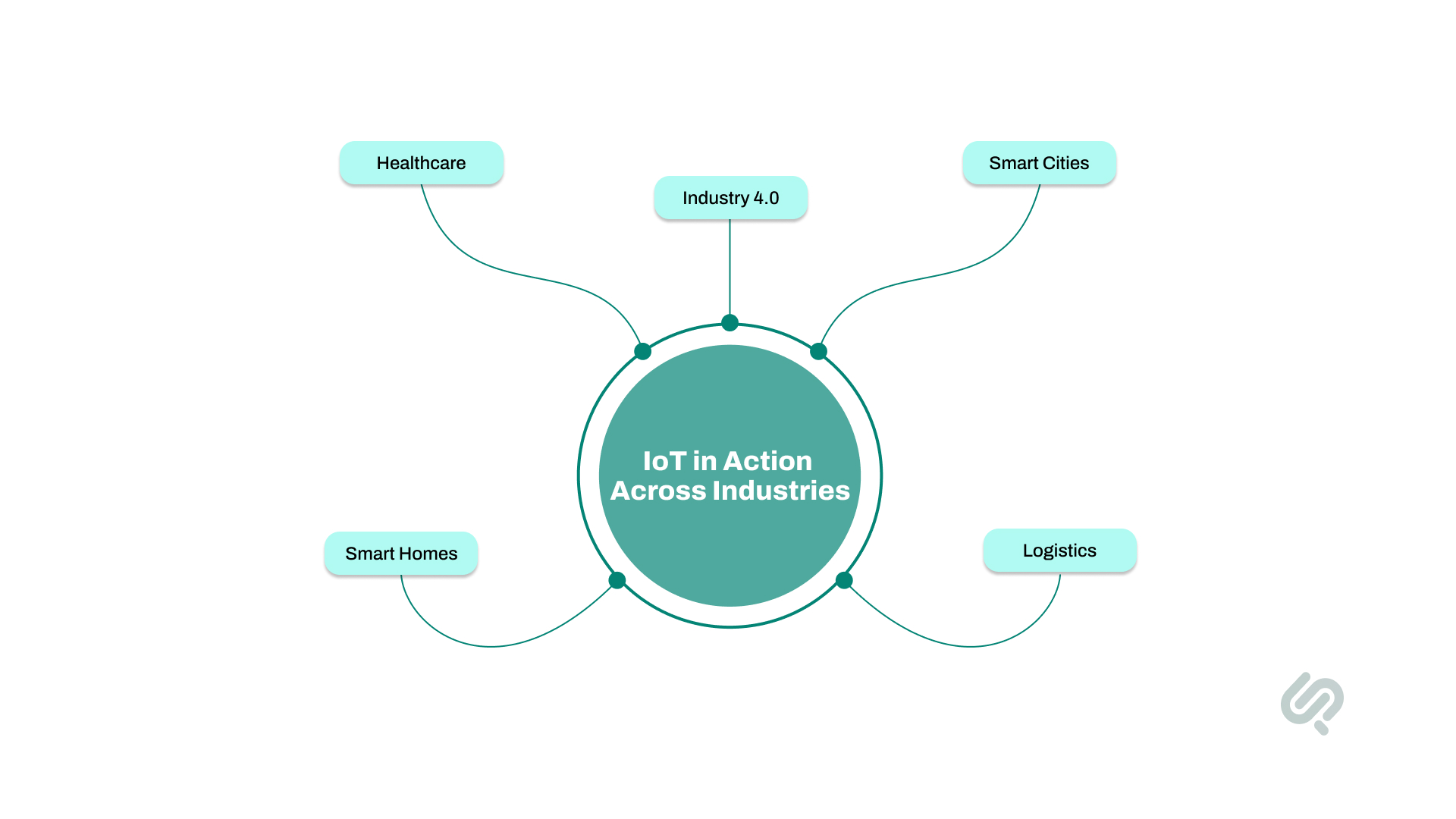
IoT networks are widely used in homes to connect devices like smart speakers, thermostats, lights, and cameras.
Example: Smart thermostats like Google Nest use IoT to learn routines and reduce heating bills by up to 12%. Smart cameras and door sensors alert homeowners instantly when unusual activity is detected.
Factories use IoT networks to monitor machines and improve operations; this is the backbone of Industry 4.0.
Sensors track things like vibration and temperature, sending real-time data to analytics platforms to predict maintenance needs and prevent downtime.
Example: Siemens cut machine downtime by 30% using predictive maintenance through IoT. Dow Chemical used wireless sensors to monitor pumps, saving millions in avoided failures.
Hospitals and clinics use IoT networks to track patient vitals, manage equipment, and deliver remote care.
Devices like glucose monitors or ECG patches can send real-time data to care teams, helping spot problems early and improve outcomes.
Example: Internet of Things healthcare may include cardiology practice reduced hospital readmissions for heart patients by 50% using IoT-connected home devices like smart scales and blood pressure monitors.
Cities use IoT to manage traffic, lighting, waste, and safety. Networks of sensors track everything from vehicle flow to pollution levels.
Smart streetlights save energy by adjusting based on motion or daylight. IoT helps reduce congestion, cut costs, and improve city services.
Example: Barcelona’s smart parking and lighting systems saved energy and reduced traffic. Pilot projects in cities like Las Vegas connect vehicles with traffic lights to improve road safety.
IoT company networks provide full visibility into where goods are, their condition, and how they’re moving.
Sensors monitor shipment temperature, GPS location, or shock exposure in real time, especially useful in food, pharma, and retail.
Example: Maersk uses IoT sensors in shipping containers to track refrigerated cargo globally. Amazon warehouses use IoT-powered robots and RFID systems to automate inventory handling.
IoT networks are also transforming:
IoT networks bring together connected devices and data systems to improve how businesses and individuals operate.
The core IoT network's meaning lies in enabling real-time insight, automation, and smarter decisions through continuous data exchange.
Some key benefits of IoT Networks are:
Example of an IoT Benefit: A logistics company uses IoT sensors and multi-network SIMs to track shipments worldwide, ensuring reliability even when one carrier’s signal fails.
While powerful, IoT networks also bring new complexities in connectivity, security, and scalability.
Some key challenges of IoT Benefits are:
Example of an IoT challenge: A smart factory using multiple IoT vendors struggled with inconsistent device communication until implementing segmentation and centralized monitoring to secure and unify the network.
As IoT adoption accelerates, the networks powering it are evolving just as fast.
Emerging technologies like 5G, edge computing, and AI-driven automation are reshaping how devices connect and communicate.

5G brings ultra-fast speeds and low latency, making advanced IoT use cases like smart cities, autonomous vehicles, and real-time remote control possible.
As 5G expands, expect even better energy efficiency and support for millions of devices. Looking ahead, 6G and satellite IoT will bring global coverage, even in remote areas.
More processing is shifting from the cloud to the edge, closer to where data is generated. This means faster responses and less data overload.
Devices like AI-enabled cameras and sensors can now make decisions locally, improving speed, saving bandwidth, and boosting privacy.
New standards like Matter (for smart homes) and oneM2M (for industrial IoT) are helping devices work together across brands and platforms.
This reduces compatibility issues, lowers vendor lock-in, and makes building IoT systems simpler and more flexible.
As networks grow, AI is being used to manage and monitor IoT traffic, predict problems, and even fix issues automatically.
AI also powers smarter analytics, helping businesses act on data before problems happen. This is often called AIoT (AI + IoT).
IoT security is becoming a priority. Expect stricter rules around device protection, encryption, and user privacy.
Zero-trust models and secure certifications will become common. People and businesses alike will demand proof that IoT devices are safe and private by design.
New network types like private 5G, mobile ad-hoc networks (for emergency or military use), and underwater IoT systems are emerging.
These expand where IoT can operate, whether in oceans, factories, or remote zones, with better control and performance.
The Internet of Things is no longer an emerging idea. It’s the foundation of a connected, data-driven world.
IoT networks power everything from smart homes to global industries, turning real-time data into insight and action. With billions of devices now online, businesses that embrace IoT gain faster decisions, predictive capabilities, and higher efficiency.
However, this growth also demands stronger security, reliable connectivity, and intelligent management to stay ahead of complexity.
As technology evolves, IoT networks will become more autonomous, edge-powered, and AI-driven, bridging every gap between the physical and digital world



Ameena is a content writer with a background in International Relations, blending academic insight with SEO-driven writing experience. She has written extensively in the academic space and contributed blog content for various platforms.
Her interests lie in human rights, conflict resolution, and emerging technologies in global policy. Outside of work, she enjoys reading fiction, exploring AI as a hobby, and learning how digital systems shape society.