

.webp)


.webp)


Building A1 DDP - Dubai Silicon Oasis
Industrial Area - 342001 -
Dubai - United Arab Emirates
+971 50 756 2346


SERVICES

COMPANY LINKS
SIGN-UP
For Newsletter


.webp)
The Internet of Things (IoT) connects billions of smart devices, everything from sensors and machines to cars and wearables. These devices constantly share data with the cloud, and that communication happens through specific IoT protocols.
Think of these protocols as “languages” that let devices talk to one another, deciding how data is sent, received, and understood.
For instance, Wi-Fi, Bluetooth, and cellular networks handle the physical connection, while MQTT, CoAP, and HTTP handle the exchange of data and commands.
Choosing the right protocol matters: low-power protocols like MQTT and CoAP work best for small, battery-based devices, while heavier ones like HTTP or AMQP suit complex systems or gateways.
In this guide, we’ll break down the main IoT protocol layers, understand the Internet of Things (IoT), explain key communication standards, and show how they come together to power real-world IoT solutions, supported by the latest stats and industry insights.
An IoT protocol is a set of communication rules that allows smart devices, like sensors, machines, and applications to share data with each other and with the cloud.
In simple terms, it’s the “language” that connected devices use to talk, understand, and work together securely.
These protocols make sure information is sent, received, and interpreted correctly, enabling smooth operation across the Internet of Things ecosystem.
There are dozens of IoT protocols, but most fall into three main layers:
In total, there are around 20–25 widely used IoT protocols, depending on how they’re categorized. Each one is chosen based on the project’s needs, like power use, range, data speed, and reliability.
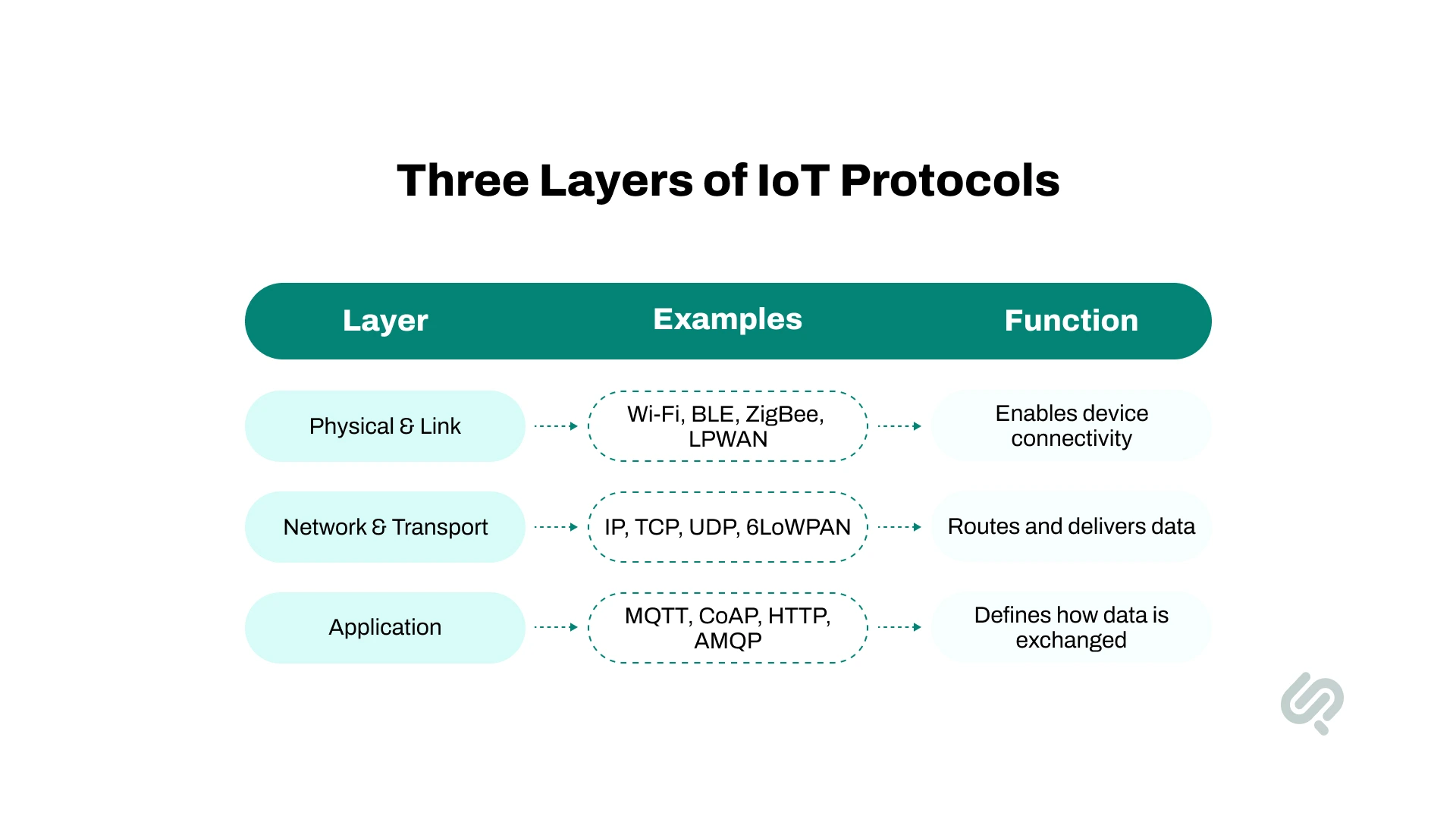
To understand how the Internet of Things (IoT) works, it helps to look at how devices communicate in layers.
Each layer handles a different part of the data journey, from collecting signals to sending information across networks and finally reaching apps and cloud systems.
This is where devices connect to the network. Technologies like Wi-Fi, Bluetooth, Zigbee, and LPWAN (Low-Power Wide-Area Networks) handle the actual data transmission through radio waves or wires.
These protocols focus on connectivity, range, and power efficiency, making them essential for sensors, wearables, and smart home devices.
Once a device is connected, it uses protocols like IP (Internet Protocol), TCP, or UDP to route and deliver data. 6LoWPAN is another lightweight option that helps low-power IoT devices use the internet efficiently.
Together, these protocols form the backbone of the IoT network, ensuring data moves reliably between devices and servers.
The number of connected IoT devices globally is forecast to reach around 39-40 billion by 2030, up from about 18.8 billion in 2024. (1)
At this top layer, protocols like MQTT, CoAP, HTTP, DDS, XMPP, and AMQP define how devices format, exchange, and process data.
This is what allows smart devices, whether in IoT healthcare, industrial systems, or smart homes, to “talk” to each other and to cloud platforms.
For example, an IoT platform may use Bluetooth to collect data, send it via IP, and share it through MQTT or HTTP to the cloud.
Successful IoT protocol implementation depends on choosing the right combination of layers for your use case.
With End-to-End IoT Platform Design, this process becomes more seamless, for example, a weather station might focus on low power and long range, while a hospital monitoring system needs faster, more secure connections.
Every IoT device needs a way to connect, whether through wires or wireless signals.
These connectivity protocols form the foundation of every IoT network, enabling devices to send and receive data efficiently.
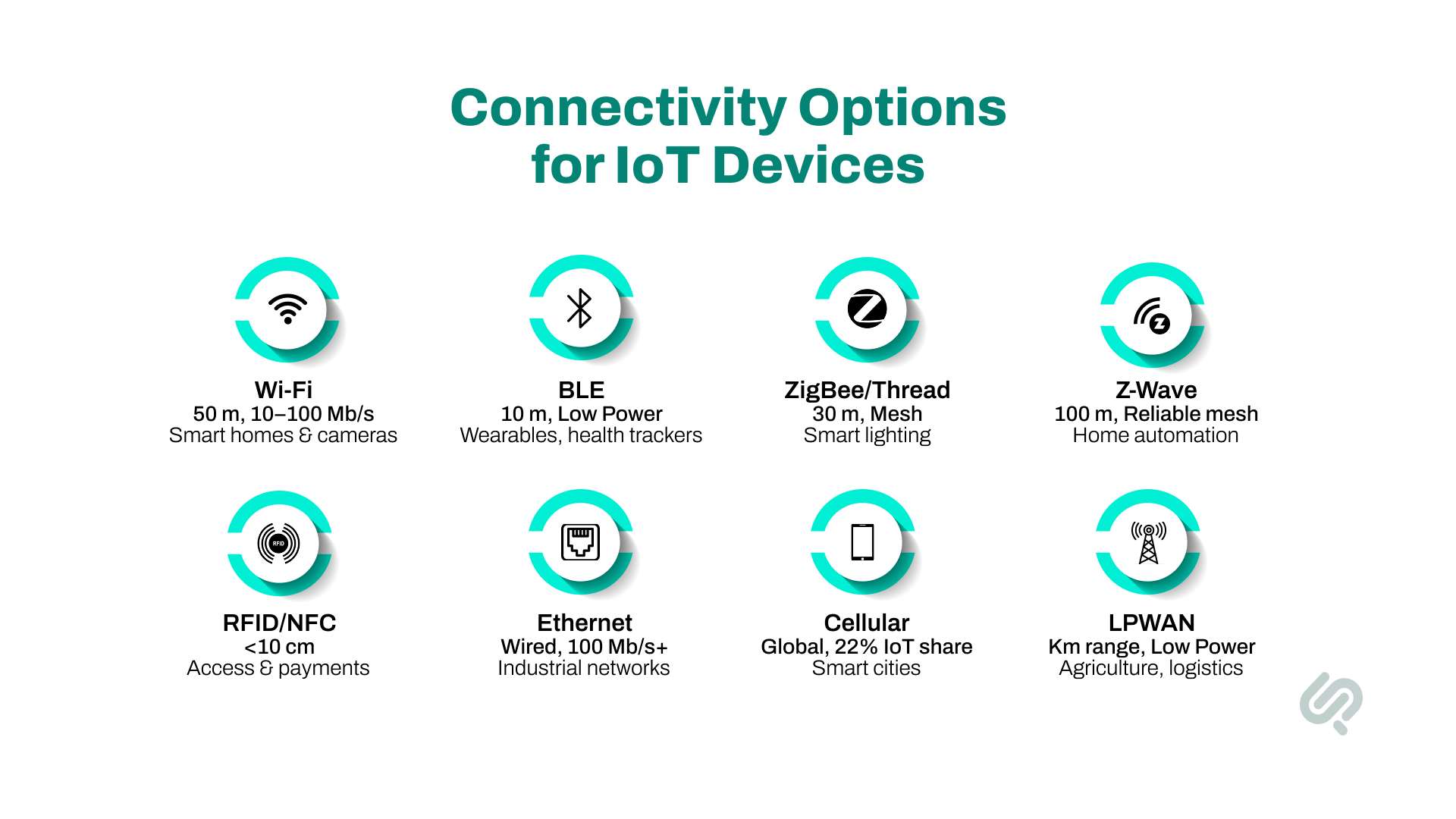
Wi-Fi is the most common IoT connectivity option, used in about one-third of all IoT devices. It delivers fast data transfer (10–100 Mb/s) over short distances (up to 50 m), making it perfect for smart homes, offices, and security cameras.
Example: A smart thermostat sending temperature updates to a mobile app via home Wi-Fi.
BLE offers short-range (around 10 m) connectivity with minimal power use, ideal for battery-powered IoT devices like fitness trackers, wireless earbuds, and medical wearables. It lets devices “sleep” between transmissions to save energy.
Example: A smartwatch syncing your heart rate data with your phone using BLE.
These standards support mesh networks of low-power devices that pass data from one node to another. ZigBee and Thread are built on IEEE 802.15.4 and commonly power smart lighting or home automation systems.
Example: Smart bulbs that automatically relay commands across rooms using a ZigBee network.
Z-Wave operates around 900 MHz and is designed for home automation. It’s known for reliability and strong interoperability; products from different brands can easily work together.
Example: A Z-Wave motion sensor triggering lights and alarms in a smart security setup.
These short-range technologies are mainly used for identification and contactless communication. RFID can track items from a few centimeters to several meters, while NFC works at a very close range.
Example: Contactless credit card payments or scanning an employee ID badge at the office entrance.
Wired protocols like Ethernet provide the most stable and high-speed connectivity (100 Mb/s or higher). They’re often used where reliability matters more than mobility — such as in factories, data centers, or smart buildings.
Example: Industrial machines in a manufacturing plant connected through Ethernet for real-time monitoring.
Cellular networks connect IoT devices across large areas.
Modern versions like NB-IoT and LTE-M are optimized for IoT, low power, low cost, and long range. Cellular connectivity makes up about 22% of global IoT connections. (2)
Example: Smart parking meters in a city sending data to the cloud using NB-IoT.
These are long-range, low-power networks designed for IoT devices that send small amounts of data over large distances. They’re perfect for remote or rural deployments.
Example: LoRaWAN-enabled soil sensors in farms sending moisture data several kilometers away to a central dashboard.
At the heart of every IoT network are the protocols that move data safely and efficiently between connected devices.
These IoT network protocols form the bridge between the physical world (sensors, devices) and the cloud, ensuring smooth and secure data communication.
IP is the foundation of all IoT data protocols, responsible for routing packets across networks. Most modern IoT systems use IPv6, which offers more addresses for billions of devices.
Through 6LoWPAN, even low-power IoT devices can use IP to connect with the wider internet, a key step in successful IoT protocol integration across devices and platforms.
Example: Smart streetlights in a city network use IP to transmit energy usage data to a central dashboard.
6LoWPAN compresses large IPv6 packets to work efficiently over low-power networks like ZigBee.
It allows even tiny sensors to send and receive information using standard internet routing, helping achieve scalable IoT solutions for smart cities, agriculture, and healthcare.
Example: Air-quality sensors use 6LoWPAN to share pollution data without draining battery life.
TCP is a reliable, connection-oriented IoT transport layer protocol. It ensures that data packets arrive in the correct order without loss, perfect for systems where accuracy matters more than speed.
However, it consumes more power, so it’s best for devices with stable connectivity and enough resources.
Example: Industrial IoT systems that transfer firmware updates over TCP to ensure data integrity.
UDP is lightweight and faster because it doesn’t check every packet for delivery. It’s ideal for applications where speed is more important than guaranteed delivery, such as real-time communication or sensor updates. Many IoT data protocols, including CoAP and MQTT-SN, run on UDP.
Example: A fleet of delivery drones sending frequent location pings over UDP to reduce delay.
CoAP is designed specifically for constrained devices, sensors, or controllers with limited power and memory. It works like a simplified version of HTTP, using UDP instead of TCP for faster communication.
CoAP supports secure data exchange through DTLS and is widely used in Internet of Medical Things (IoMT) and smart agriculture devices.
Example: A hospital’s temperature sensors use CoAP to monitor storage conditions for vaccines.
MQTT is one of the most popular IoT communication protocols. It uses a publish/subscribe model where devices (publishers) send data to a broker, and other devices (subscribers) receive updates.
Lightweight and reliable, MQTT performs well even on slow or unstable networks, a proven protocol implementation success in both consumer and industrial IoT.
Example: Leading IoT Providers use smart meters powered by MQTT to send electricity readings to utility companies in real time, enabling faster billing, accurate monitoring, and improved energy efficiency..
While not optimized for small IoT devices, HTTP is still used for IoT platform integration, especially when connecting devices to cloud dashboards or APIs.
It’s common for gateways or enterprise systems that need compatibility with web standards.
Example: A factory gateway collects sensor data via MQTT but uploads it to a web portal using HTTPS.
AMQP is an enterprise-grade messaging protocol that guarantees reliable message delivery. It’s heavier than MQTT or CoAP, so it’s mostly used on servers or cloud applications where resource limits aren’t an issue.
Example: An IoT logistics platform using AMQP to manage high-volume message traffic between warehouses and central systems.
DDS is a real-time, high-performance publish/subscribe IoT protocol used in industries like aerospace and defense. It handles large data volumes with precise control and supports fine-grained Quality of Service (QoS).
Example: Autonomous vehicles sharing sensor and radar data instantly using DDS for split-second decision-making.
At the application layer of the IoT protocols list, devices handle how data is structured, shared, and managed.
These IoT data protocols make sure every sensor, app, or gateway can exchange and interpret information smoothly across different systems.
An XML-based messaging standard first built for chat, now used in IoT Connectivity Network setups requiring real-time IoT protocol communication.
XMPP supports structured data exchange and “presence” — knowing whether a device is online or offline.
A smart home hub uses XMPP to check if connected lights or sensors are active.
As part of modern IoT protocols layers, XMPP ensures secure communication via TLS encryption, though it’s more complex for smaller devices.
A lightweight version of MQTT designed for ultra-low-power or memory-limited devices.
Uses UDP instead of TCP to reduce energy and bandwidth consumption.
Ideal for sensor data communication protocols in IoT, such as remote environmental monitors.
Soil moisture sensors in agriculture send readings to a central MQTT-SN broker.
MQTT-SN simplifies IoT protocol implementation for constrained devices and enhances protocol adoption success in low-power networks.
These define how information is packaged and exchanged between devices at the application layer.
An IoT example can be a weather station that uses CBOR to send temperature and humidity data to a mobile app.
Choosing the right format is essential for smooth IoT protocol integration across diverse devices.

A global IoT device management protocol standardized by the Open Mobile Alliance (OMA).
Operates over CoAP/UDP to enable remote configuration, firmware updates, and monitoring of connected devices.
Widely adopted in smart city and industrial IoT environments.
A utility company uses LwM2M to update thousands of smart meters over the air.
LwM2M simplifies managing large device fleets, ensuring protocol adoption success and long-term scalability for IoT standards compliance.

Used by manufacturers for remote setup and diagnostics.
Common in industrial IoT, providing standardized data exchange between machines.
Many vendors use secure MQTT or HTTPS-based management systems.
A factory dashboard uses OPC-UA over MQTT to track machine performance in real time.
Stick to recognized IoT standards like LwM2M or secure MQTT APIs for reliable IoT protocol implementation guidance and future-proofing.
For the Internet of Things (IoT) to work seamlessly, devices from different brands need a common language. IoT standards define how data is shared, transmitted, and understood, ensuring compatibility and smooth communication.
A single IoT system may use multiple protocols, for example, a thermostat using Bluetooth for setup, MQTT for data sharing, and HTTP for cloud sync.
Gateways act as translators, converting signals so devices can communicate effortlessly — this highlights the classification of IoT protocols, which is often visualized through an IoT protocols diagram.
Such setups are common examples of Iot, showing how diverse communication standards work together within one connected ecosystem.
Adhering to standards ensures secure, scalable, and future-proof IoT solutions where devices work together, reliably and efficiently.
In short, IoT interoperability is the backbone of connected technology. Whether it’s a smart home, a city-wide sensor grid, or industrial automation, aligning with global IoT standards ensures devices stay compatible, secure, and efficient — now and in the future.
Picking the right IoT protocols can make or break your project. Each protocol has its strengths; some save battery life, others deliver higher data speeds or better reliability. Below are practical ways to choose wisely, supported by insights from an IoT Impact Case Study showcasing real-world results.
Different devices and environments demand different IoT network protocols:
Example:
A smart farm uses LPWAN sensors with CoAP to report soil moisture once per hour, while a remote surveillance system uses 5G and HTTP to stream live footage continuously.
💡 Tip: Always balance range, power use, and data volume when selecting from the IoT protocols list.
Example:
A smart hospital system may use MQTT/TCP for patient monitoring (to avoid data loss), while a wildlife tracking sensor uses UDP to conserve energy.
Every IoT data protocol must ensure secure data exchange:
Example:
A connected insulin pump uses CoAP over DTLS for secure patient data transmission — balancing safety with low-power operation.
💡 Best practice: Security adds overhead, so plan for it early to avoid performance bottlenecks later.
Managing thousands of devices can get complex. Using standardized IoT device management protocols like LwM2M makes large-scale operations easier.
Example:
A utility company uses LwM2M to remotely update firmware on thousands of smart meters without visiting each location.
Many businesses rely on IoT platforms like Azure IoT Hub, IBM Watson IoT, or ThingsBoard to handle multi-protocol integration.
Example:
A logistics company uses an IoT gateway that receives data from BLE trackers and forwards it to a cloud dashboard using MQTT.
💡 Best practice: Choose well-supported standards to avoid vendor lock-in and simplify scaling.
User forums like Reddit and Stack Overflow reveal practical experiences:
Example:
Home automation users often add ZigBee repeaters to extend signal coverage, a small tweak that dramatically improves performance.
It is forecast that by 2030, the IoT market will reach US$2 trillion in revenue, showing the scale of growth across devices, connectivity, and application (3)
The IoT ecosystem evolves quickly. To stay ahead:
Example:
A manufacturing plant adopting MQTT today can easily upgrade to DDS or 5G-based systems later, thanks to a layered, interoperable design.
Every connected device in the IoT world depends on one thing — the right communication protocol.
Choosing the right mix of MQTT, CoAP, HTTP, or LPWAN standards isn’t just a technical choice. It’s the difference between a system that scales smoothly and one that fails under pressure.
Whether you’re building smart homes, managing industrial sensors, or creating city-wide networks, your success depends on how efficiently these protocols connect data to decisions.
By following global standards, securing each layer, and matching the right protocol to your use case, you can future-proof your IoT ecosystem for speed, security, and scalability.



Ameena is a content writer with a background in International Relations, blending academic insight with SEO-driven writing experience. She has written extensively in the academic space and contributed blog content for various platforms.
Her interests lie in human rights, conflict resolution, and emerging technologies in global policy. Outside of work, she enjoys reading fiction, exploring AI as a hobby, and learning how digital systems shape society.