







Building A1 DDP - Dubai Silicon Oasis
Industrial Area - 342001 -
Dubai - United Arab Emirates
+971 50 756 2346


SERVICES

COMPANY LINKS
SIGN-UP
For Newsletter



You’re probably here because you’ve been hearing about prompt engineers everywhere (and wondering if the salaries really live up to the hype).
The truth is, they do!
With generative AI tools like ChatGPT and Claude transforming industries, companies need experts who know how to shape AI responses through effective prompts.
That’s where prompt engineers come in, and why demand has spiked.
This role isn’t just popular, it’s profitable.
Current prompt engineer salary trends show earnings starting high and climbing quickly, with total packages often beating those of senior software engineers or data scientists.
In this guide, we’ll break down averages, industries, and career levels so you know exactly what to expect.
A prompt engineer is someone who designs and refines the instructions or prompts given to artificial intelligence models so they produce useful, accurate, and safe results.
In simple terms, they act as translators between humans and AI, turning business goals or creative ideas into carefully crafted inputs that guide large language models (LLMs) like ChatGPT or Claude.
The core responsibilities of a prompt engineer include:
Prompt engineering has quickly positioned itself as one of the most well-compensated careers in AI worldwide.
The combination of high demand, limited talent, and the critical role prompt engineers play in guiding large language models (LLMs) has pushed salaries well above traditional tech benchmarks.
Across global markets, average base salaries show a consistent trend: prompt engineers earn significantly more than the median tech worker. According to multiple reports:
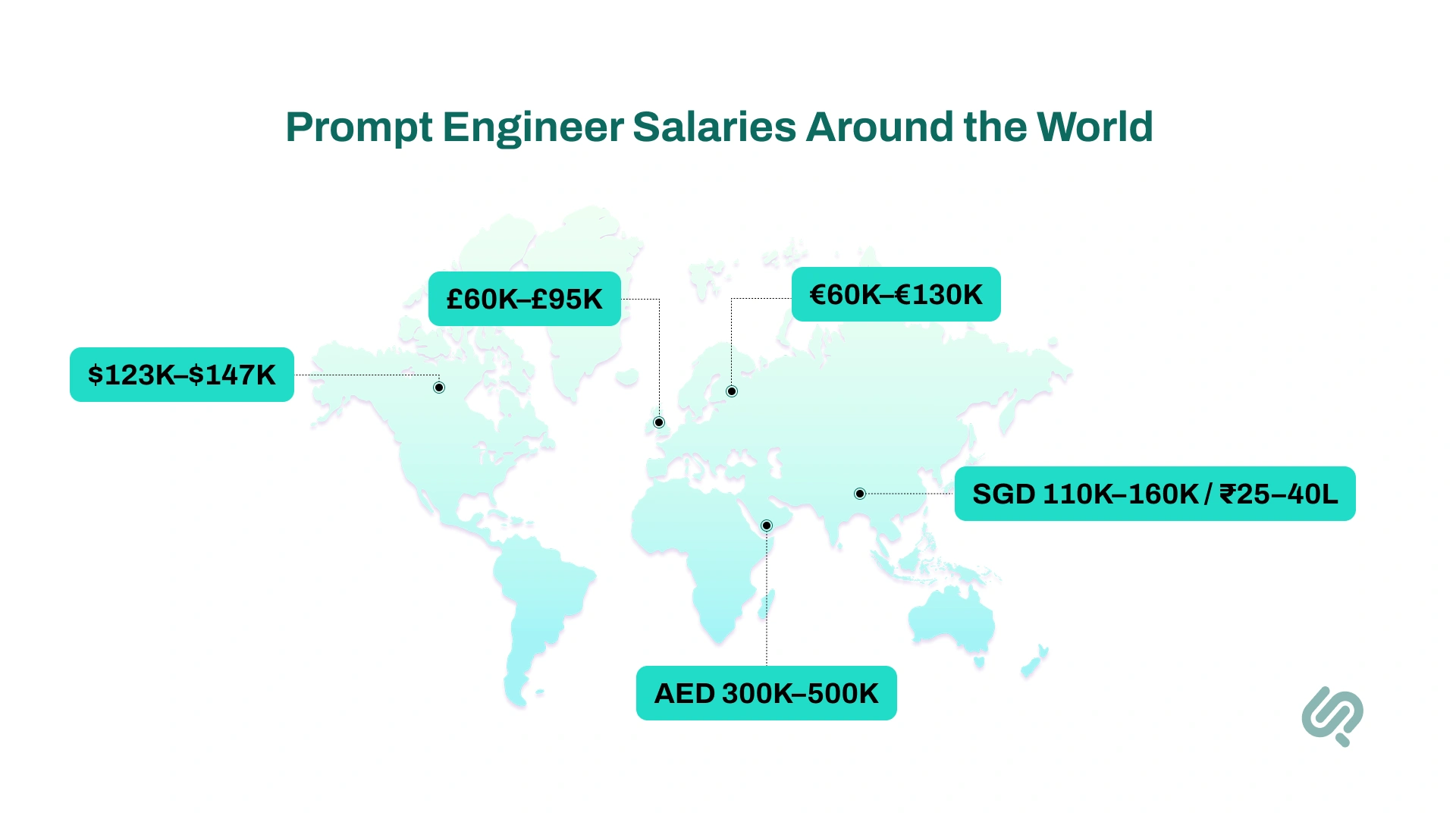
Beyond base pay, total compensation packages are what truly set this role apart. Bonuses, stock options, and equity can add 25–45% more to overall earnings.
At global AI firms and top startups, total packages of $300K–$500K+ are not uncommon.
Compared to national salary medians, prompt engineers often earn 2–3x more, making this one of the most lucrative global career paths in AI. The consistency across continents shows that prompt engineering isn’t just a U.S. trend, it’s a worldwide phenomenon.
Like most technical careers, experience is one of the biggest factors in determining prompt engineer salaries.
However, unlike traditional tech roles, the pay curve in prompt engineering is much steeper, reflecting both the novelty of the field and the scarcity of talent.

Even newcomers in prompt engineering start strong. Entry roles often pay between $90,000–$130,000 annually, with some reports citing averages closer to $140K in competitive markets.
Early-career responsibilities include testing and refining prompts, building reusable libraries, supporting data analysis, and learning under senior engineers.
The fact that entry-level professionals can earn nearly double the median tech salary highlights the demand for this role.
By mid-career, salaries jump significantly, averaging $140,000–$175,000. Mid-level prompt engineers typically run projects independently, design full prompt lifecycles, and begin mentoring junior teammates.
At this stage, they shift from task execution to driving measurable outcomesoptimizing AI systems for efficiency, accuracy, and business alignment.
Seasoned AI prompt engineers command some of the highest salaries in AI, often $200,000–$270,000+, with total compensation packages easily crossing $300K at top firms.
Senior responsibilities expand to setting AI strategy, architecting scalable prompt systems, leading cross-functional teams, and ensuring AI ethics and compliance (4)
At this stage, prompt engineers are not just writing promptsthey’re shaping how entire organizations adopt and scale AI.

While prompt engineer salaries are consistently high across the board, compensation often depends on the industry.
Sectors that rely heavily on accuracy, compliance, or innovation tend to offer the most competitive packages.
The highest-paying opportunities for prompt engineers are found in Big Tech companies (like Google, OpenAI, or Anthropic) and fast-growing AI startups.
Salaries here can range from $180,000–$270,000+, often paired with equity, stock options, and bonuses. Engineers in these firms work on cutting-edge generative AI applications that shape the future of the industry (5)
Banks, hedge funds, and fintech firms are leading adopters of prompt engineering tools for risk assessment, fraud detection, and algorithmic trading. Salaries in this sector usually range from $150,000–$220,000, with higher pay for roles tied to regulatory compliance and mission-critical AI systems.
In healthcare, LLM prompt engineering is used to power medical research, patient data analysis, and compliance-heavy workflows. Prompt engineers here typically earn $140,000–$200,000, reflecting the importance of ensuring accurate, safe, and ethical AI outputs in such a sensitive field.
Retail and e-commerce platforms rely on prompt design for personalized shopping, automated customer service, and supply chain optimization. Salaries here often fall between $120,000–$180,000, making this an attractive sector for prompt engineers focused on customer-facing solutions.
Consultancies and law firms are hiring prompt optimization consultants to help clients adopt AI responsibly. Pay in these roles ranges from $110,000–$160,000, with responsibilities centered on compliance, strategy, and safe AI integration into workflows.

Prompt engineering is still an emerging field, but it overlaps with several established AI and tech roles.
Understanding how salaries compare helps both job seekers and employers see where this role stands in the broader AI job market.
AI/ML engineers focus heavily on technical coding, model training, and deployment. They write algorithms, build pipelines, and ensure machine learning systems work at scale.
In contrast, prompt engineers are more concerned with guiding AI behavior through language, optimizing instructions so that large language models (LLMs) generate accurate and safe outputs.
Overlap exists in areas like AI model knowledge, Python proficiency, and system optimization, but the focus is different: engineers code, while prompt engineers design natural language “interfaces” for those systems.
Data scientists specialize in statistics, data analysis, and predictive modeling. Their value comes from interpreting massive datasets and turning them into insights or forecasts.
Prompt engineers, by comparison, fine-tune human–AI interactions by crafting precise prompts.
Key overlaps include analytical thinking, AI literacy, and problem-solving, but their focus diverges: data scientists ensure statistical accuracy, while prompt engineers ensure linguistic precision and output reliability.
NLP engineers are deeply technical, responsible for building and training natural language processing models from scratch.
Prompt engineers don’t build models. They guide them with structured prompts to achieve the desired results.
Both roles share knowledge of linguistics, semantics, and AI models, but the difference lies in execution: NLP engineers build the systems, prompt engineers make those systems usable.

The most valuable professionals in AI today are those who combine prompt engineering with ML, NLP, or data science skills. These hybrid specialists don’t just craft prompts they analyze model behavior, apply advanced prompt engineering techniques, and understand the technical side of LLM prompt engineering.
Because this mix is rare, employers are eager to hire prompt engineers with such versatility. Many move beyond the prompt engineer average salary, commanding $250K–$350K+ in global tech firms or working as prompt optimization consultants.
Even prompt engineer salary remote roles remain highly competitive, with top offers rivaling or exceeding in-office pay. Simply put, mastering prompt hierarchy, prompt design, and prompt engineering tools alongside ML/NLP makes you stand out and get paid accordingly.
The career outlook for prompt engineers is exceptionally strong. AI roles overall are expected to grow by 15% or more through 2030 (BLS), far outpacing most industries.
Within this surge, prompt engineering is projected to grow even faster due to the limited supply of skilled professionals and the rising importance of AI in everyday business operations.
Between 2025 and 2030, salaries are expected to climb steadily, with senior-level prompt engineers at leading companies commanding $300,000–$400,000+ total packages.
As AI becomes more deeply embedded in finance, healthcare, retail, and creative industries, the demand for professionals who can “speak the language of AI” will only accelerate.
Importantly, the role is evolving. What started as a niche specialty is quickly becoming a core skill across industries. Much like Excel or SQL became standard business tools, prompting skills will be expected of many professionals.
The good news is that prompt engineer salaries are already high. The better news? You can grow them even further by being intentional with your skills and career strategy.
Prompt engineering has quickly evolved from a niche skill into one of the most lucrative and future-proof careers in AI.
Salaries already outpace many established tech roles, and total compensation can rival executive-level packages. The field rewards not just technical expertise but also creativity, linguistic precision, and strategic thinking.
With AI adoption accelerating across industries, prompt engineering is shifting from a specialized role to a core business skill (similar to how Excel or SQL once became standard).
For professionals looking to maximize earnings and career security, now is the best time to build prompting expertise, develop hybrid skills, and position yourself at the intersection of language and AI.


1. https://www.glassdoor.com/Salaries/prompt-engineer-salary-SRCH_KO0%2C15.htm
2. https://itbrief.co.uk/story/uk-demand-surges-for-ai-prompt-engineers-as-salaries-climb
3. https://www.erieri.com/salary/job/prompt-engineer/singapore
4. https://www.refontelearning.com/salary-guide/prompt-engineering-salary-guide-2025
5. https://blog.promptlayer.com/ai-prompt-engineering-jobs-in-2025-skills-salaries-future-outlook/

Ameena is a content writer with a background in International Relations, blending academic insight with SEO-driven writing experience. She has written extensively in the academic space and contributed blog content for various platforms.
Her interests lie in human rights, conflict resolution, and emerging technologies in global policy. Outside of work, she enjoys reading fiction, exploring AI as a hobby, and learning how digital systems shape society.