








Building A1 DDP - Dubai Silicon Oasis
Industrial Area - 342001 -
Dubai - United Arab Emirates
+971 50 756 2346


SERVICES

COMPANY LINKS
SIGN-UP
For Newsletter



The finance industry is a high-stakes arena where every second and data point can mean the difference between profit and loss.
In markets moving at machine speed, staying ahead demands more than intuition it requires innovation.
Enter machine learning in finance - a technology that’s no longer just hype but a proven game-changer.
Over 72% of financial services firms already use ML for fraud detection, credit scoring, algorithmic trading, and personalized wealth management. (1)
But here’s the challenge: ML’s “black box” nature can feel risky in an industry built on precision and transparency. That’s why this guide goes beyond the buzzwords.
We’ll break down real-world use cases, compare ML to traditional methods, and tackle its risks and limitations so you can decide exactly where it fits into your financial strategy.
By the end of this guide, you’ll know:
At its core, machine learning (ML) is about enabling computers to learn from data and make decisions without being explicitly programmed for every step.
In finance, it’s a game-changer, helping institutions like banks, investment firms, and insurers process massive amounts of data to uncover patterns, predict outcomes, and make smarter decisions.
Here’s how ML works and why it matters in finance:
Techniques include:
Let’s also look at why machine learning is booming in finance:
And finally, some real world applications include fraud detection, credit scoring, algorithmic trading, personalized wealth management, and more.
While ML is a subset of AI, the terms are often used interchangeably in finance because most “AI” systems rely on ML. Its ability to process and learn from vast data sets is transforming the industry, making it indispensable for staying competitive.
It’s no secret that the finance industry is racing toward new technology.
They’re trying to:
And AI and data science are helping them do it.
Here’s the big picture: experts predict that the value of artificial intelligence in finance will keep growing fast through the 2020s. That’s because the financial industry has realized AI isn’t just a buzzword; it’s a powerful way to handle huge amounts of information and make smarter choices.
One big reason for this shift is widespread adoption.
A few years ago, AI was mostly used in special projects. Now, it’s becoming a normal part of running a financial business.
And the growth keeps getting faster.
Nobody wants to fall behind.
Another big reason is data. Lots of data.
Every second, the finance world produces massive amounts of information. There’s market data, transaction data, customer records, and more.
Traditional ways of analyzing this data can’t keep up. But machine learning algorithms love big data. They can identify patterns and spot risks or opportunities much faster than people can.
Firms that use ML have a real competitive advantage. They’re able to see market trends, predict changes, and protect themselves better than those still relying only on manual analysis.
And let’s talk about money. Machine learning tools are saving financial companies serious cash. Some AI systems can handle tasks up to 90% faster than older methods.
Even today, AI is helping financial businesses lower costs by about 22% to 25% on average. (3)
Beyond cost savings, machine learning is also helping financial firms make better decisions. Finance is all about balancing risk and reward. AI systems can analyze way more variables than a human analyst, which is crucial for things like
For example, in investment management, ML can help decide which stocks to buy or sell and when to act. Some systems react in split seconds to changes in the financial markets, something no human could do on their own.
But it’s not just the companies that want AI. Customers do, too.
People are used to apps like Amazon and Google, which feel smart and personalized. They expect the same from their bank or insurance app. So, financial institutions are feeling pressure to deliver faster, smarter, and more customized services.
That’s why FinTech startups using AI have become so popular. They’re offering services that feel personal and high-tech. To compete, bigger banks and financial companies are adopting AI so they don’t lose customers. For them, AI isn’t just a cool tool; it’s a way to keep their business strong and competitive.
The finance industry has always been about numbers and patterns. Now, with AI and machine learning, it’s about seeing those patterns clearly, faster, and smarter than ever before.

Machine learning in finance isn’t just a fancy term; it’s solving real problems every day.
From Wall Street trading desks to your mobile banking app, financial institutions are using artificial intelligence and data science to work smarter, faster, and safer.
Here’s why: machine learning can identify patterns, predict risks, and handle massive amounts of data quicker than any team of humans could.
Below is a quick look at the biggest ways machine learning is transforming the finance industry. Each of these use cases will be covered in more detail next.
Let’s dive into each of these in detail so you can see how machine learning techniques are reshaping the financial world.
One of the most talked-about ways machine learning in finance is changing the game is through algorithmic trading.
This means using computers to make trading decisions in markets like stocks, bonds, commodities, or currencies. Instead of human traders sitting at desks deciding when to buy or sell, smart algorithms analyze huge amounts of market data and make split-second moves.
Here’s how it works:
Machine learning models, sometimes even deep learning networks, can sift through tons of price data, trading volumes, and news.
They look for tiny patterns that humans might never notice. For example, a model might learn that when certain signals appear together, a stock price usually jumps. These hidden clues help traders spot good moments to act.
Unlike humans, computers don’t get tired. ML systems can trade 24/7, reacting in milliseconds to changes in the financial markets. That’s why so much trading is now run by machines.
Back in 2018, between 60–73% of all U.S. equity trading volume was driven by algorithmic trading systems, and that number has likely grown even more. In currency markets, over 90% of trades happen through automated systems.
Humans sometimes let fear or excitement guide trading decisions. Machines don’t. A machine learning model trades based on data and logic, not feelings. So, it won’t panic sell during a sudden drop or hold on too long out of greed. This can help keep trading strategies steady and reliable.
Big hedge funds and banks use machine learning for all sorts of tasks, like:
Some firms even use reinforcement learning, a type of ML where the computer learns the best trading moves by trying different actions and seeing what brings the most profit over time.
JPMorgan’s LOXM trading algorithm and systems at Goldman Sachs are well-known examples of ML in action. These models digest tons of data: market prices, news reports, and even unusual data sources like satellite images or social media trends, to decide how and when to trade.
The goal? Faster, smarter decisions and higher returns.
Using machine learning algorithms in trading gives financial firms a real competitive advantage. They can move quicker than competitors, manage risk better, and potentially earn more profit.
But it’s not foolproof. There’s a danger called overfitting, where a model learns patterns that only worked in the past but won’t hold up in future markets. A model might look perfect in backtests yet fail badly in real life if it learned random noise instead of true signals.
Algorithmic trading shows how artificial intelligence and data science are reshaping the financial services industry. It’s fast, data-driven, and continually getting smarter.

For decades, investment management was mostly about humans. Financial advisors and fund managers built personal relationships, gave advice, and managed portfolios for clients.
But machine learning in finance is changing that fast.
Today, we have robo-advisors; online services that utilize machine learning algorithms and data science to manage investments with minimal human intervention.
Here’s how they’re making waves in the finance industry:
Robo-advisors ask clients simple questions like:
Then, the system uses smart algorithms to build a portfolio tailored to those answers. It balances stocks, bonds, and other assets to try to achieve good returns while staying within the client’s comfort zone. It’s a blend of financial engineering and artificial intelligence at work.
Markets move up and down every day. That can cause a portfolio to drift away from its target mix.
For example, if stocks suddenly shoot up, they might make up too big a slice of the pie. Robo-advisors watch for these shifts and automatically adjust the portfolio, called “rebalancing,” to keep things on track.
Some even help save on taxes by selling losing investments to offset gains, a trick known as tax-loss harvesting.
Because they rely on algorithms instead of people, robo-advisors are usually much cheaper.
This opens investment opportunities to more people, not just wealthy clients. Routine tasks like checking your progress or suggesting changes are handled automatically. Human advisors are free to focus on complex planning instead.
Companies like Betterment and Wealthfront are leaders in robo-advising.
They manage billions of dollars using models rooted in modern portfolio theory and machine learning methods. They adjust a user’s portfolio as the market changes or as the user grows older, all without the user needing to pick up the phone.
It’s like having a personal wealth management expert available 24/7, driven by data science and smart algorithms.
It’s not just for everyday investors. Hedge funds and big financial institutions are also using ML for portfolio management.
This helps them find the perfect balance between risk and reward, sometimes spotting things traditional math might miss.
In short, machine learning is bringing a powerful mix of human finance knowledge and smart algorithms to portfolio management.
Investors get the benefits of round-the-clock monitoring and disciplined strategies. And as technology advances, we’re seeing more hybrid models, where human advisors work hand-in-hand with AI tools.

When it comes to money, there’s always someone trying to steal it.
Financial fraud and cybercrime cost the finance industry and consumers billions of dollars every year. This includes things like credit card fraud, identity theft, money laundering, and even insider trading.
That’s why machine learning has become such a powerful weapon in fighting financial crime.
In fact, 91% of U.S. banks now use AI for fraud detection, showing just how important artificial intelligence and data science have become in keeping money safe. (4)
Here’s how machine learning techniques help financial institutions protect us all:
Traditional systems used simple rules like “flag all transactions over $1,000 from Country X.” But fraudsters quickly learn to avoid these rules.
Now, machine learning algorithms look at dozens of factors at once:
For example, if you usually spend $50 on groceries in your town, but suddenly there’s a $500 charge overseas, the system knows something’s off. That’s called anomaly detection.
ML systems scan transaction data as it happens.
Using tools like decision trees, logistic regression, or even deep learning networks, they quickly calculate a “fraud probability score.”
If that score is high, the system can:
Speed is critical here. The goal is to stop fraud on the first suspicious transaction, not after ten have slipped through.
Fraudsters are always inventing new tricks.
Unlike old rule-based systems, machine learning models can be retrained with new data to catch emerging scams.
Let’s say a new phishing scam tricks people into sending money to a fake account. An ML system can learn the signals, like unusual devices or new payees, and start blocking those transactions faster than humans could spot the pattern.
In banking and the financial markets, ML is also helping detect money laundering and suspicious trades.
These systems look at things like:
They flag odd behavior that might signal crimes like insider trading or market manipulation. This is vital for banks trying to meet strict corporate finance and regulatory rules.
Companies like PayPal rely heavily on ML to fight payment fraud.
They feed millions of examples of both good and bad transactions into machine learning models. These systems then learn to spot suspicious transactions and stop them in real time.
Thanks to ML, financial services companies are saving billions globally by catching fraud before it causes damage. It’s no wonder nearly all big banks consider it essential to their risk management strategies.
In the fight against financial crime, machine learning in finance is proving it’s not just a trend, it’s a necessity.

When you apply for a loan, your future comes down to one question: Will you pay it back?
In the past, banks and lenders answered that question using simple rules and scores like your FICO score. They’d look at things like your income, debts, and how you’ve paid bills in the past.
But now, machine learning is taking credit scoring and loan underwriting to a whole new level.
Instead of looking at just a few numbers, machine learning algorithms can study hundreds of data points about a person or business.
Here’s how it works:
Traditional credit scoring models are like one-size-fits-all shirts; they don’t always fit everyone perfectly.
But ML-based credit models are more like tailored suits. They can analyze hundreds of details, such as:
These machine learning techniques can spot hidden patterns that traditional formulas miss. This helps lenders better judge the risk of borrowers who might be overlooked by old systems.
One of the coolest things about ML in credit is how it uses “alternative data.”
For example:
Data scientists love this because these new data sources are huge and messy, but ML thrives on messy data. It helps give credit to people who don’t have traditional credit histories, sometimes called “thin-file borrowers.”
Remember waiting weeks for a loan decision?
Not anymore. ML lets lenders approve or deny loans in seconds.
Online lenders train models on millions of past loans. These systems are increasingly used for specialized lending products, where machine learning evaluates complex borrower profiles, including areas like SMSF lending solutions, where retirement fund structures and associated investment risks require careful assessment. These models can instantly decide:
Companies like Upstart say their AI models approve more borrowers than traditional methods, without raising default rates. That’s great news for people who might have been denied before.
With old systems, your credit was checked once when you applied.
Now, ML allows financial institutions to monitor borrowers in real time.
Let’s say someone’s income drops, or their spending patterns change. An ML model can quickly pick up on this and alert the bank to adjust credit limits or interest rates.
It’s a proactive way of risk management, sometimes called discrete-time stochastic control in technical terms. ML makes this complex task possible at scale.
There’s a catch: machine learning methods can be complex and hard to explain.
Regulators require that banks and financial services companies tell borrowers why they were denied credit. There’s also the risk of bias. If old data has hidden prejudices, an ML model might accidentally make unfair decisions.
To stay safe, many institutions:
Transparency and fairness are critical in lending decisions.
Example
An ML model might discover that people with irregular income but large savings and a graduate degree are low-risk borrowers. A traditional score might have rejected them, but ML finds the hidden signals that show they’re likely to repay.
Done right, machine learning in finance helps expand credit access while keeping risk management strategies strong. Lenders can approve more “good” borrowers and avoid bad loans.
In short, machine learning methods are turning credit decisions into a smarter, faster, and fairer process. That’s a win for both lenders and borrowers in the modern financial services industry.

Managing risk is the heartbeat of the finance industry.
Banks, insurance companies, and investment managers all live by one rule: know your risks and control them before they control you.
That’s why machine learning is quickly becoming a game changer for risk management and analytics.
Here’s how it’s transforming the field:
In the old days, risk managers used spreadsheets and basic math to predict how much money they could lose if the market crashed.
Today, machine learning algorithms look at mountains of market data and spot patterns that humans would miss.
For example:
Banks have to prove they’d survive tough times, like a big recession.
ML helps create more realistic crisis scenarios by learning how the economy affects financial performance. For instance:
Risk isn’t just about markets; it’s also about day-to-day operations.
Imagine a system that usually processes 1,000 trades an hour suddenly processing only 100 or 10,000. That’s a red flag.
ML anomaly detectors spot these unusual spikes or dips, helping prevent system errors or even cyberattacks.
In the insurance world, machine learning techniques are used to price policies more accurately.
For example:
Insurers analyze not just age and health, but also wearable device data or genetic information to predict how long someone might live or how likely they are to have an accident.
This lets them price premiums fairly while managing risk at the customer level.
Investors want returns, but not at the cost of sleepless nights.
ML helps portfolio management by analyzing which combination of investments delivers the best return for a given level of risk.
Some hedge funds even use reinforcement learning, where an AI agent constantly tweaks investment positions to keep risk steady while seeking profits.
One of the most powerful things about ML is its ability to see hidden connections.
For instance, ML might discover that a rare mix of economic signals tends to come before a market crash.
By surfacing these hidden patterns, ML turns unknown risks into known risks, giving firms time to prepare.
Example:
A bank might use an ML model to notice that credit card delinquencies are quietly rising in one customer segment. Instead of waiting for losses, the bank can tighten credit for that group and avoid bigger problems.
Machine learning offers risk teams a powerful upgrade:
Instead of relying on old reports, firms can build live dashboards powered by data science and real-time ML models. This means faster decisions and fewer surprises.
However, there’s one catch:
Regulators want to know how decisions are made. Many ML models can seem like a black box, which worries both regulators and customers. So, most firms combine ML insights with human judgment.
The machine spots the risk. A human decides how to handle it.
In the end, machine learning methods are giving the financial services industry tools to see risks clearly, faster, and smarter than ever before.

When people think about machine learning in finance, they often imagine flashy things like trading algorithms or predicting stock prices.
But some of the biggest wins are happening behind the scenes in the world of corporate finance.
In corporate finance departments, there’s a mountain of paperwork and routine tasks. These include reporting, compliance checks, accounting service and more. They’re time-consuming, repetitive, and prone to human error.
Machine learning and artificial intelligence are changing that.
Here’s how ML is making life easier and faster for finance teams:
Companies handle thousands of invoices and receipts every month.
ML-powered tools with Optical Character Recognition (OCR) can read scanned invoices and extract data automatically. But they don’t stop there.
This cuts down on manual bookkeeping and prevents costly mistakes.
Matching records across different systems is a huge headache in the financial services industry.
For instance:
ML models learn the patterns in data and can spot matches even if details don’t line up perfectly. This makes reconciliation faster and more accurate.
Traditionally, analysts spend hours creating reports.
Now, machine learning techniques help generate routine reports automatically.
Think earnings reports or portfolio management summaries written by an AI, then quickly checked by humans.
In financial markets, settling trades correctly is crucial.
ML tools now help by:
This reduces failed trades and keeps operations running smoothly.
Financial institutions have strict rules to follow.
ML models help by learning which patterns might violate regulations. For example:
This cuts down on human error and speeds up compliance work.
Forecasting revenue and expenses used to rely on basic models.
ML changes that. It can:
This makes budgeting more accurate and flexible, a huge advantage for corporate finance teams.
All these improvements mean fewer errors and faster work. Machines don’t get tired, even during the end-of-quarter rush.
Example:
Studies show that almost half of the repetitive tasks in finance can be automated using AI and ML. Tasks like data entry, matching records, and generating simple reports can now be done by machines, saving companies time and money.
Faster operations mean firms can close their books quicker at quarter-end. In the world of finance companies, speed is a major competitive edge.
In short, machine learning in finance isn’t just about market predictions. It’s about freeing finance professionals from boring work so they can focus on smarter decisions. And that’s a win for everyone in the financial industry.

When we think of finance, we often picture spreadsheets full of numbers.
But there’s another side to financial data: a massive ocean of words, images, and conversations.
This is called unstructured data. It includes things like:
For years, it was almost impossible to analyze all this at scale.
But thanks to machine learning in finance, and especially natural language processing (NLP), the financial services industry can finally unlock this treasure trove of information.
Here’s how ML is transforming unstructured data into powerful insights:
Imagine a news headline breaks: “CEO resigns suddenly.”
ML systems can scan news sites, blogs, and even Twitter in real time. They figure out whether the news is good or bad, and how strongly it might affect a company’s stock.
Hedge funds and traders love this. For example:
This gives traders a real-time edge in the financial markets.
Financial reports like 10-K filings, legal contracts, and research papers are long and packed with dense language.
NLP tools can read these documents and pull out important data points, like:
For instance, an ML model might spot that a company quietly changed its wording about a lawsuit, a potential red flag for investors. This is a big help for financial analysts who would otherwise have to read thousands of pages.
Banks and financial institutions are using AI chatbots to help customers faster.
Over time, these bots get smarter by learning from conversations. It saves banks money and gives customers quick answers without waiting on hold.
One-size-fits-all marketing is out.
ML models now analyze customer data, online behavior, and even transaction data to predict what someone might need next. For example:
The bank’s AI might suggest it’s the perfect time to offer them a mortgage. This personal touch boosts marketing success and helps financial services companies serve customers better.
Fraud doesn’t always hide in numbers; it hides in words, too.
Financial services industry compliance teams now use NLP to scan:
They look for suspicious language or patterns that could hint at market manipulation or policy breaches. It’s like a security guard reading between the lines.
Handling this flood of data takes serious technology. Many firms use big data platforms like Hadoop or Spark, or modern cloud data lakes to store and analyze it all.
ML models then connect the dots across different data types. For example:
Example:
Hedge funds have even analyzed satellite images of parking lots to estimate how busy stores are. That helps them predict a retailer’s sales before the official earnings report.
That’s big data analytics in action, and it’s changing how investment decisions are made.
Thanks to machine learning, the financial industry can finally see insights that were invisible in piles of text and images.
Estimates say that about 80% of useful financial data is unstructured. Now, AI and data science are turning that into valuable signals for smarter decisions.
In today’s world, the next big financial clue might not come from numbers—it might come from words, images, or even tweets. And ML makes it possible to read them all.
Some parts of machine learning sound like science fiction, and financial engineering is definitely one of them.
This is the world of options, derivatives, and other complex financial products. People in this field, called “quants,” usually build complicated math models to figure out how these instruments should be priced and traded.
But now, machine learning is giving financial engineers new tools to tackle problems that even advanced math can’t always solve easily.
Here’s how ML is shaking things up in financial markets and beyond:
Many exotic derivatives don’t have simple formulas for pricing.
ML can help by learning from examples.
This technique, called “learned pricing models,” allows trading desks to price complicated products in real time, a huge advantage in fast-moving markets.
Hedging is how traders protect themselves against big price swings. Traditionally, humans used rules like “delta hedging” to balance risks.
But machine learning algorithms can go further.
This leads to smarter, more adaptive hedging strategies that react better to changing market conditions.
Financial models often need constant tuning so their outputs match real-world prices.
ML helps with this “calibration.” For example:
ML can also serve as a check. If an AI pricing model keeps disagreeing with the bank’s traditional pricing, it might signal a hidden problem, a type of “model risk” that needs investigation.
ML isn’t just for pricing. It’s also helping design algorithmic trading strategies for options and futures markets.
This blends the art of trading with the science of financial engineering.
Places like Imperial College London and other top universities are pushing the boundaries between ML and mathematical finance.
For advanced graduate students or anyone deep in quant finance, this is an exciting frontier. Some textbooks even save their final chapter for exploring how ML might shape the future of financial engineering.
Example:
Imagine a derivatives desk that used to wait minutes or even hours for complex models to produce prices. Now, an ML model delivers approximate prices in milliseconds, fast enough for live trading. That’s the power of combining ML with financial engineering.
In the end, ML isn’t here to replace all traditional finance models.
But when calculations become too complex, or when there’s simply too much data for humans to handle, ML steps in as a powerful partner. It’s helping financial pros find better ways to price products, manage risk, and stay ahead in the competitive world of the finance industry.
From corporate finance to trading desks, ML is adding a new layer of intelligence to the world of complex finance, and that’s a big deal for the future of the financial services industry.
Connecting to Real-World Use Cases:
At Phaedra Solutions, we’ve seen firsthand how machine learning excels in high-volume, real-time analysis. Our AI Cloud Surveillance Platform analyzes live video feeds to detect security threats for businesses.
While that’s a physical security use case, the principle is strikingly similar to financial surveillance:
This shows how ML’s strength in real-time anomaly detection can revolutionize monitoring and risk management strategies, whether it’s guarding a building or safeguarding a financial market.
It’s clear that machine learning in finance isn’t just hype; it’s reshaping how the entire finance industry operates.
From spotting fraud to speeding up trades, ML is helping financial services companies make smarter decisions faster.
Here’s a look at some of the biggest benefits ML brings to the world of corporate finance, financial engineering, and beyond:
Machine learning doesn’t just improve numbers on a spreadsheet; it changes how the financial industry serves customers, manages risks, and builds new products.
It allows financial practitioners to shift from gut-based decisions to data-driven strategies, bringing more precision and confidence into every move.
Of course, these benefits don’t come automatically. Financial firms need strong data infrastructure, skilled data scientists, and the right governance to put machine learning techniques into action safely.
But one thing’s clear: as ML becomes more embedded in financial services companies, the future of finance will only get faster, smarter, and more personalized.
While machine learning offers powerful tools for the financial industry, it’s not all smooth sailing.
There are real risks and challenges that financial institutions and financial services companies need to manage to keep ML projects safe, ethical, and effective.
Here’s a look at some of the most important concerns:
Banks, asset managers, and financial engineering teams are learning how to balance innovation with safety.
Done right, ML can help the finance industry move faster and smarter, while keeping risks under control.
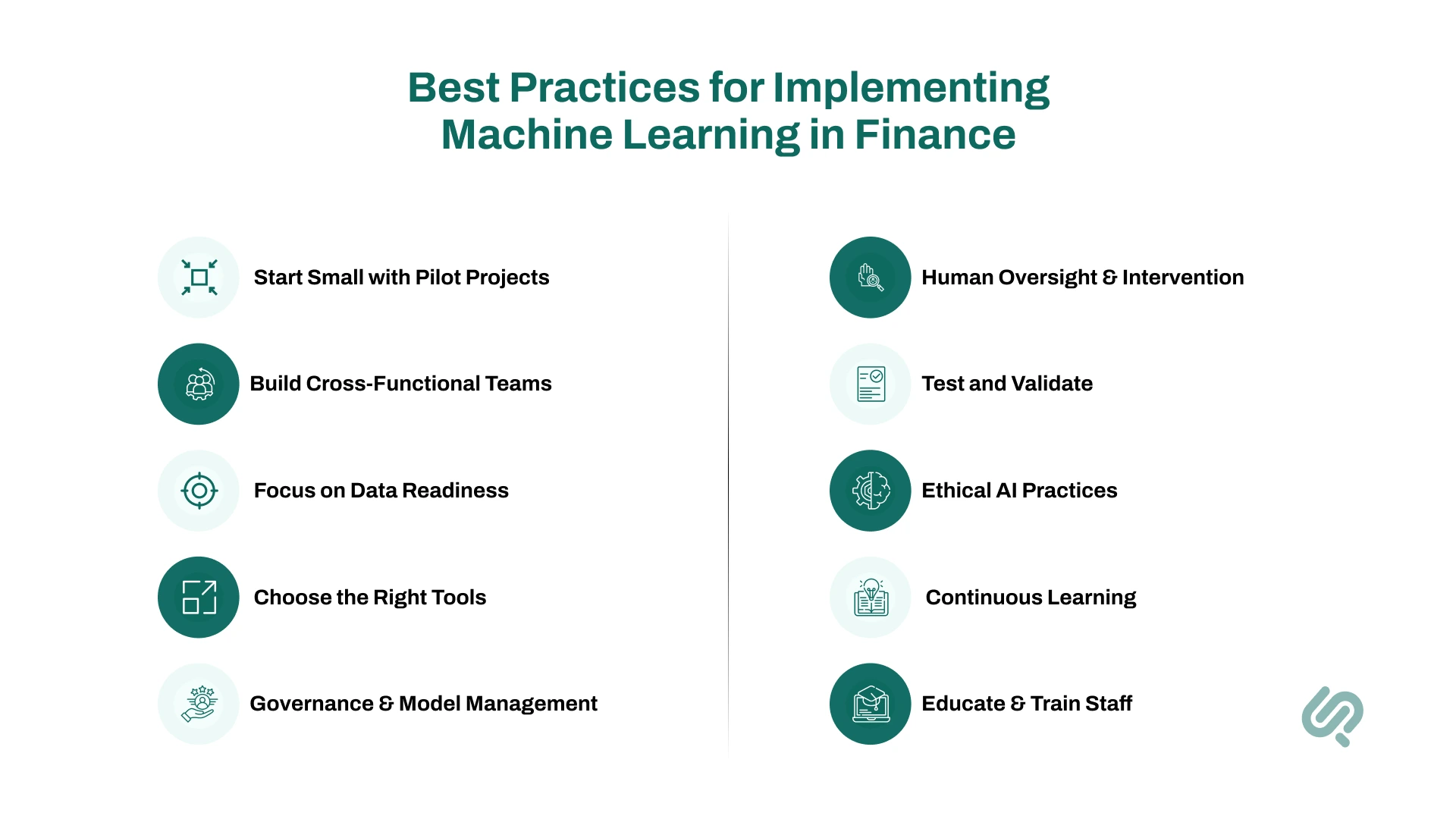
So, you’re ready to bring machine learning in finance to life, but how do you avoid pitfalls and make it work in the real world?
The finance industry is unique: it’s fast-moving, regulated, and full of complex data.
Here’s how financial institutions and financial services companies can implement ML successfully, whether it’s for algorithmic trading, fraud detection, or credit scoring.
Don’t try to transform your whole business overnight.
Instead:
This builds confidence, reduces risk, and helps you spot problems early.
ML in finance works best when technical and business people team up.
People are more likely to trust systems they help build.
ML is all about data. But financial data can be messy, split across departments, or incomplete.
A huge chunk of ML project time (sometimes 80%) goes into data prep!
However, for fast-moving areas like algorithmic trading, on-premises systems may be faster. Choose tools that fit your speed, security, and regulatory needs.
Treat your ML models as serious business assets.
Financial regulators want to know your ML isn’t a mystery box.
Even the smartest AI can make mistakes.
Over time, as trust grows, you can adjust how much oversight is needed. Always keep an override option, like turning off an ML trading bot if markets go haywire.
Before using ML live, test it thoroughly:
Ask tough questions like: “Would this model have caught past crises like 2008?”
Don’t forget ethics.
Transparency builds trust and helps you stay ahead of regulations.
ML models can “drift” if market conditions change.
ML isn’t just for techies.
When everyone understands the tool, it’s more likely to be used effectively.
In our experience at Phaedra Solutions, the ML projects that succeed follow these best practices.
Those that fail often don’t stumble because the math was wrong, but because of poor planning, messy data, or teams that weren’t ready for change.
Done right, machine learning can transform everything from fraud detection to financial engineering, helping the finance industry make faster, smarter, and safer decisions.
The world of machine learning in finance is moving fast, and it’s only getting faster.
Banks, investment firms, and financial services companies are looking ahead to new ways of using artificial intelligence and data science to stay competitive and serve customers better.
So, what’s next for ML in the finance industry? Let’s peek into the future.
1. Generative AI – Large language models will summarize reports, draft documents, and answer complex finance questions, but need human oversight.
2. AI for Compliance – Regulators and banks are using machine learning for faster rule-checking, fraud detection, and automated reporting.
3. Reinforcement Learning – AI will test millions of market scenarios to discover smarter trading and investment strategies.
4. AI + Blockchain – Expect AI to predict crypto prices, detecting blockchain fraud, and power smart contracts for new financial products.
5. Personalized Finance – Banks and fintechs will act like financial coaches, helping customers save, invest, and manage money better.
6. Quantum Machine Learning – Quantum computing might supercharge financial calculations for portfolio management and derivatives pricing.
7. AI Governance – New standards and regulations will emerge to ensure AI is used safely, fairly, and transparently in finance.
8. Talent Crossover – Future finance pros will blend data science skills with financial expertise to stay competitive.
In the coming years, knowing both data science and finance could become essential for many jobs. It’s like how computer skills became a must-have for everyone.
The bottom line? Machine learning in finance isn’t slowing down.
Those who stay updated and keep learning will ride the wave of change and possibly shape the next big thing in the finance industry.
Those who ignore it might find themselves left behind as smarter, faster competitors take the lead.
We’ve come a long way through the world of machine learning in finance; from what it is, to how it powers everything from algorithmic trading to fraud detection, and even how it’s reshaping corporate finance.
One thing is clear: ML isn’t just fancy tech talk. It’s real tools, helping financial institutions make smarter moves, manage risk, and serve customers better. Whether you’re optimizing investment management or scanning huge amounts of financial data modeling, this is the new edge in the finance industry.
Of course, it’s not magic. Success takes good data, skilled data scientists, and strong governance. But when done right, ML helps the financial services industry stay ahead in fast-moving financial markets, turning insight into action faster than ever before.
And the future? Even brighter.
From deep learning to Generative AI, new frontiers are opening every day.
Machine learning isn’t just part of finance anymore; it’s becoming how finance works.
Ready to join the next wave?



Areesha is a content writer with over 2 years of experience in writing about tech and digital trends. She focuses on topics like AI, remote work, and productivity.
Her blogs have helped startups grow their content reach and improve lead generation. She writes with a focus on clarity, simplicity, and reader value.