







Building A1 DDP - Dubai Silicon Oasis
Industrial Area - 342001 -
Dubai - United Arab Emirates
+971 50 756 2346


SERVICES

COMPANY LINKS
SIGN-UP
For Newsletter



LLM prompt engineering is the art of writing instructions that unlock the best possible results from large language models.
Put simply, it’s about using clear, detailed natural language to guide an AI toward exactly the response you want.
Think of it as giving the AI a role or a script asking ChatGPT to “act like a teacher” or to “format the answer as bullet points.”
Small tweaks like these can completely change the quality of the output.
This skill matters now more than ever. LLMs are deeply embedded in industry workflows. ChatGPT is used by over 92% of Fortune 500 companies. (1)
Rather than spending time and money on retraining models, applying LLM prompt engineering best practices can deliver results that are faster, cheaper, and more reliable.
Large Language Models (LLMs) generate text by predicting the next word based on the input they receive. The instruction you give tells the model how to respond. If the prompt is clear and structured, the model is far more likely to produce an accurate, useful answer.
Here’s how the process works in practice:
In short, prompts act like directions for the AI. Simple prompts can give quick answers, but detailed prompts allow you to control tone, format, and accuracy.
This is the foundation of prompt engineering techniques, and it’s why good prompting is one of the most valuable skills for anyone using AI today.

A prompt is simply the instruction you give to a large language model (LLM) to generate a response.
It can take many forms: a direct command, a question, or even a partially completed sentence or pattern that the model finishes.
For example:
The key idea is that the clearer and more structured your instruction, the more accurate and useful the output will be.
Prompts matter because they control how the model interprets and delivers results. A well-written prompt improves three things: accuracy, context, and output control.
Specific prompts reduce guesswork and ensure the model gives a precise answer. Supplying context, such as the audience, goal, or constraints, keeps the response relevant.
Finally, defining the output format, whether bullet points, a table, or JSON, makes results easier to read, share, or automate.
For developers, this level of control is especially important because it allows them to integrate outputs directly into workflows.
At the beginner level, you’ll mainly use three kinds of prompts:
Example: “Act as a travel planner and create a three-day Tokyo itinerary for food lovers, with breakfast, lunch, and dinner suggestions plus transit tips.”
Example: “What is caching in web development? Explain in under 120 words for a junior developer and include one real-world analogy.”
Example: “Explain in one sentence: React state lets components __________.”
Each type gives you a different way to guide the model, and using the right one depends on the outcome you want.
A helpful way to write better prompts is to use a formula. It looks like this:
Role + Task + Context + Constraints + Output Format + Tone/Audience
This formula reminds you to include the most important detailswho the AI should act as, what it should do, what background matters, and how the answer should be delivered.
Example: You might tell the AI to act as a product marketer, write a three-sentence blurb about a new calendar app for remote teams, mention timezone syncing, avoid jargon, and format the answer as three sentences plus three emoji bullet points in a clear, friendly tone for busy managers.
This simple structure captures the essence of LLM prompt engineering techniques and works across nearly every type of task.
Clear, specific prompts can improve output accuracy by up to 30% compared to vague instructions. (2)
Once you’ve learned the basics, you can move on to intermediate LLM prompt engineering techniques that add more reasoning, structure, and reliability.
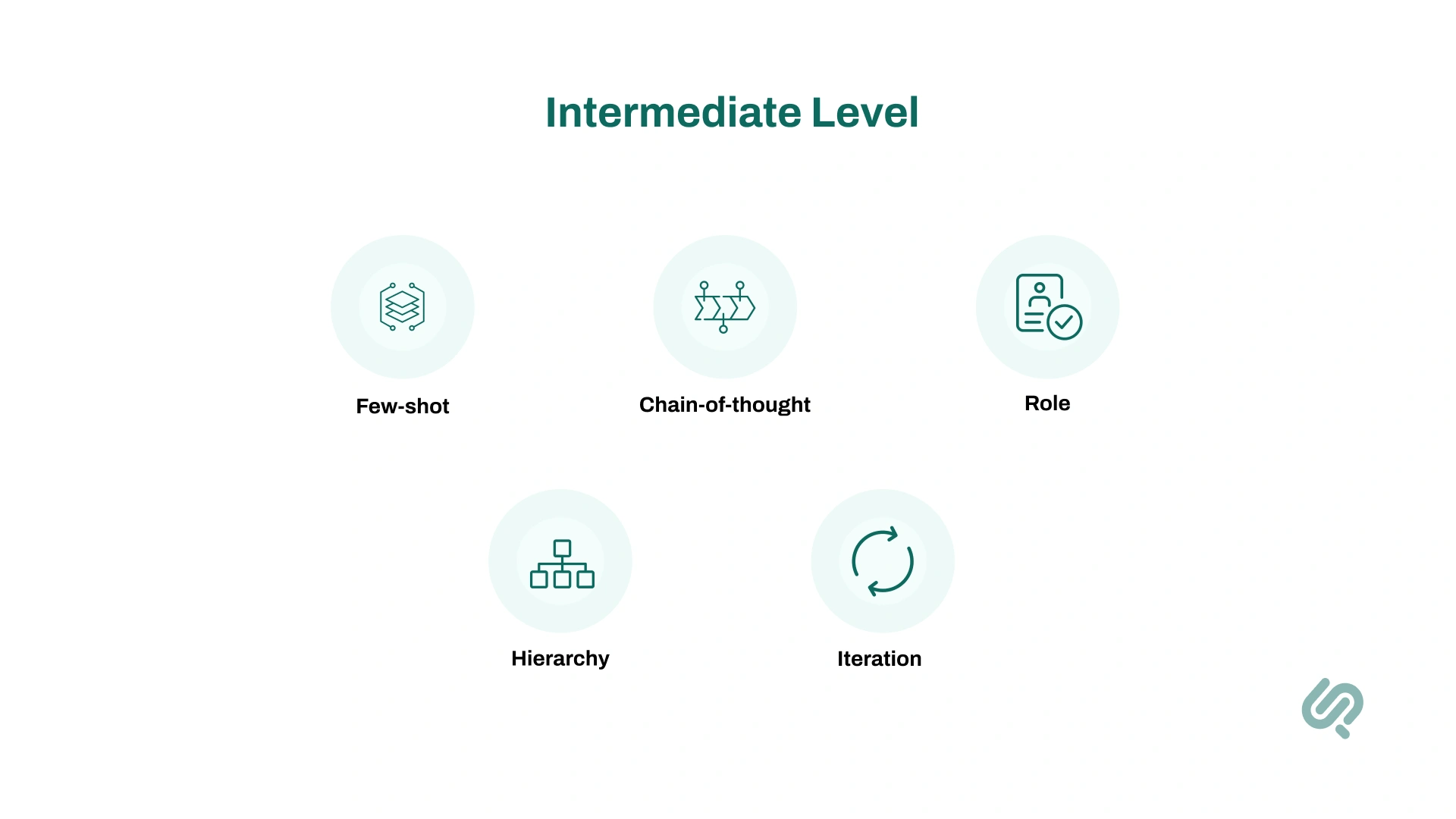
These include few-shot prompting, chain-of-thought reasoning, role-based prompts, prompt hierarchies, and iterative refinement. Each technique helps you guide the model more effectively, producing clearer and more consistent results.
For developers, they’re especially important when building prompt flows and evaluation pipelines that need to perform well at scale.
Few-shot prompting means showing the model one to three strong examples before giving it the real task. This teaches it the format, tone, or decision pattern you want it to follow.
For instance, you could first show how to explain caching in simple terms, then ask it to do the same for rate limiting. The key is quality over quantity excellent example is often better than several weak ones.
This method is one of the most practical LLM prompt engineering techniques for shaping consistent outputs.
Few-shot prompting reduces error rates by 20–40% compared to zero-shot prompting in reasoning tasks. (3)
Chain-of-thought prompting is useful for problems that require reasoning across multiple steps, such as planning, troubleshooting, or math.
Instead of asking for the final answer directly, you guide the model to explain its steps briefly.
For example, you might ask it to outline a three-stage rollout plan for a new feature before presenting the final sequence. Adding checks like “Verify calculations before answering” makes results more reliable.
Assigning a role helps you control the tone, vocabulary, and level of detail in the output. You might tell the model to act as a security architect, a project manager, or a math tutor.
By specifying both role and audience, you can ensure the response is appropriately framed.
For example, asking a senior site reliability engineer persona to draft a plain-language postmortem with measurable action items leads to targeted and practical results.
This is especially valuable in LLM prompt engineering for developers who need responses tailored to technical or professional contexts.
Big tasks are easier to handle when broken into smaller steps. A prompt hierarchy might begin by asking the model to list sections and key points.
The next step could be drafting content for the first sections, followed by refining for clarity and detail, and finally verifying for errors or gaps.
Saving outputs between stages avoids rework and produces a stronger result. This method is a proven part of LLM prompt engineering techniques because it keeps complex workflows manageable.
Iteration is central to LLM prompt practices. You start with a zero-shot prompt that includes only the task, format, and constraints.
If the output isn’t quite right, add one or two examples. From there, adjust constraints such as word count, schema, or tone. Roles and hierarchies can also be layered in for extra control.
At each step, compare the result against your criteria and refine. For developers, this process minimizes retries and ensures higher-quality outputs in line with LLM prompt engineering for developers' workflows.
Imagine you need to extract company information from messy text and return it in JSON format. You could begin with a zero-shot prompt asking for the company name, country, and website.
If the results are inconsistent, add a few-shot example to teach the pattern. Next, apply a role prompt, such as “Act as a data QA analyst,” so the model validates fields, normalizes websites, and standardizes country codes.
Finally, add a verification step that checks the JSON for accuracy and flags assumptions. This layered approach shows how combining different LLM prompt engineering techniques creates robust resultsexactly the kind of workflow worth highlighting in any LLM prompt engineering techniques blog.
For developers, intermediate LLM prompt engineering techniques work best when supported by structure and automation.
Storing prompts as parameterized templates allows them to be reused consistently across tasks.
Outputs should always be validated against JSON schemas, with automatic retries when results don’t meet requirements. Unit tests built on “gold” examples can further confirm correctness and keep quality high.
Evaluation loops are also importantthey help track accuracy, hallucination rates, and completeness over time.
Finally, observability is critical. Logging prompts, responses, and version history ensures you can detect regressions quickly. These practices form the backbone of LLM prompt engineering for developers, turning one-off experiments into repeatable, reliable workflows.

At the advanced stage, LLM prompt engineering techniques become more powerful and nuanced.
Instead of relying on one-off queries, you begin designing full systems of prompts layered with reasoning, automation, and safeguards. This is where developers and AI practitioners move beyond experimentation and start building production-ready, reliable solutions.
Understanding how many examples to provide is crucial for balancing cost, accuracy, and stability.
Self-consistency improves reliability by asking the model to solve the same problem multiple ways, then comparing results.
For example, you might have it generate three different solutions and then return the most consistent answer. This is especially valuable in math, planning, diagnostics, or compliance summaries where accuracy is non-negotiable.
Advanced LLMs handle not just text but also images, audio, and video. This makes prompts richer and more context-aware.
For instance, you could upload a chart and ask the model to explain three insights in plain English, then suggest one action per insight.
Use cases include analyzing screenshots, evaluating design mockups, or summarizing customer feedback recordings.
Meta-prompting uses AI itself to refine or improve prompts. For example, you could ask ChatGPT to review your draft prompt and make it more specific, less ambiguous, and better structured.
This reduces human trial and error, making it an efficient option for developers scaling large prompt libraries or creating workflows for an LLM prompt engineering techniques blog.
At this level, advanced users rarely rewrite prompts manually. Instead, they rely on prompt templates and frameworks that automate patterns.
Tools like LangChain allow developers to parameterize roles, tasks, and output formats so prompts can be reused across scenarios such as customer support, report generation, or structured data extraction.
For developers, this is one of the most valuable practices, as it turns prompts into scalable systems.
With greater power comes greater responsibility. Advanced engineers must guard against risks such as prompt injection attacks, where malicious inputs trick the model into ignoring its instructions.
Research shows these attacks succeed in over 50% of cases. To prevent this, inputs should always be validated and sanitized, while system-level rules should remain locked.
Bias and fairness also matter. Prompts should be phrased neutrally to avoid steering outputs in unintended directions.
Content filters and post-processing checks are also vital, ensuring harmful or irrelevant material doesn’t slip through. This reflects a core principle of LLM prompt engineering for developersoutputs must be both accurate and safe.
Prompt injection attacks succeed against major LLMs in over 50% of attempts without guardrails (4)
At the advanced stage, prompts often become part of larger workflows. AI agents may chain prompts together to perform tasks such as searching, analyzing, summarizing, and recommending actions.
Pipelines may also combine prompts with APIs, databases, or calculators to extend functionality.
Frameworks like LangChain handle these processes at scalemanaging templates, retries, evaluations, and integrations.
A real-world use case might be automating due diligence research: extracting company data, summarizing findings, and generating a risk report all within one workflow.
Even at the advanced level, mistakes can hold back results. Here are five of the most common issues and how to fix them:
As LLM prompt engineering techniques evolve, so do the tools that make it easier to design, test, and manage prompts.
Instead of copy-pasting trial prompts into a chat window, advanced developers now rely on frameworks, playgrounds, and evaluation platforms to systematize experimentation.
These tools save time, improve reliability, and scale your work from tinkering to production-ready pipelines.
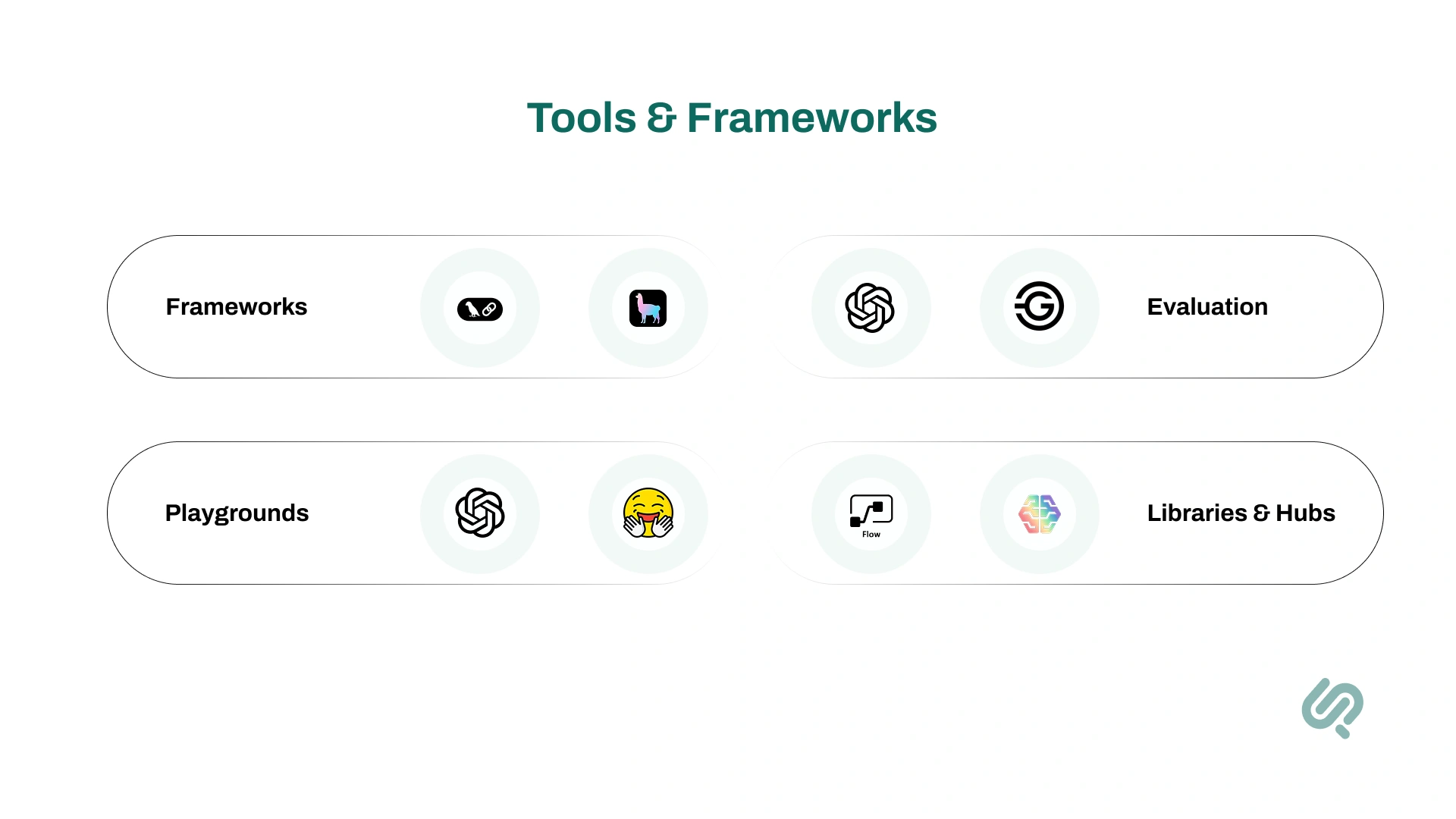
LangChain has become the go-to framework for building LLM-powered applications. It allows you to chain prompts, connect APIs, and manage workflows in a structured way.
Its companion platform, LangSmith, extends these capabilities by providing a full prompt engineering interface where you can version prompts, add tags, and run A/B tests in a dedicated “prompt playground.”
This combination is best for developers building production pipelines or AI agents as part of LLM prompt engineering for developers.
Prompt libraries are community or commercial collections of pre-built prompts that cover common tasks such as marketing, coding, or customer support.
Examples include Awesome Prompts on GitHub, FlowGPT, and PromptBase. These resources allow you to borrow and adapt proven LLM prompt engineering best practices rather than starting from scratch.
They are especially useful for rapid prototyping and experimenting with prompt patterns that others have already validated.
Playgrounds provide an easy way to experiment with prompts in a controlled environment. The OpenAI Playground offers a web-based interface where you can test prompts, adjust parameters like temperature or max tokens, and see live results.
Other environments, such as AI Studio or Hugging Face Spaces, offer similar functionality for different models.
For developers, IDE plugins for VS Code or JetBrains embed prompt testing directly into the coding workflow, often with AI assistants. These tools make experimentation quick and accessible without requiring extra boilerplate code.
Prompts must be tested for accuracy, reliability, and safety, especially before they are deployed in production.
Tools like OpenAI Evals, DeepEval, and Guardrails AI provide ways to score outputs against benchmarks, enforce schema compliance, and identify bias or hallucinations.
These evaluation frameworks are critical for maintaining consistency and ensuring that your LLM prompt engineering techniques blog recommendations translate into practical, safe workflows.
Frameworks such as the LangChain SDK, Hugging Face Transformers, and LlamaIndex allow developers to dynamically generate and manage prompts directly inside code.
These SDKs provide abstractions for templating, retries, error handling, and chaining prompts together into pipelines. They are perfect for developers scaling applications and integrating LLMs into real products where repeatability and reliability matter.
Enterprise teams often need to collaborate on prompts at scale. Platforms like Promptable, PromptLayer, and Weights & Biases provide features such as version control, experiment tracking, and performance monitoring.
They typically include dashboards, logs, and analytics so you can see how prompts evolve over time. These platforms are designed for collaboration, making them ideal for teams that need to scale experimentation and refine prompt libraries continuously.
Solid prompts are clear, structured, tested, and secured. Following these LLM prompt engineering best practices helps you get consistent, reliable results while avoiding common mistakes.
Looking ahead, prompt engineering will evolve quickly as
become smarter and more integrated into daily work. Here are the key trends shaping the future:
Tools will increasingly help write, refine, or even auto-generate prompts, making the process faster, easier, and more accessible.
Future AI may infer user intent from minimal cue like voice, context, or background data without needing explicit prompts.
Prompting will move beyond text, allowing users to combine speech, images, or even gestures to guide AI models.
Prompt engineering will become part of many professions. Reports already show that “AI literacy,” including prompt crafting, is among the most in-demand job skills.
AI agents, copilots, and assistants will rely on prompt techniques behind the scenes, with prompt engineers fine-tuning these workflows for reliability.
The field will keep advancing, so continuous practice and staying up to date with new LLM prompt engineering techniques will remain essential.
LLM prompt engineering is no longer just about writing clever instructions. It’s becoming a core skill for anyone working with AI.
From simple prompts to advanced systems with automation and guardrails, each stage builds on the last.
For developers, these practices mean moving from experiments to production-ready workflows.
For everyone else, they mean faster, clearer, and more reliable results. As AI keeps evolving, the ability to guide models effectively will remain one of the most valuable skills in the digital world.



Ameena is a content writer with a background in International Relations, blending academic insight with SEO-driven writing experience. She has written extensively in the academic space and contributed blog content for various platforms.
Her interests lie in human rights, conflict resolution, and emerging technologies in global policy. Outside of work, she enjoys reading fiction, exploring AI as a hobby, and learning how digital systems shape society.